
SDG 12 In Number
Amount of waste generated (mt)
102
Amount of waste recycled (mt)
79
Amount of waste sent to landfill (mt)
23
12.2.6 Policy For Minimisation of Disposable Items
Policy and Implementation of Minimizing the Use of Single-Use Items
The use of single-use items on campus has the potential to increase waste generation and resource use. To reduce this impact, Universitas Sebelas Maret (UNS) implements various policies and practices to reduce single-use items through the use of reusable items, reduced use of single-use materials, and greater awareness among the academic community of more sustainable consumption. These efforts are part of UNS’s commitment to creating a sustainable campus environment and supporting the achievement of SDG 12: Responsible Consumption and Production.
The policy is implemented through several official policies:
- Vice Rector’s Circular Letter Number 29/UN27/SE/2020 on the Prohibition of Single-Use Plastic Drinking Water Packaging and/or Plastic Bags at UNS.
File: https://cdna.uns.ac.id/wp-content/uploads/sites/49/2025/09/SE-No-29-UN27-2020-tentang-larangan-penggunaan-kemasan-air-minum-berbahan-plastik.pdf - Rector’s Instruction Number 28 of 2023 on the Paper and Plastic Use Reduction Program at the UNS Campus. This instruction encourages reducing and making more efficient use of paper and promotes the use of information technology in organizational management and academic activities.
File : https://cdna.uns.ac.id/wp-content/uploads/sites/49/2025/09/Rectors-Instruction-on-Paper-and-Plastic-Usage-Reduction-Program.pdf
This policy aims to limit items that contribute significantly to waste generation, including plastic, paper, and other single-use materials. Through these measures, UNS actively encourages the entire academic community to switch to reusable and environmentally friendly items.
Concrete actions taken include double-sided printing for academic documents and reports, reuse of blank paper, and the adoption of digital management through the official website, email, SMS Gateway, and other information technology. These efforts are in line with Law Number 18 of 2008 on Waste Management and Law Number 32 of 2009 on Environmental Protection and Management, which emphasize the obligation to reduce waste through sorting, recycling, and reuse.
On October 5, 2025, the PPKMB of the UNS Environmental Science Study Program introduced sustainable campus values to new students. During the event, UNS Green Campus promoted a zero waste lifestyle, including through the habit of bringing personal tumblers and lunchboxes and reducing the use of single-use plastics. This activity is evidence of the implementation of education and behavior formation among the academic community in support of reducing single-use items.
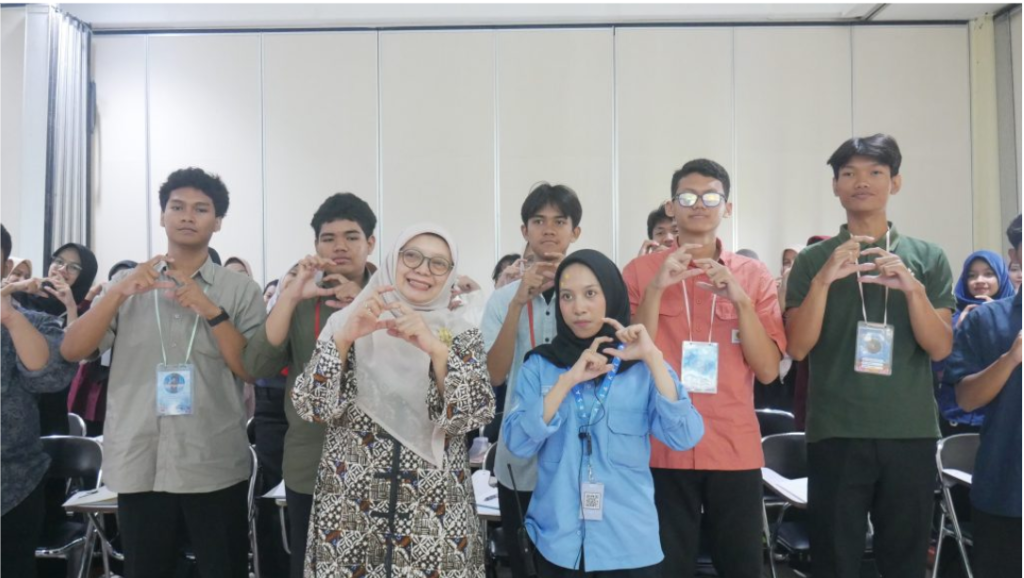
Introduction of Sustainable Campus Values to New UNS Students
This educational role is in line with Saputri et al. (2025), who analyzed the role of university waste banks in raising students’ environmental awareness (IOP Conference Series: Earth and Environmental Science, DOI: 10.1088/1755-1315/1462/1/012040), so that the habit of bringing tumblers and lunchboxes from the orientation period is supported by real campus mechanisms such as the UNS Waste Bank.
In December 2025, students of the UNS Electrical Engineering Study Program developed a Reverse Vending Machine (RVM) called “SiTukar”, a smart machine that identifies, sorts, and digitally records plastic bottle and can waste. The waste collected can be exchanged for points or incentives, encouraging the public to sort waste while giving economic value to inorganic waste. The SiTukar innovation was supported through the UNS WIBAWA Program 2025 and applies the concepts of green technology and circular economy. Besides helping manage waste, this technology also serves as an educational tool to raise public awareness of the importance of sorting waste at the source.

UNS Students Develop the “SiTukar” Reverse Vending Machine for Green Technology-Based Waste Management
Universitas Sebelas Maret (UNS) is committed to minimizing the plastic and paper waste generated each year. More than 10 programs have been implemented by UNS to reduce the amount of plastic and paper waste. These programs are grouped into 11 integrated strategic programs, which involve the entire UNS academic community and work units on a continuing basis. The efforts undertaken include:
- Implementation of an integrated paperless office (Integrated Paperless Office). UNS limits paper use in administrative management, among other things through an electronic correspondence system and centralized archiving with UNS-developed applications.
- Paperless scientific work and final project system. Submission of undergraduate theses, master’s theses, dissertations, and final projects is done online through the Digital Library (Digilib UNS). This policy is reinforced by limiting the number of manuscript pages so that the need for printing (hardfiles) is reduced.
- Digitalization of cross-sector research management (IRIS UNS). Proposal submission, monitoring, and final reporting for research and community service grants for lecturers and researchers are done 100% digitally through the UNS Institutional Research Information System (IRIS).
- Academic services based on a learning management system (SPADA). Class activities, distribution of materials, exam registration, and student assignment submission are done online through UNS SPADA, thereby reducing the photocopying of worksheets in class.
- 3R culture education campaign. The campaign is carried out through digital posters on the website and social media, posters or banners in various corners of campus, student activities and academic community events, videos at national and international conferences, and calls to stop the habit of using single-use plastics. The evidence file contains the posters “Let’s Recycle!”, “Use a Tumbler Bottle”, and “Tumbler Day”.
- Installation of the UNS drinking water supply system (SPAM UNS). UNS provides free drinking water dispensers at various strategic points in lecture buildings and the rectorate. SPAM is managed by the UNS Business Management Agency (BPU) to ensure sustainability, and this program encourages the academic community to bring their own drinking bottles so that plastic bottle waste is reduced.
- Point-based smart waste exchange machine (Smart Waste Vending Machine). Automatic deposit box facilities for plastic bottles are available, connected to a digital reward point system. The evidence file shows the Reverse Vending Machine from SiTukar.
- Substitution of seedling media in practical classes and reuse for compost and liquid organic fertilizer (POC). The UNS Faculty of Teacher Training and Education (FKIP) laboratory units no longer buy commercial plastic polybags and instead reuse containers and used plastic cups from campus consumption as seedling media. The Faculty of Animal Husbandry uses used plastic bottles to make Liquid Organic Fertilizer (POC) and used gallon containers for composting.
- Program for upcycling cardboard, paper, and plastic into works of art. Cardboard, paper, and plastic waste is turned into artworks, decorations, and architectural models of high aesthetic and economic value. The works are displayed at the annual Art Edu Care exhibition.
- Standardization of online administrative services and student academic services. An example is SIAKAD, an integrated system used by students from admission until graduation without needing to print documents. SIAKAD covers registration, document verification, course planning, transcript issuance, class administration, academic advising, and examinations. Systems for research proposals, community service, MBKM, KKN (community service program), and internships are also being developed without printed administration.
- Optimization of the centralized UNS Waste Bank. The centralized waste bank serves as a center for collecting, sorting, and recording the tonnage of plastic bottle and paper waste from all faculties. Customers earn points that can be exchanged for gold. The program is supported by PT Pegadaian. In 2026, its development involves the UNS TPST Development Team to expand the waste bank’s coverage and capacity.
The upcycling programs and alternatives to single-use items are also supported by UNS research. Widagdo et al. (2025) evaluated the benefits, impacts, and contributions of steamed ecoprint training to the green economy (E3S Web of Conferences, 652, DOI: 10.1051/e3sconf/202565203002), and Istiqomah et al. (2025) developed packaging films made from chitosan, starch, and aloe vera as a more sustainable packaging alternative (Food Biophysics, 20(36), DOI: 10.1007/s11483-024-09921-y).
The expected outcomes include the formation of an environmentally friendly culture, improved resource efficiency, and less single-use waste released into the environment. For long-term sustainability, UNS is committed to strengthening digital services, expanding environmentally friendly initiatives across faculties and units, and involving students in green-technology-based innovation. Through this policy, Universitas Sebelas Maret demonstrates its commitment to supporting SDG 12 by promoting more responsible and sustainable consumption practices.
SDG 12 Indicator
Operational Measures
Proportion Of Recycled Waste
Publication Of A Sustainability Report
Policy | Link | Summary | Relevant Articles |
Law Number 32 of 2009 on Environmental Protection and Management (UUPPLH) | https://peraturan.bpk.go.id/details/38771/uu-no-32-tahun-2009 | Emphasizes the principles of sustainable development by requiring every person to preserve the function of the environment, prevent pollution and damage, and by regulating the public’s right to a good and healthy environment. This law also contains a prohibition on littering and provides a legal basis for the government to control waste, including single-use plastics, through supervisory instruments, administrative sanctions, and criminal sanctions. | Article 67: Every person is obliged to preserve the function of the environment and to control environmental pollution and/or damage. |
Law Number 18 of 2008 on Waste Management | https://peraturan.bpk.go.id/Details/39067/uu-no-18-tahun-2008 | Regulates the principles, responsibilities, and governance of waste management in Indonesia to protect the environment and public health. This law emphasizes the importance of reducing waste at its source, reuse, recycling, and environmentally friendly final processing. | Article 12: Every person, in managing household waste and waste similar to household waste, must reduce and handle waste in an environmentally sound manner. |
Rector’s Instruction Number 28 of 2023 on the Paper and Plastic Use Reduction Program at the UNS Campus | Official guidelines for the entire academic community to reduce the consumption of single-use items on campus. This policy encourages the use of paper on both sides, reuse of blank paper, and the digitalization of organizational management to reduce physical printing. | ||
Circular Letter Number 29/UN27/SE/2020 on the Prohibition of Single-Use Plastic Drinking Water Packaging and/or Plastic Bags at UNS | Prohibits the use of single-use plastic packaging or similar materials that can increase waste generation, and replaces them with environmentally friendly equipment. |