

SDG 7 In Number
Total energy used (GJ)
19,141
University floor space (m²)
523,299
Total energy used from low-carbon sources (GJ)
9,413
7.4.4 Policy Development For Clean Energy Technology
Supporting Clean Energy and Low-Carbon Technology Policy through Research, Collaboration, and Capacity Building
Universitas Sebelas Maret (UNS) advances clean energy and energy-efficient technologies through research, technical collaboration, public engagement, and capacity-building activities. These initiatives provide scientific information, practical knowledge, and technical support to help governments understand emerging technologies and address energy-transition challenges.
Through collaboration with government institutions, industry partners, research organizations, and international universities, UNS supports efforts to inform and strengthen policy development related to clean energy, energy efficiency, and low-carbon technologies. These contributions align with the global commitment to ensure access to affordable, reliable, sustainable, and modern energy while supporting the transition to more sustainable production and transportation systems.
1. Local – Local Government
At the local level, UNS raises public awareness and supports the adoption of clean energy technologies through collaboration with energy-sector partners. These activities introduce practical applications of clean energy and provide technical knowledge to help local stakeholders understand the opportunities and challenges of the energy transition.
Electric Vehicle Education and Action Roadshow by FT UNS and PLN
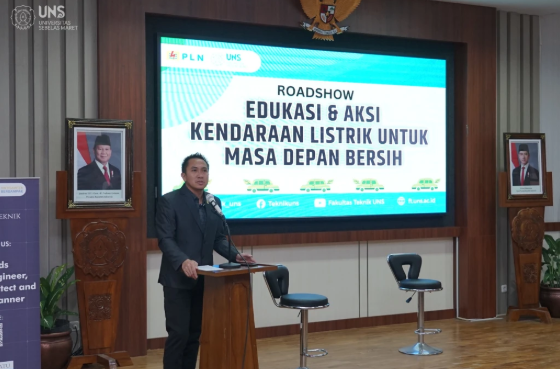
In 2025, the Faculty of Engineering at UNS collaborated with PT PLN to organize educational activities and collaborative actions promoting electric vehicles in the Solo Raya area. The initiative introduced the public to electric vehicle technology and its role in supporting cleaner transportation. Through education, training, and public engagement, the program helped improve understanding of the benefits and practical considerations of adopting electric vehicles as an alternative to conventional transportation.
The initiative supports broader clean energy and energy-efficient technology development by promoting electric vehicles and encouraging public understanding of low-carbon transportation. The technical knowledge and public awareness generated through this collaboration can inform local stakeholders as they consider initiatives related to sustainable mobility, electricity infrastructure, and the wider energy transition.
Although the available evidence primarily shows public education and technology promotion rather than direct consultation on local government policy development, the activity supports the local adoption of clean energy technologies. Further documentation of collaboration with local governments, policy discussions, or formal recommendations would strengthen its relevance to government policy development.
References:
2. Regional – Provincial Government
At the regional level, UNS works with provincial government institutions and research organizations to strengthen stakeholders’ capacity to implement sustainable industrial transformation. These activities provide technical knowledge and practical support for regional initiatives on energy efficiency, low-carbon technologies, and renewable energy use in industrial processes.
Training for Green Industry Transformation Facilitators in Central Java
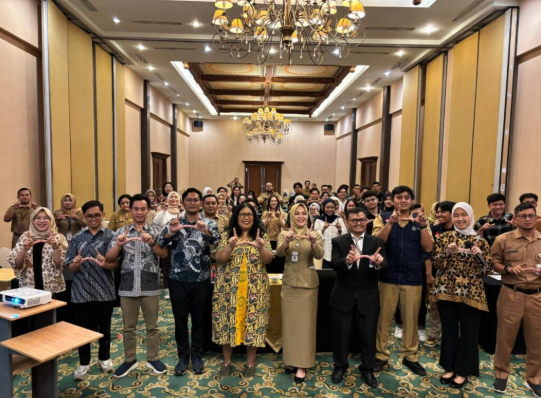
In 2025, UNS contributed to the training and capacity building of Green Industry Transformation Facilitators in Central Java. The program was conducted in collaboration with the Institute for Essential Services Reform (IESR), Diponegoro University (UNDIP), and the Central Java Provincial Department of Industry and Trade. It aligned with the Governor of Central Java Circular Letter No. 500.9/0006073 of 2025, which provided a regional policy framework to accelerate green industrial transformation.
Through this initiative, UNS supported the development of technical capacity among facilitators who can assist industries, particularly small and medium-sized enterprises, in adopting more sustainable production practices. The training addressed key aspects of green industry transformation, including low-carbon technologies, energy efficiency, renewable energy, and sustainable production. This technical support helps translate regional policy directions into practical knowledge and assistance for the industrial sector.
By strengthening facilitators’ capacity and providing technical knowledge on clean energy and energy-efficient technologies, UNS supports regional policy implementation and helps create an enabling environment for sustainable industrial development. The initiative demonstrates how university expertise can inform and support provincial government efforts to advance clean energy solutions and improve energy efficiency across industrial activities.
3. National – National Government
At the national level, UNS contributes scientific research and expert knowledge to discussions involving government institutions and industry stakeholders. Through research-based consultation and multi-stakeholder forums, the university provides information and technical perspectives that can support the development of national strategies and policies for clean energy technologies.
Life Cycle Assessment (LCA) of Sustainable Aviation Fuel Production from RBDPKO
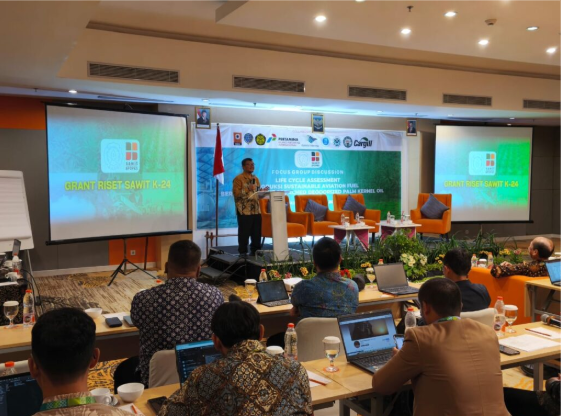
In 2025, the Department of Chemical Engineering and the Institute for Research and Community Service (LPPM) of UNS organized a series of Focus Group Discussions (FGDs) on the Life Cycle Assessment (LCA) of Sustainable Aviation Fuel (SAF) production using Refined, Bleached, and Deodorized Palm Kernel Oil (RBDPKO). The activities were conducted in collaboration with PT Kilang Pertamina Internasional and supported by the Palm Oil Plantation Fund Management Agency (BPDPKS). Government representatives in the discussions included the Ministry of Energy and Mineral Resources, the Ministry of Transportation, and the Ministry of Environment.
The research assessed the environmental, economic, and social aspects of SAF production using a life-cycle approach. The findings provided scientific information on the potential development of alternative aviation fuel based on palm kernel oil. The two FGDs, held on 19 February and 30 October 2025, provided opportunities for consultation, discussion, and validation involving government representatives, industry partners, researchers, and other relevant stakeholders.
Through these activities, UNS contributed research-based information and technical perspectives to discussions on sustainable aviation fuel development. The consultation process enabled stakeholders to exchange views and provide input for strategic recommendations concerning SAF development and the alignment of related policies. This work supports national efforts to advance clean fuel technologies, reduce transportation’s environmental impact, and strengthen sustainable energy alternatives. It also demonstrates how university research can inform and support government policy development by providing evidence for decisions concerning emerging clean energy technologies.
References:
4. Global – International Government / Cross-Country Collaboration
At the global level, UNS engages in international research collaboration and knowledge exchange involving government institutions from different countries. These activities provide opportunities to share research findings, discuss technological developments, and exchange perspectives on clean energy and low-carbon infrastructure policy challenges.
- DIBI Project – Decarbonization Pathways for Indonesian Bus Infrastructure
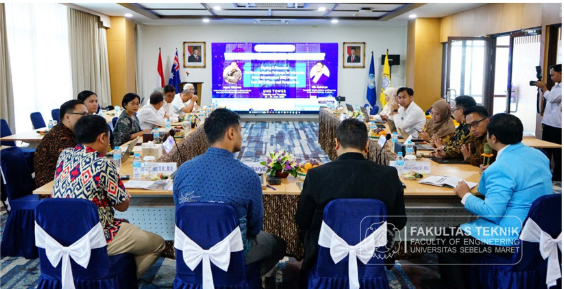
In 2025, the Faculty of Engineering at UNS held a discussion on the Decarbonization Pathways for Indonesian Bus Infrastructure (DIBI) Project, involving representatives from Australia’s Department of Industry, Science and Resources, Indonesia’s Coordinating Ministry for Economic Affairs, and the Ministry of Higher Education, Science, and Technology (Kemdiktisaintek). The project is an international research collaboration between UNS and the University of Canberra, supported by the KONEKSI program.
During the meeting, UNS presented research progress and discussed pathways to reduce carbon emissions from bus infrastructure and improve the sustainability of public transportation systems. The discussion addressed the potential role of low-carbon transportation technologies, including electric public transport, and provided a platform for exchanging research findings and perspectives with government stakeholders from Indonesia and Australia.
By presenting research findings and engaging with government institutions from both countries, UNS contributed scientific information and technical perspectives to discussions on sustainable transportation infrastructure. This collaboration supports the development of low-carbon technology approaches that can inform future government strategies and policy considerations. It also demonstrates the role of international university partnerships in supporting cross-country knowledge exchange and policy discussions on clean energy and energy-efficient technologies.
Reference:
Conclusion
UNS contributes to clean energy and energy-efficient technology policy development through different forms of engagement at local, regional, national, and international levels. Its contributions range from public education and technical capacity building to research-based consultation and international knowledge exchange. These activities provide governments and other stakeholders with relevant information, technical expertise, and practical perspectives to address energy-related challenges.
The strongest contributions are demonstrated through the Green Industry Transformation Facilitator Training in Central Java, the LCA study and stakeholder consultations on Sustainable Aviation Fuel, and the DIBI international research collaboration. Together, these initiatives show how UNS uses research, education, and partnerships to inform and support government efforts to advance clean energy technologies, improve energy efficiency, and accelerate the transition toward sustainable and low-carbon development.