

SDG 2 In Number
Total food waste (mt)
1,66
Campus population
31,279
Number of graduates
6,213
Number of graduates from agriculture and aquaculture courses including sustainability aspects
1,727
2.5.2 Events For Local Farmers and Food Producers
Events for Local Farmers and Food Producers at Universitas Sebelas Maret in 2025
Universitas Sebelas Maret (UNS) is committed to supporting local farmers and food producers by organizing events that facilitate knowledge exchange, capacity building, and networking. Throughout 2025, UNS organized discussion forums, technical training sessions, and field-based learning activities that brought together farmers, farmer groups, producer communities, academics, practitioners, and other agricultural stakeholders.
These events give local farmers and food producers opportunities to connect, share experiences, learn relevant practices, and transfer knowledge to support sustainable agriculture and food production. All community empowerment and outreach activities described below were provided free of charge to the participating local farmers and food producers. Through these initiatives, UNS contributes to SDG 2: Zero Hunger by strengthening local agricultural capacity, supporting sustainable food production, and promoting collaboration within local food systems.
1. FANRes 2025: Knowledge Exchange and Organic Farming Practices with Local Farmers
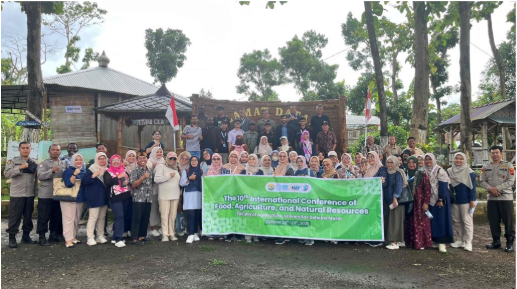
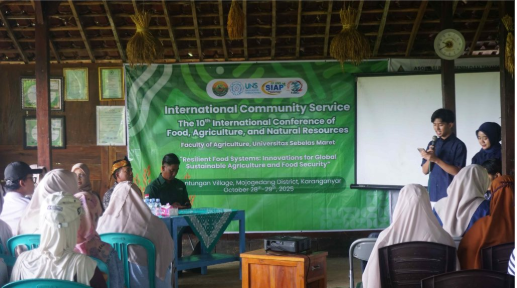
On October 29, 2025, the Faculty of Agriculture at UNS organized a community engagement activity in Gentungan Village, Mojogedang District, Karanganyar Regency. The activity was part of the 10th International Conference on Food, Agriculture, and Natural Resources (FANRes), held on October 28–29, 2025. It brought conference participants, academics, and researchers together with local organic farmers, including members of the Tani Mulyo 1 Farmer Group and Taruna Tani Lestari. The field-based learning and knowledge-exchange activities were provided free of charge to participating local farmers.
Through field visits and direct discussions, participants learned about organic farming practices used by local farmers. The activity also provided a platform for farmers to share their practical experience and knowledge of sustainable farm management, the use of organic fertilizers, and empowering young farmers. In this way, the activity not only transferred knowledge from academics to the community but also recognized farmers’ experience as a valuable source of learning.
FANRes created opportunities for farmers and participants from different backgrounds to connect, exchange experiences, and transfer knowledge through direct interaction in a farming environment. This field-based learning approach strengthened networks among the university, farming communities, and agricultural practitioners. It also increased understanding of sustainable farming practices, supporting UNS’s contribution to SDG 2: Zero Hunger through more sustainable and resilient local food production.
Sources:
2. Pusdi Perlintan UNS Focus Group Discussion: Strengthening Networks and Empowering Farmers toward Food Self-Sufficiency

On July 22, 2025, the Center for Farmer Protection and Empowerment Studies (Pusdi Perlintan), under the Institute for Research and Community Service (LPPM) at UNS, collaborated with the Central Java Provincial Agriculture and Plantation Office to organize a Focus Group Discussion (FGD). The discussion focused on policy directions and strategies for farmer empowerment and institutional development toward food self-sufficiency. It was held at the Central Java Agricultural Training Center and involved various stakeholders in the agricultural sector. All discussion and facilitation sessions were provided free of charge to the participating farmers and farmer organization representatives.
The FGD brought together academics, government representatives, farmer organizations, agricultural businesses, and other relevant stakeholders. The discussion covered strengthening farmer organizations, encouraging the next generation of farmers, improving access to markets and capital, and developing empowerment strategies to support an independent agricultural sector. This cross-sector forum allowed participants to share experiences, discuss the challenges farmers face, and exchange perspectives on practical solutions.
Through this forum, UNS gave farmers and organizations representing their interests an opportunity to connect with academics, government representatives, and other stakeholders. The exchange of information and experience also supported knowledge transfer on agricultural policies, farmer institutions, and empowerment strategies. By facilitating this event, UNS strengthened its connections with farming communities and created opportunities to collaborate on developing the local food sector. These efforts support SDG 2: Zero Hunger by strengthening farmer institutions and building more resilient food systems.
Sources:
3. Mushroom Baglog Production Training Using Rice Husk for Farmer Groups in Karangbangun

On August 10, 2025, the Student Scientific Study Group (KSI) team from the Faculty of Agriculture at UNS, through the Student Organization Capacity Strengthening Program (PPK Ormawa), organized training on mushroom baglog production using rice husk waste as part of the growing medium. The activity took place at the Karanganyar Hamlet Community Health Center in Karangbangun Village, Matesih District, Karanganyar Regency. Participants included members of the Sumber Gede Young Farmers Group, the local Youth Organization, and the Mushroom Farmers Community, with support from a local agricultural extension officer. The technical training and practical mentoring sessions were provided free of charge to the participating farmers and community members.
The training featured a mushroom cultivation practitioner who explained the composition of the materials, baglog production techniques, mushroom seeding, and cultivation maintenance. Participants also joined discussions and hands-on practice, from preparing and sterilizing the growing medium to planting mushroom seeds. This approach allowed participants to gain both knowledge and practical skills that could be applied to their own mushroom cultivation activities.
The activity gave farmers and potential mushroom producers opportunities to connect and share experiences about production challenges, including the availability and cost of growing materials. Through interaction with practitioners and other participants, the training encouraged knowledge transfer on using agricultural waste as a more cost-effective alternative for mushroom production. The involvement of farmer groups, mushroom farmers, and agricultural extension officers also strengthened local learning networks. This initiative supports SDG 2: Zero Hunger by promoting the productive use of agricultural resources and strengthening local food production capacity.
Sources:
4. Training of Trainers for Sekolah Kopi Gemawang: Strengthening Mentors’ Capacity to Empower Coffee Farmers

On July 1–2, 2025, Pusdi Perlintan LPPM UNS organized a Training of Trainers (ToT) program titled “Strengthening the Capacity of Sekolah Kopi Gemawang Mentors.” The program was held at the UNS campus and Pathok Bangkrong, Karanganyar, to improve the capacity of mentors who support the empowerment of coffee farming communities in Gemawang, Temanggung. The ToT program and mentoring materials provided to support the coffee farming community were free of charge for local mentors and target farmers.
The training covered community empowerment, entrepreneurship, communication, digital marketing, branding, and community-based institutional management. Participants received materials from academics and practitioners on coffee business development strategies, using social media, and strengthening community organizations. These topics were designed to equip mentors with the skills needed to guide farmers, improve business management, and expand market access.
By strengthening mentors’ capacity, this activity supported knowledge transfer to coffee farming communities and strengthened connections among the university, community empowerment mentors, and local business operators. Trained mentors were expected to share their technical and management knowledge with farmers and facilitate experience sharing and collaboration within the community. This initiative represents UNS’s efforts to provide learning opportunities that strengthen connections and improve the capacity of local food producers. It also supports SDG 2: Zero Hunger by developing the skills and capacity of local agricultural communities and supporting sustainable livelihoods.
Sources:
Conclusion
Throughout 2025, UNS provided various events for local farmers and food producers to connect and transfer knowledge through discussion forums, field-based learning, technical training, and mentor capacity-building programs. UNS provided all activities free of charge to participating farmers, local producers, and target communities. These initiatives demonstrate UNS’s commitment to creating inclusive opportunities for learning, networking, and collaboration. By strengthening the knowledge, skills, and networks of local agricultural communities, UNS contributes to SDG 2: Zero Hunger, particularly by supporting sustainable food production and stronger local food systems.