

SDG 1 In Number
Number of student
27,537
Number of low income students receiving financial aid
20,870
1.3.5 Low Or Lower-Middle Income Countries Student Support
Low or Lower-Middle Income Countries Student Support
Universitas Sebelas Maret (UNS) is committed to expanding access to higher education for students from low- and lower-middle-income countries. This commitment is demonstrated through national scholarship programs, university-funded scholarships, additional financial assistance, and accommodation support. These initiatives aim to reduce financial barriers to higher education and help international students continue and successfully complete their studies.
1. Developing Countries Partnership Scholarship/Beasiswa Kemitraan Negara Berkembang (KNB)
UNS is one of the Indonesian universities selected to host the Developing Countries Partnership Scholarship (Beasiswa Kemitraan Negara Berkembang/KNB), a scholarship program organized by the Government of Indonesia for international students from eligible developing countries. Through this program, students pursuing studies at UNS receive financial support, including tuition fee coverage, living allowances, accommodation support, and other assistance in accordance with the scholarship provisions.
The KNB Scholarship expands opportunities for students who may face financial barriers to accessing higher education in Indonesia. It also strengthens international academic cooperation and contributes to more inclusive and equitable access to higher education.
Over the past five academic years, UNS has admitted KNB Scholarship recipients from various countries across Asia, Africa, and other regions. These countries include Bangladesh, Burundi, Ghana, Madagascar, Malawi, Egypt, Pakistan, Rwanda, Sierra Leone, Sudan, Syria, Tanzania, Timor-Leste, Uganda, Vietnam, Yemen, and Zimbabwe, among others. Country eligibility and income classifications are considered in accordance with the applicable scholarship provisions and World Bank income classifications for the relevant reporting period.
Table 1. KNB Scholarship Recipients at UNS over the Past Five Academic Years
|
Academic Year |
Number of New KNB Students |
|---|---|
|
2021/2022 |
8 |
|
2022/2023 |
0 |
|
2023/2024 |
7 |
|
2024/2025 |
5 |
|
2025/2026 |
8 |
2. UNS Scholarship
In addition to the national KNB Scholarship program, UNS offers its own UNS Scholarship scheme for international students, including those from low- and lower-middle-income countries. This university-level initiative provides an additional pathway for international students to access higher education at UNS with financial assistance.
Scholarship recipients from countries across Africa, Asia, and the Middle East demonstrate the initiative’s international reach. By providing scholarship opportunities to students from countries with different economic circumstances, UNS seeks to promote equal educational opportunities and reduce financial barriers to international study.
Table 2. Active UNS Scholarship Recipients from Low- and Lower-Middle-Income Countries
No. | Country of Origin | Number of Active Students |
1 | Chad | 1 |
2 | Egypt, Arab Rep. | 1 |
3 | Morocco | 1 |
4 | Ghana | 1 |
5 | Afghanistan | 2 |
6 | Syrian Arab Republic | 2 |
7 | India | 2 |
8 | Madagascar | 2 |
9 | Sierra Leone | 2 |
10 | Tanzania | 2 |
11 | Kenya | 3 |
12 | Papua New Guinea | 3 |
13 | Rwanda | 3 |
14 | Bangladesh | 5 |
15 | Sudan | 6 |
16 | Yemen, Rep. | 6 |
17 | Myanmar | 10 |
18 | Nigeria | 11 |
19 | Pakistan | 11 |
20 | Timor-Leste | 69 |
Total | 143 |
Through the KNB Scholarship and UNS Scholarship, UNS provides structured financial support to international students from eligible countries. These schemes demonstrate the university’s institutional commitment to widening access to higher education and reducing financial barriers for students from low- and lower-middle-income economies.
3. Tuition Fee Waivers for International Short-Course Participants
In 2025, UNS welcomed international students from low- and lower-middle-income countries to participate in short-term international learning activities at the university. These activities gave international students opportunities to engage in academic and community-based learning programs without the financial burden of regular long-term degree enrolment.
Based on UNS’s international inbound student records for 2025, four students from lower-middle-income countries participated in short-term activities at UNS, comprising one student from Pakistan and three students from Sri Lanka. They participated in the Community Service Program (Kuliah Kerja Nyata – KKN), which lasted about two weeks (0.5 month) and awarded one academic credit (SKS) per participant.
Through tuition fee waivers provided to eligible international short-course participants, UNS supports access to short-term educational and experiential learning opportunities for students from lower-middle-income countries. This initiative complements the university’s full-degree scholarship schemes by extending financial support to international students participating in non-degree learning activities.
4. Scholarship Support for International Volunteer Exchange Participants
In 2025, UNS also extended scholarship support to international students from lower-middle-income countries participating in the AIESEC Global Classroom – Incoming Global Volunteer (IGV) program in Surakarta. The program provided a six-week international volunteering experience focused on addressing local educational challenges and contributing to Sustainable Development Goal 4 (Quality Education).
International participants from Pakistan and Sri Lanka, both classified as lower-middle-income economies under the World Bank’s FY2025 income classification, participated in the program. Through scholarship assistance from UNS, these students received financial support to access an international volunteering and learning experience in Indonesia.
The Global Classroom program combined cross-cultural exchange, community engagement, and practical educational activities. Participants collaborated with local volunteers to address educational challenges in Surakarta, while developing their leadership skills, international perspectives, and understanding of sustainable development.
By providing scholarship support for international volunteer exchange participants, UNS extends its commitment beyond conventional degree-based scholarships. This initiative helps reduce financial barriers to international learning mobility and creates opportunities for students from lower-middle-income countries to participate in educational and community-based programs at UNS.
Supporting evidence: AIESEC Global Classroom – Incoming Global Volunteer 2025
5. Additional Support for Students from Low- and Lower-Middle-Income Countries
Beyond regular scholarship schemes, UNS also provides additional assistance to international students experiencing unexpected financial difficulties. In 2025, Universitas Sebelas Maret (UNS), through its Zakat Collection Unit (UPZ UNS), provided additional financial assistance to international students from countries classified by the World Bank as low-income or lower-middle-income economies. These cases demonstrate UNS’s commitment to helping students from these countries overcome unexpected financial barriers that could disrupt their studies.
- Medical Assistance for a Student from Yemen (Low-Income Country)
On October 21, 2025, UPZ UNS provided IDR 3,000,000 in medical assistance to Mohammed Ali Hasan Al-Sakkaf, an international master’s student from Yemen. Under the World Bank’s FY2026 income classification, Yemen is categorized as a low-income economy.
The assistance was intended to help cover medical expenses following his hospitalization that were not covered by Indonesia’s national health insurance scheme (BPJS Kesehatan). This support helped address an unexpected financial burden that could otherwise affect the student’s welfare and ability to focus on his studies.
Source: UPZ UNS – Medical Assistance for an International Master’s Student from Yemen
- Residence Permit Assistance for a Student from Bangladesh (Lower-Middle-Income Country)
On March 25, 2025, UPZ UNS provided IDR 3,000,000 in financial assistance to Mahmud, an international student at the Faculty of Agriculture, UNS, from Bangladesh. Under the World Bank’s FY2025 income classification, Bangladesh is categorized as a lower-middle-income economy.
Although Mahmud was receiving a full scholarship, a family hardship created additional financial difficulties that affected his ability to pay for the renewal of his Indonesian residence permit. The assistance was intended to help cover this expense, enabling him to maintain his legal residence status while continuing his studies.
Source: UPZ UNS – March 2025 Activity Report (PDF)
These two cases illustrate how UNS extends support beyond regular scholarship provision. By helping with unexpected medical expenses and residence permit costs, the university helps international students manage additional financial barriers that may disrupt their studies.
6. Priority Access to UNS Student Dormitories
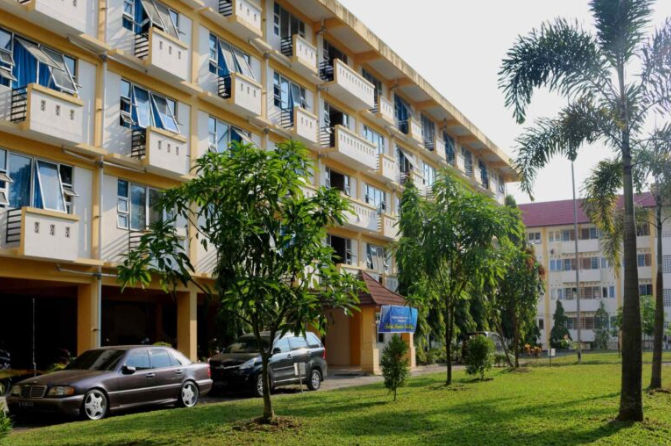
UNS also supports international students through access to university student dormitories. International students from low- and lower-middle-income countries are given priority access to UNS student accommodation, helping them obtain a place to live at an affordable cost during their studies.
Access to affordable accommodation can reduce the overall cost of pursuing higher education, particularly for international students who must manage living expenses in a country away from their home communities. This accommodation support complements tuition assistance and other financial aid by addressing another essential component of students’ educational expenses.
7. Research Supporting Inclusive Access to Education
UNS’s broader academic engagement with educational access and socioeconomic vulnerability is also reflected in research addressing the social rights of international refugees in Indonesia. The study “Reforming Social Rights for International Refugees in Indonesia: Towards Enhanced Welfare and Legal Protection” examines barriers to education and livelihoods faced by refugee communities and identifies areas for legal and policy reform to strengthen their social rights and welfare.
Although the study focuses on refugees rather than scholarship recipients specifically, it reflects academic engagement with educational access, socioeconomic vulnerability, and social protection. This research provides broader context for UNS’s commitment to inclusive education and complements the university’s direct scholarship and financial assistance programs.
Conclusion
Through the KNB Scholarship, UNS Scholarship, additional financial assistance, and accommodation support, Universitas Sebelas Maret demonstrates its commitment to expanding access to higher education for students from low- and lower-middle-income countries. These initiatives address both the direct costs of education and additional financial challenges that international students may encounter while studying at UNS.
The university’s scholarships and targeted assistance, including documented medical assistance to a student from Yemen and residence permit assistance to a student from Bangladesh in 2025, illustrate its efforts to prevent financial barriers from disrupting students’ educational journeys. Together, these measures support more inclusive access to higher education and advance UNS’s broader commitment to reducing inequality and achieving Sustainable Development Goal 1 (No Poverty) and Sustainable Development Goal 4 (Quality Education).