
SDG 6 In Number
Volume of water used in the university: Inbound (treated/extracted water) (m³)
60,056
Campus population
31,279
6.3.1 Wastewater treatment
Wastewater Treatment Process at Universitas Sebelas Maret (UNS)
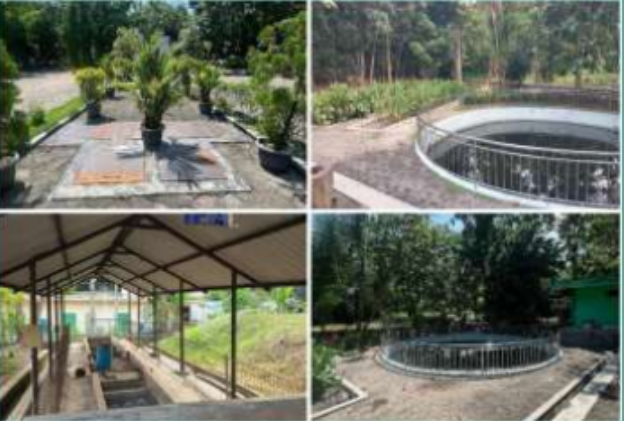
The Ministry of Public Works and Housing (PUPR) has developed a centralized Wastewater Treatment Plant (WWTP) on the Universitas Sebelas Maret (UNS) campus to improve campus environmental quality and support Green Campus principles. The UNS WWTP serves campus buildings and supporting facilities through an integrated wastewater collection and treatment system. Its reported treatment capacity is 1,293.60 m³ per day, supported by a campus-wide pipeline network that connects wastewater sources to the centralized treatment facility.
This institutional wastewater treatment process collects and conveys domestic wastewater from campus facilities to the communal WWTP for treatment before discharge or reuse. The treatment system includes primary treatment, aeration and control basins, wetland treatment, and a final control pond. The reported treatment efficiency reaches 90–95%. The system is designed to treat wastewater with Total Suspended Solids (TSS) and Biochemical Oxygen Demand (BOD) benchmarks of 300 mg/L, with reported treated-water values of 35 mg/L for TSS and 45 mg/L for BOD. These treatment measures help reduce pollutant loads and minimize the risk of water pollution in the surrounding environment.
After treatment and quality control, the facility stores and distributes suitable reclaimed water through a dedicated 2.5-kilometer campus pipeline network with 82 irrigation outlets. The treated water is subsequently reused for non-potable purposes, particularly landscape irrigation for campus trees and grass, with a reported reuse volume of approximately 1,000–1,200 m³ per day. This approach integrates wastewater collection, treatment, quality control, storage, distribution, and beneficial reuse into a continuous institutional management process.
In addition to the centralized WWTP, UNS encourages decentralized water-reuse initiatives at the faculty and building levels. These include collecting and reusing ablution water for landscape irrigation at the Faculty of Mathematics and Natural Sciences and the Faculty of Medicine; treating ablution water with eco-enzyme at the Faculty of Agriculture; and collecting air-conditioner condensate for vertical gardens at the Graduate School. These complementary initiatives extend responsible water management practices across the university.
UNS also continues to develop wastewater treatment technologies through research and external collaboration. In 2025, the Faculty of Engineering collaborated with PT Risechem Technology Indonesia to develop wastewater treatment technologies, including an Advanced Oxidation Process (AOP) system and its potential application at UNS Hospital. The collaboration also supports research, intellectual property development, and scientific publications. Furthermore, a research group from the Faculty of Mathematics and Natural Sciences developed and implemented a dual-tank anaerobic biogas reactor to process wastewater from tofu production in Donohudan, Boyolali. This technology reduces the direct discharge of untreated wastewater into surrounding drainage systems while converting organic waste into useful biogas, contributing to pollution prevention and improved environmental sanitation.
Overall, implementing a centralized WWTP, supported by decentralized water-reuse initiatives and ongoing research and technological development, shows that UNS has an institutional process to treat wastewater generated by campus activities. By collecting, treating, monitoring, and reusing wastewater where appropriate, UNS strengthens responsible water management, reduces water pollution, and helps protect surrounding water resources and ecosystems. These institutional efforts contribute directly to SDG 6 by improving wastewater treatment, promoting water quality, preventing the release of untreated wastewater into the environment, and supporting the sustainable management of water resources.
Source: Wastewater Treatment and Water Recycling Program Implementation