

SDG 5 In Number
Number of women starting a degree
6,185
Number of first-generation women starting a degree
4,124
Number of students starting a degree
8,965
Number of first-generation students starting a degree
6,191
Number of students
27,537
Number of employees
3,699
Number of academic staff
1,923
Number of senior academic staff
639
Number of female senior academic staff
292
Number of graduates by subject area (STEM, Medicine, Arts & Humanities / Social Sciences): Total
6,213
Number of graduates: STEM
2,042
Number of graduates: Medicine
721
Number of graduates: Arts & Humanities / Social Sciences
3,450
Number of female graduates by subject area (STEM, Medicine, Arts & Humanities / Social Sciences): Total
4,464
Number of female graduates: STEM
1,308
Number of female graduates: Medicine
367
Number of female graduates: Arts & Humanities / Social Sciences
2,623
Number of graduates: Total
6,213
5.3.3 Women’s Access Schemes
Provide women’s access schemes, including mentoring, scholarships, or other provision
SheRises: UNS and Aston University Support Women Graduates’ Entry into Work and Entrepreneurship
Women university graduates in Indonesia still face barriers when entering industry and starting businesses. In 2025, Universitas Sebelas Maret (UNS) continued an interdisciplinary project with Aston University in the United Kingdom, funded by the British Council’s Gender Equality Programme, to address this gap. The project supports SDG 5: Achieve gender equality and empower all women and girls.
Other Provision: Education and Support Resources for Women Students
On 20 February 2025, as part of the 49th anniversary of UNS, the UNS interdisciplinary lecturer team held the seminar “Embracing Gender Equality in Higher Education Institutions” at the G.P.H. Haryo Mataram Auditorium. The project, initiated by the Vice-Rector for Planning, Cooperation, Internationalisation, and Information, Prof. Irwan Trinugroho, involved lecturers from the Faculties of Law, Economics and Business, and Social and Political Sciences, as well as Professor Hannah Bartlett and Claire Richard of Aston University. It also received a Matching Fund from Kedaireka.
The team reported that the project produces a report on the barriers faced by female students in employment and entrepreneurship, a collection of education and support resources for students and staff, and a website to share these materials across universities in Indonesia and the United Kingdom. Its recommendations included integrating gender equality into university courses, restarting gender mainstreaming across the entire academic community, and providing comprehensive training to prepare graduates for industry. About 300 participants from UNS and other universities attended.
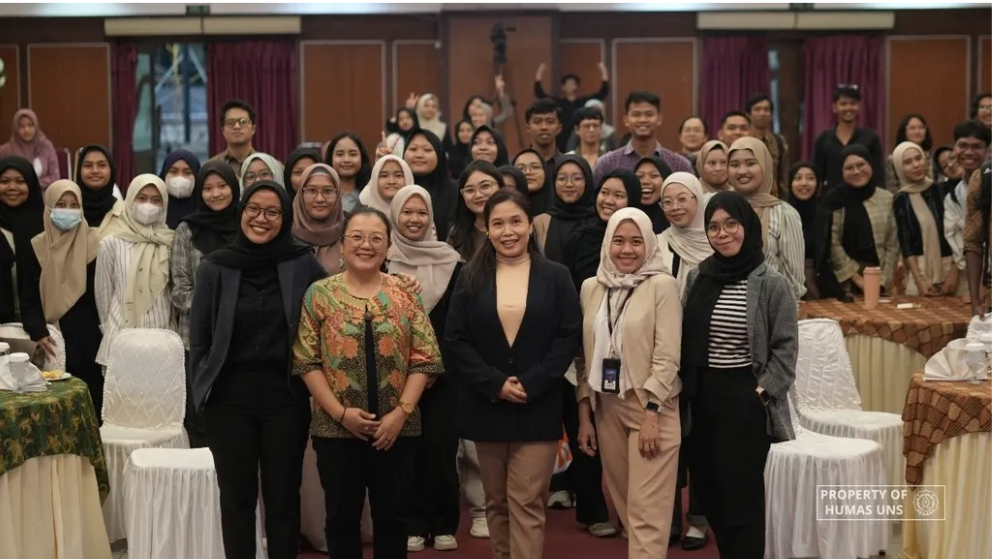
Source: UNS Gelar Seminar Bertajuk Embracing Gender Equality in Higher Education Institutions
The resources are publicly available on the SheRises Project website, which states that the project is dedicated to narrowing the gender gap in the workplace for women university graduates through economic, cultural, and legal approaches.
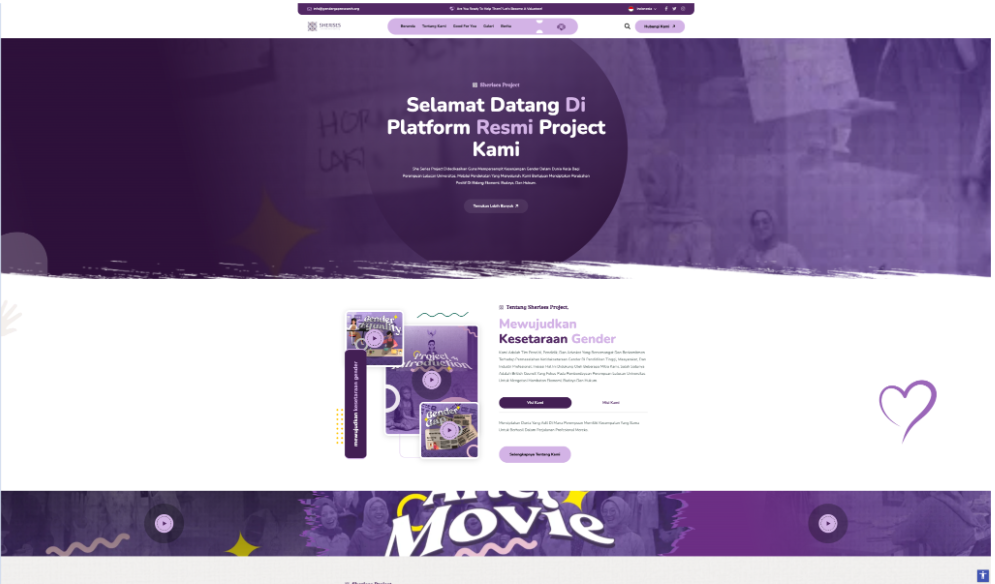
Scholarships: Financial Support Reaching Women Students
UNS supports women’s access to higher education through its scholarship and financial assistance system, governed by Rector’s Regulation No. 18 of 2025 concerning Student Scholarships, enacted on 14 July 2025. The regulation establishes an institutional framework to improve access and learning opportunities for students who are economically disadvantaged and/or demonstrate academic achievement.
Source: Rector’s Regulation No. 18 of 2025 concerning Student Scholarships
Through the Indonesia Smart College Card programme (KIP Kuliah) for students from economically disadvantaged households, UNS appointed 664 recipients admitted through the National Selection Based on Achievement (SNBP) under Rector’s Decree No. 3001/UN27/HK.02/2025, and 724 recipients admitted through the National Selection Based on Test (SNBT) under Rector’s Decree No. 3098/UN27/HK.02/2025, a total of 1,388 KIP Kuliah recipients in 2025.
Source: Rector’s Decree No. 3001/UN27/HK.02/2025 – KIP Kuliah Recipients, SNBP Pathway 2025; Rector’s Decree No. 3098/UN27/HK.02/2025 – KIP Kuliah Recipients, SNBT Pathway 2025
More broadly, in 2025 UNS provided financial assistance to 20,870 students from low-income households through its internal and externally funded scholarship and financial assistance programmes.
Source: 2026 Indicator 1.3.1 – Bottom Financial Quintile Admission Target
Of these 20,870 recipients, 13,565 (65.0%) are women, showing that the university’s financial assistance reaches a majority of women students.
Relevant Research
- Dr. Erna Dyah Kusumawati, S.H., M.Hum., LL.M.; Rachma Indriyani, S.H., LL.M., Ph.D.; Dewanti Cahyaningsih, S.E., M.Rech.; Likha Sari Anggreni, S.Sos., M.Soc.Sc.; Monika Sri Yuliarti, S.Sos., M.Si. with Aston University – research since late 2023 on the barriers faced by female students and graduates in employment and entrepreneurship, using interviews, focus group discussions, and expert input, with partner universities in Maluku, Central Kalimantan, Jambi, Papua, and Mataram. Source: UNS Gelar Seminar Bertajuk Embracing Gender Equality in Higher Education Institutions