
SDG 6 In Number
Volume of water used in the university: Inbound (treated/extracted water) (m³)
60,056
Campus population
31,279
6.5.7 Promoting Conscious Water Usage In The Wider Community
Promoting Responsible Water Use and Conservation in Local Communities
Universitas Sebelas Maret (UNS) actively promotes conscious water usage in the wider community through community engagement, student community service programs, public education, and practical water conservation initiatives. These activities aim to raise public awareness, improve understanding, and encourage individuals and communities to use water responsibly and sustainably.
Through collaboration among lecturers, students, local communities, and community organizations, UNS extends its commitment to water conservation beyond campus. The initiatives focus on promoting water-saving habits, improving rainwater absorption, protecting groundwater resources, and introducing practical solutions for sustainable water management. These efforts contribute directly to Sustainable Development Goal 6 by encouraging responsible water use and supporting the long-term availability of clean water for communities.
Community Education and Water Conservation Initiatives
The following activities demonstrate how UNS actively promotes conscious water usage through education, awareness campaigns, and practical community-based initiatives.
1. Water-Saving and Sanitation Education at SD Negeri Kaliwedi 2, Sragen
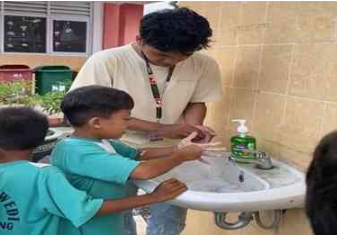
In January 2025, UNS students participating in the Community Service Program (KKN) conducted a sanitation and water-saving education program at SD Negeri Kaliwedi 2, Gondang, Sragen. The initiative aimed to increase children’s awareness of responsible water use, clean living habits, and the importance of water conservation from an early age. By engaging directly with elementary school students, UNS extended its water awareness campaign to the wider community through educational activities outside the university campus.
The program included educational presentations, handwashing demonstrations, interactive games, and question-and-answer sessions. Students learned practical ways to promote conscious water use in daily activities, including turning off taps after use and reusing suitable household water to water plants. These activities encouraged children to adopt simple water-saving habits and understand their role in protecting water resources.
Through this initiative, UNS actively promotes responsible water consumption and strengthens public awareness of clean water and sanitation. Educating young learners also helps build long-term behavioral changes within families and the surrounding community, supporting SDG 6 objectives.
Evidence: UNS Students Promote Sanitation and Water-Saving Awareness at SD Negeri Kaliwedi 2
2. Community-Based Biopore Education and Rainwater Infiltration in Bulurejo Village
In February 2025, students from UNS Community Service Program (KKN) Group 37 conducted a community education and biopore installation program in Bulurejo Village, covering Gunungduk, Mendungsari, and Cinet hamlets. The program aimed to raise public awareness of responsible rainwater management, groundwater conservation, and the environmental benefits of biopore technology.
The activities began with public education sessions explaining the benefits and construction methods of biopore infiltration holes. Residents then helped install biopores in selected locations. More than 55 members of the local youth organization participated in activities in Cinet Hamlet, demonstrating active community engagement. The program encouraged residents to adopt and maintain biopore technology independently to improve rainwater absorption, reduce surface runoff, and support groundwater quality.
Through direct education and practical demonstrations, UNS promoted conscious water management by helping residents understand the importance of preserving water resources and improving natural water infiltration. This community-based approach supports sustainable groundwater management and contributes to SDG 6 objectives.
Evidence: KKN 37 UNS Promotes and Installs Biopore Holes to Improve Rainwater Infiltration
3. Community Training on Biopore Technology for Water Runoff Management in Karanganyar
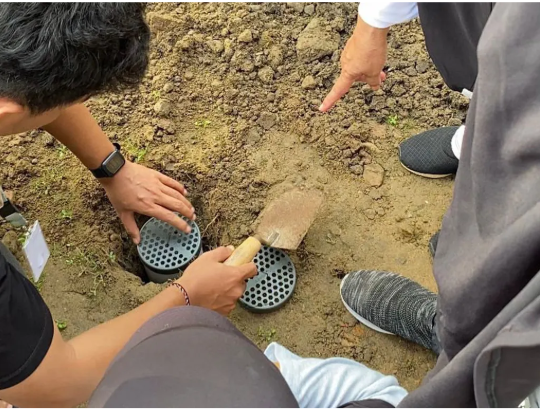
On September 20–21, 2025, the Center of Applied Physics for Wellness and Sustainable Living at UNS, through a community service team from the Faculty of Mathematics and Natural Sciences (FMIPA), implemented a biopore technology program in Bumi Graha Indah (BGI) Housing Complex, Jaten, Karanganyar. The program involved lecturers, students, and local residents in promoting water conservation and improving rainwater infiltration in a residential area.
Activities included site surveys, community awareness sessions, practical training, installing 20 biopore infiltration holes, and field evaluations. Residents received practical knowledge about how biopore technology can increase rainwater absorption, reduce surface runoff, and support groundwater conservation. Monitoring results showed that the average waterlogging depth decreased from 8.05 cm to 2.98 cm, representing an improvement of approximately 63%. Community understanding and participation also increased by up to 30%. The program further encouraged residents to maintain and expand the biopore installations independently.
By combining public education with direct community participation, UNS actively promotes conscious water usage and sustainable water management beyond the campus. The initiative demonstrates how practical conservation methods can empower local residents to protect groundwater resources, manage rainwater more effectively, and improve environmental resilience, in line with SDG 6.
Evidence: FMIPA UNS Implements Biopore Technology to Manage Surface Runoff in BGI Housing Complex, Karanganyar
4. Community Education on Rainwater Harvesting and Sustainable Water Use through SustainaTalk
On February 27, 2025, the Environmental Science undergraduate, master’s, and doctoral programs at the UNS Graduate School organized the third SustainaTalk session, focusing on “Community-Based Rainwater Utilization and Engineering.” The event featured Prof. Dr.-Ing. Ir. Agus Maryono from Universitas Gadjah Mada, who discussed practical approaches to using rainwater as an alternative water source.
The discussion highlighted household-level rainwater harvesting methods, including collecting rainwater from rooftops, directing it into storage tanks, and applying simple filtration techniques to prevent contaminants from entering the storage system. Participants learned about the potential of using harvested rainwater for daily needs, reducing dependence on groundwater and piped water supplies, and minimizing surface runoff. The session also encouraged participants to consider rainwater use as a practical water-conservation strategy in their communities.
Through this educational initiative, UNS promotes conscious water usage by sharing practical knowledge about rainwater harvesting and responsible water resource management. The activity builds public understanding of alternative water sources and encourages sustainable household practices, supporting SDG 6 objectives.
Evidence: Community-Based Rainwater Utilization and Engineering in the Environmental Science SustainaTalk
5. Community Training on Drinking Water Filtration and Water Quality Monitoring in Padang
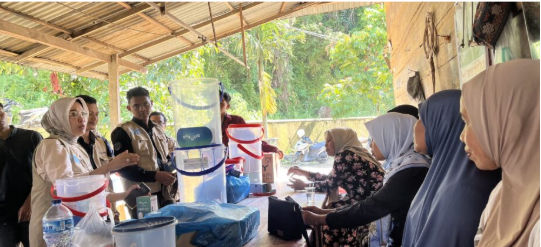
On December 19, 2025, UNS, through its Community Service Team, delivered a drinking water filtration system and technology-based water quality monitoring equipment to residents of Kampung Batu Busuk, Pauh District, Padang, West Sumatra. The initiative was part of UNS’s emergency community service response to support communities affected by flooding and improve access to safe drinking water.
Beyond providing the equipment, the UNS team provided technical training on operating the filtration system independently and on regular filter maintenance. These activities helped residents understand the importance of maintaining water quality and properly managing drinking water facilities. The monitoring technology also enabled communities to observe water quality parameters and support safer water consumption.
By combining appropriate technology with community education and practical training, UNS encourages residents to take an active role in managing their drinking water resources. This initiative strengthens community capacity for responsible water management and supports SDG 6, particularly the availability of safe and sustainable drinking water.
Evidence: UNS Community Service Team Provides Drinking Water Filters to Batu Busuk Community, Padang
Conclusion
Through its community service programs, public education activities, and practical water conservation initiatives in 2025, Universitas Sebelas Maret demonstrates an active commitment to promoting conscious water usage in the wider community. By engaging school students, village residents, youth organizations, and households, UNS extends water conservation awareness beyond the university campus and encourages communities to adopt responsible water practices.
These initiatives combine awareness campaigns, hands-on training, rainwater infiltration, rainwater harvesting education, and drinking water management. More importantly, they empower local communities with practical knowledge and skills to conserve water resources independently. Through these sustained community engagement efforts, UNS contributes to SDG 6 by promoting responsible water use, protecting water resources, and supporting sustainable water management for present and future generations.