
SDG 3 In Number
Number of graduates
6.192
Number of graduates in health professions
927
3.3.4 Sexual and Reproductive Health Care Services for Students
UNS Provides Free Access to Sexual and Reproductive Health Services for Students
Universitas Sebelas Maret (UNS) is committed to providing students with access to sexual and reproductive health-care services, including information, education, counseling, and support. Through institutional initiatives led by the Sexual Violence Prevention and Response Task Force (Satgas PPK) and the student-managed Youth Information and Counseling Center (PIK-R Cakra), UNS promotes awareness of sexual and reproductive health, prevention of sexual violence, informed decision-making, and access to appropriate guidance. Throughout 2025, these initiatives combined institutional prevention and response mechanisms with student-focused educational activities and peer counseling to support students’ health, safety, and well-being in an inclusive and supportive campus environment.
1. Satgas PPKS – Sexual Violence Prevention and Response Task Force
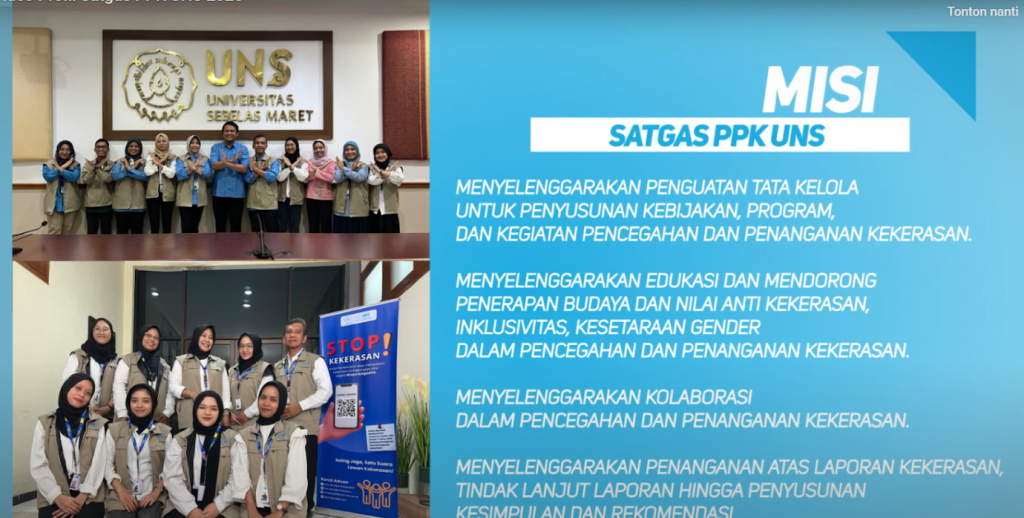
Universitas Sebelas Maret (UNS) provides students with access to sexual and reproductive health-related information, education, guidance, and support services through its Sexual Violence Prevention and Response Task Force (Satuan Tugas Pencegahan dan Penanganan Kekerasan, or Satgas PPK). These services support students’ sexual and reproductive health, personal safety, and overall well-being by promoting awareness, preventing sexual violence, and facilitating access to appropriate assistance. Through these institutional initiatives, UNS seeks to ensure that students can access relevant information and support in a safe, inclusive, and nondiscriminatory academic environment.
Throughout 2025, UNS continued to strengthen its institutional capacity to prevent and respond to violence, including sexual violence, through the Satgas PPK. On October 3, 2025, UNS officially inaugurated the members and volunteers of the Satgas PPK for the 2025–2026 term at the UNS Rectorate Building in Surakarta. The inauguration was led by UNS Rector Prof. Dr. Hartono, dr., M.Si., and marked a concrete step toward strengthening campus-wide prevention, education, and response mechanisms. The task force included 26 volunteers who were expected to help raise awareness, promote respectful behavior, and foster a campus culture free from violence.
UNS also strengthened the policy framework supporting these services by enacting UNS Rector Regulation No. 7 of 2025 on the Prevention and Handling of Violence, supported by established standard operating procedures (SOPs). These policies guide members of the university community on preventing and responding to violence and establish clear procedures for seeking assistance. In addition, UNS continued to implement structured educational programs and awareness campaigns, provide support systems for victims and survivors, conduct training on violence prevention and response, and carry out periodic monitoring and evaluation. These activities contribute to students’ access to information and education on sexual violence prevention, personal boundaries, respectful relationships, and personal safety.
Through the official Satgas PPK website (satgasppk.uns.ac.id), students can access information about reporting suspected cases of sexual violence and the applicable reporting procedures. The reporting mechanism provides a channel for students to seek assistance, while the task force facilitates access to psychological, legal, and recovery support for victims and survivors in accordance with established procedures. These services aim to protect the dignity, safety, and well-being of individuals seeking assistance and ensure that cases are addressed through appropriate institutional mechanisms rather than informal mediation that could compromise the rights or safety of those affected.
UNS also assessed awareness of its prevention and response measures through a university-wide Prevention and Handling of Violence Survey conducted in late September 2025, involving 773 members of the university community. The results indicated that most respondents were aware of the university’s policies and programs and understood the forms of violence recognized on campus. However, the survey also identified gaps in respondents’ understanding of case-handling procedures, highlighting the continued importance of accessible information, education, and awareness-raising initiatives. These findings reinforce the need for ongoing efforts to improve prevention, strengthen institutional responses, and ensure that members of the university community understand how to seek appropriate assistance.
Through the Satgas PPK, its online reporting channel, educational programs, awareness campaigns, and support mechanisms, UNS demonstrates its institutional commitment to providing students with access to sexual and reproductive health-related information, education, and support. By strengthening its prevention and response mechanisms throughout 2025, UNS continued to promote a safe, inclusive, and violence-free learning environment that supports students’ sexual and reproductive health, personal safety, and overall well-being, in alignment with SDG 3: Good Health and Well-Being.
References:
2. Sexual Violence Prevention Education through the ROSES Program
On March 8, 2025, Universitas Sebelas Maret (UNS), through its Sexual Violence Prevention and Response Task Force (Satgas PPKS), provided educational information to students through the ROSES program, Respecting Our Sisters, Ending Silence, and Empowering Women. Organized by the Center for Indonesian Medical Students’ Activities (CIMSA) of the UNS Faculty of Medicine, the event was held in Lecture Room 5 of the Faculty of Medicine’s Medical Education Building and attended by approximately 65 medical students and student organization representatives.
During the session, Evie Kusumawaty Sardjana, S.Sos., M.A.P., together with Arinda and Ella from the UNS Satgas PPKS, provided information on the task force’s roles and responsibilities, violence prevention, case handling, follow-up procedures for reports, and reporting mechanisms. The session also included an interactive discussion that allowed students to ask questions and exchange experiences related to violence prevention and response.
This activity provided students with direct access to educational information on sexual violence prevention, reporting procedures, and available institutional support mechanisms. By engaging medical students and student organization representatives in an interactive learning environment, UNS promoted awareness, encouraged informed help-seeking, and reinforced the importance of creating a safe and respectful campus environment. The activity demonstrates UNS’s implementation of student-focused information and education initiatives in 2025 that support personal safety, well-being, and the prevention of sexual violence.
3. PIK-R Cakra – Youth Information and Counseling Center
PIK-R Cakra UNS is a student-managed center that provides free access to information, education, and counseling on adolescent health and reproductive health. Officially recognized as a Student Activity Unit (Unit Kegiatan Mahasiswa, or UKM) at Universitas Sebelas Maret (UNS) since 2018, PIK-R Cakra implements the Generasi Berencana (GENRE) program to help young people develop healthy lifestyles, make informed decisions about reproductive health, plan for family life, prevent premarital sexual activity, understand HIV/AIDS prevention, and avoid substance abuse. Through counseling, life skills education, and peer-based learning, PIK-R Cakra helps students and adolescents access relevant information and guidance in a supportive environment.
Throughout 2025, PIK-R Cakra continued to develop its peer education and counseling capacity through the 2025 Peer Educator and Peer Counselor Training Program, themed SATUKAN HARMONI: Building Awareness, Nurturing Mental Health, and Developing Personal Potential. The program was designed to equip members with foundational knowledge and skills to become peer educators and peer counselors who can provide supportive guidance and serve as positive influences within their communities. Recognizing that young people may feel more comfortable discussing personal concerns with peers, the training emphasized accessible information, empathy, active listening, self-awareness, and appropriate peer support.
The training also prepared participants to continue as peer counselors through Halo PIK, PIK-R Cakra’s peer counseling service. Through this service, students can access a supportive space to discuss personal concerns and seek initial guidance. The training also emphasized the importance of maintaining personal well-being while supporting others, helping participants build awareness of their own mental health and recognize when to seek appropriate assistance.
These initiatives demonstrate PIK-R Cakra’s role in expanding access to student-oriented information, education, and counseling through peer-based approaches. Alongside its reproductive health education and the GENRE program, its peer educator development and counseling activities contribute to a supportive environment in which students can seek guidance on personal well-being and health-related concerns. Through these services, UNS strengthens access to sexual and reproductive health-related information and education while supporting students’ broader health and well-being, in alignment with SDG 3: Good Health and Well-Being.
Sources:
- Instagram: https://www.instagram.com/pikrcakrauns/
- Website: https://pikrcakrauns.wixsite.com/pikrcakrauns
- Halo PIK Peer Counseling Service: https://linktr.ee/halopik.sebelasmaret
Conclusion
Through the Satgas PPK’s sexual violence prevention education, reporting mechanisms, and survivor support, alongside PIK-R Cakra’s reproductive health education, peer educator training, and counseling initiatives, UNS demonstrates its commitment to giving students access to sexual and reproductive health information, education, and support. Implementing these initiatives in 2025 reflects UNS’s continued efforts to strengthen students’ knowledge, encourage informed and responsible health decisions, and facilitate access to appropriate assistance. Together, these services contribute to a safer, more inclusive, and supportive learning environment and reinforce UNS’s commitment to SDG 3: Good Health and Well-Being, particularly through student access to sexual and reproductive health information and education services.