
SDG 6 In Number
Volume of water used in the university: Inbound (treated/extracted water) (m³)
60,056
Campus population
31,279
6.5.5 Cooperation on Water Security
Strengthening Water Security Through Government Collaboration and Sustainable Water Management
Universitas Sebelas Maret (UNS) actively contributes to strengthening water security through cooperation with local, regional, and national governments. Throughout 2025, UNS implemented various collaborative initiatives involving government institutions and regional water service providers to improve access to clean water, protect water resources, maintain water quality, and strengthen community resilience to water-related challenges.
These initiatives demonstrate UNS’s commitment to supporting Sustainable Development Goal 6 (Clean Water and Sanitation) through institutional cooperation, scientific knowledge transfer, technological innovation, and community-based interventions. By working with government partners at different levels, UNS supports more sustainable water resource management and strengthens communities’ capacity to maintain reliable access to safe, clean water.
The following activities highlight UNS’s cooperation on water security at the local, regional, and national levels.
Local Government Cooperation
1. Supporting Clean Water Supply Recovery Through Cooperation with PDAM Tirta Pasai, Aceh Utara

In December 2025, Universitas Sebelas Maret (UNS), through its Disaster Response Community Service Team, cooperated with PDAM Tirta Pasai, a regional government-owned water utility in Aceh Utara, to support the recovery of clean water services following severe flooding. UNS provided two tons of Poly Aluminum Chloride (PAC), a water treatment material, to help the utility restore its water purification capacity and maintain clean water supply for about 53,000 customers, particularly in flood-affected areas. The Director of PDAM Tirta Pasai received the assistance directly.
This cooperation on water security demonstrates UNS’s direct contribution to restoring access to clean water through collaboration with a local government-owned water service provider. The initiative supports SDG 6 by strengthening the availability and continuity of safe water services, particularly for communities facing water supply disruptions caused by natural disasters.
Reference: UNS – Supporting Clean Water Recovery in Aceh Utara Through the Distribution of Two Tons of PAC
2. Groundwater Resource Mapping to Address Water Scarcity in Kulurejo Village, Wonogiri
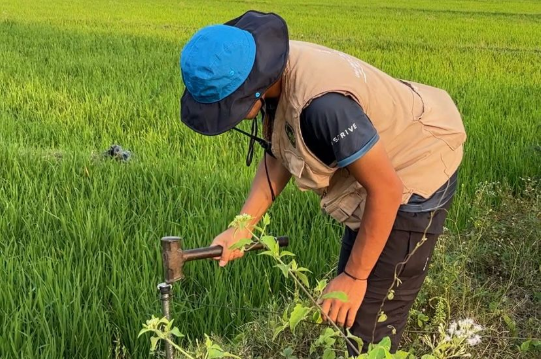
In August 2025, UNS, through its Thematic Community Service Program (KKN) Group 339, cooperated with the Kulurejo Village Government in Nguntoronadi, Wonogiri, to identify potential groundwater resources using geoelectrical technology. The survey covered four strategic locations across three hamlets to identify underground water-bearing layers and potential sites for new groundwater wells. The survey locations were determined through direct coordination with the village government, and the findings were officially presented to village officials and residents on August 19, 2025.
This collaboration supports local water security by providing scientific information for groundwater exploration, clean water infrastructure planning, and sustainable water resource management. Through cooperation with local government authorities, UNS helps address water scarcity, particularly during the dry season, and contributes to SDG 6 by supporting more sustainable access to clean water for rural communities.
Regional Government Cooperation
1. Sustainable Water Resource Management Through the Rawa Pening Restoration Initiative, Central Java

In 2025, UNS, through its Faculty of Engineering, strengthened its cooperation with the Central Java Provincial Government to support the sustainable management of the Rawa Pening Lake area in Semarang Regency. As part of the Memorandum of Understanding between UNS and the provincial government, the university provided technical assistance and community training to process excess water hyacinth into environmentally friendly bio-briquettes and paving blocks. The initiative was implemented in cooperation with the Central Java Provincial Government and Bank Jateng, with equipment provided to support local community participation.
This regional cooperation supports water security by helping manage an important freshwater ecosystem and address environmental pressures caused by excessive water hyacinth growth. The initiative also supports efforts to maintain Rawa Pening’s ecological functions, including its role in water resource management and flood control. Through collaboration with the provincial government, UNS contributes to sustainable water management and SDG 6 environmental objectives.
References:
2. Providing Water Filtration and Smart Water Quality Monitoring Technology in West Sumatra

On December 19, 2025, UNS, through its Community Service Team, provided water filtration equipment and a technology-based water quality monitoring system to the West Sumatra Disaster Risk Reduction Forum (FPRB). The team handed over the equipment at Universitas Negeri Padang (UNP) as part of the Disaster Response Community Service Program covering Aceh, North Sumatra, and West Sumatra, supported by the Directorate General of Research and Development of the Ministry of Higher Education, Science, and Technology. The technology includes digital sensors that monitor water quality parameters in real time, helping ensure that water supplied to disaster-affected communities is safe to drink.
This initiative supports regional water security by strengthening access to safe drinking water and improving capacity to monitor water quality during emergencies. Through cooperation with regional disaster response stakeholders, UNS contributes technological solutions to restore water services disrupted by flooding and supports SDG 6 through improved water quality, access to safe water, and sustainable water management.
National Government Cooperation
1. Institutional Cooperation with the Coordinating Ministry for Infrastructure and Regional Development

On August 8, 2025, UNS signed a Memorandum of Understanding with the Coordinating Ministry for Infrastructure and Regional Development (Kemenko Infra) to strengthen cooperation in implementing higher education’s three pillars: education, research, and community service. The agreement establishes a framework for collaboration in infrastructure research and development, policy studies, innovation, and human resource development. During the signing, the Ministry emphasized the importance of academic contributions to national infrastructure priorities, including food, water, and energy self-sufficiency under the national development agenda.
This institutional cooperation provides a framework for UNS to contribute scientific expertise, research, and innovation to national development priorities related to water security. By strengthening collaboration between the university and the national government, UNS supports evidence-based policymaking and sustainable infrastructure development, contributing to SDG 6 and broader efforts to strengthen national water resource management.
Reference: Kemenko Infra – Government and Academic Collaboration for Stronger National Infrastructure
2. National Government Support for UNS Disaster Response and Water Security Initiatives
In 2025, UNS implemented disaster response community service initiatives supported by the Ministry of Higher Education, Science, and Technology (Kemendiktisaintek) through its Disaster Response Community Service Program. The program included interventions in Aceh Utara and West Sumatra to address flooding-related water supply disruptions. In Aceh Utara, UNS supported PDAM Tirta Pasai by providing two tons of PAC for water purification; in West Sumatra, the university provided water filtration equipment and a digital water quality monitoring system to support the recovery of safe water access in affected communities.
This cooperation, supported through a national government program, demonstrates UNS’s contribution to water security through emergency water supply support, water treatment technology, and water quality monitoring. By implementing these initiatives with government-supported funding and coordinating with local and regional stakeholders, UNS helps strengthen community resilience and restore access to safe water after disasters. These efforts directly support SDG 6 by addressing water-quality challenges and improving clean water availability for vulnerable communities.
References:
Conclusion
Through cooperation with local, regional, and national government partners, UNS demonstrates its institutional commitment to strengthening water security and supporting sustainable water resource management. The initiatives range from restoring clean water services through regional water utilities and identifying groundwater resources in rural communities to protecting freshwater ecosystems, providing water treatment technologies, and developing institutional cooperation with national government authorities.
These collaborative efforts strengthen access to safe, clean water; improve water quality; support sustainable water management; and enhance community resilience to water-related challenges. By integrating academic expertise, technological innovation, and government cooperation, UNS contributes to achieving SDG 6 and supports more sustainable, resilient water systems at the local, regional, and national levels.