
SDG 5 In Number
Number of women starting a degree
6.489
Number of first-generation women starting a degree
4.113
Number of students starting a degree
9.032
Number of first-generation students starting a degree
6.205
Number of students
27.604
Number of employees
3.760
Number of academic staff
1.950
Number of senior academic staff
685
Number of female senior academic staff
303
Number of graduates by subject area (STEM, Medicine, Arts & Humanities / Social Sciences): Total
6.192
Number of graduates: STEM
1.905
Number of graduates: Medicine
627
Number of graduates: Arts & Humanities / Social Sciences
3.660
Number of female graduates by subject area (STEM, Medicine, Arts & Humanities / Social Sciences): Total
4.353
Number of female graduates: STEM
1.244
Number of female graduates: Medicine
301
Number of female graduates: Arts & Humanities / Social Sciences
2.808
Number of graduates: Total
6.192
5.6.7 Track Women’s Graduation Rate
UNS Systematically Tracks Women’s Likelihood of Graduating Compared with Men’s
Universitas Sebelas Maret (UNS) measures and publishes the academic outcomes of female and male students through its official data portal, analitik.uns.ac.id, managed by the UNS Policy Data Center (Pusat Data Kebijakan). The portal is synchronized daily with the national higher education database (PDDikti) and follows the One Data Indonesia principles (Presidential Regulation No. 39 of 2019). This supports SDG 5: Achieve gender equality and empower all women and girls.
Tracking the Graduation Gap between Women and Men
The portal’s Students page includes a dedicated section, “Selisih Capaian antara Mahasiswa & Mahasiswi” (Achievement Gap between Male and Female Students), which the portal describes as a way “to ensure that UNS services are fair for all”. It compares three outcomes, calculated from 148,033 graduates with recorded gender data over the last ten years:

The portal classifies each difference qualitatively (small, medium, or large); all three are currently classified as medium. The data show that, at UNS, women are more likely than men to graduate on time. The portal also reports the gender composition of active students (61.4% female, 38.6% male) and on-time graduation by faculty and level.
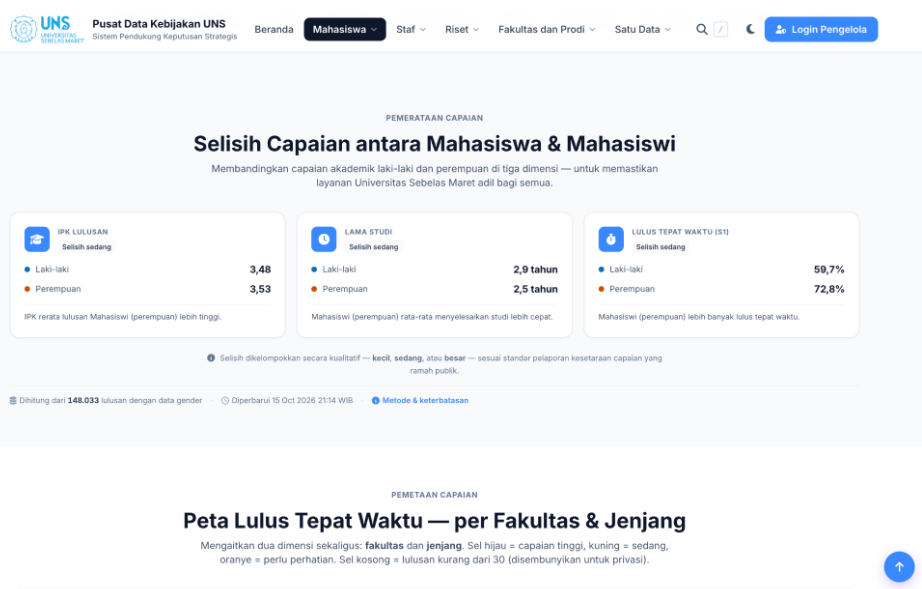
Source: Mahasiswa — Universitas Sebelas Maret (Pusat Data Kebijakan UNS, analitik.uns.ac.id)
The underlying student datasets are published through the UNS Open Data API under a CC BY-SA 4.0 license, so you can reproduce and audit the measurement.
Source: Open Data API v1 — Universitas Sebelas Maret
Using the Data
Because the comparison is updated daily and broken down by faculty and level, study programs can see where either group falls behind and respond. At UNS, the current gap favors women; continued tracking allows the university to detect any reversal and to direct support where it is needed.