

SDG 16 In Number
Number of graduates
6,213
Number of graduates from law and enforcement related courses
1,554
16.2.1 Elected Representation
Inclusive Representation in University Governance: Amplifying the Voices of Students, Faculty, and Staff
In support of SDG 16: Peace, Justice and Strong Institutions, inclusive representation in the university’s highest governing body ensures that students (both undergraduate and graduate), faculty, and staff (non-faculty employees) are represented and involved in institutional decision-making processes. This representation promotes participatory, transparent, and accountable governance by providing university stakeholders with a voice in shaping institutional policies and strategic directions.
Since being designated as a State University with Legal Entity status (Perguruan Tinggi Negeri Badan Hukum, PTN-BH) under Government Regulation of the Republic of Indonesia Number 56 of 2020, Universitas Sebelas Maret (UNS) has managed its non-academic affairs autonomously and established the Board of Trustees (Majelis Wali Amanat, MWA) to represent the interests of the government, the public, and the university itself. The MWA is the university’s highest governing body and is responsible for formulating, approving, and overseeing university policies, including appointing and dismissing the Rector, endorsing strategic plans and annual budgets, and supervising non-academic management at UNS.
To ensure inclusive representation, the Minister appoints MWA members based on recommendations from the Academic Senate. The composition includes representatives from students (both undergraduate and graduate), faculty (represented through Academic Senate members), and staff (non-faculty employees), as well as members representing the government, alumni, and the broader community. Although the MWA has only one student representative, this representative serves as the voice of the entire student body across all educational levels, from diploma and undergraduate programs to master’s and doctoral programs. This arrangement ensures that student interests are represented at the university’s highest governing level, rather than being limited to a particular academic program or educational level. Faculty and non-faculty staff are also represented through their respective institutional representatives, ensuring that all three internal university groups have a voice in strategic decision-making, including the selection of the Rector.
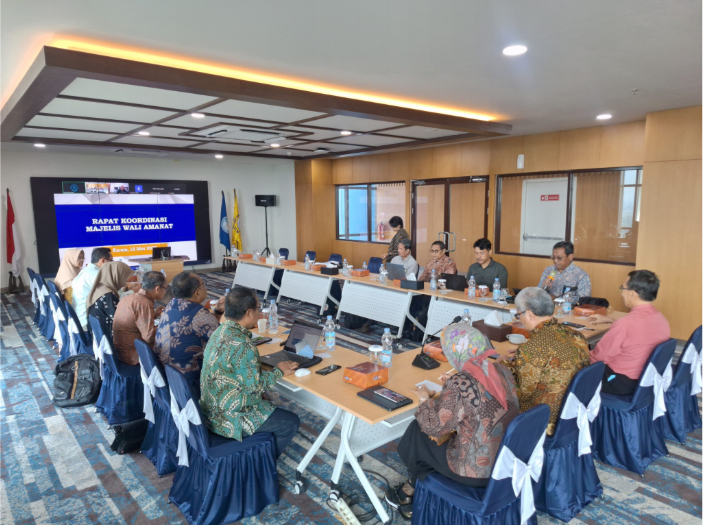
These representatives also actively participated in MWA’s governance activities throughout 2025. For example, on March 25, 2025, MWA held a hybrid coordination meeting attended by its leadership and all MWA members. The meeting addressed institutional performance, the alignment of university strategies, and coordination with other university governing bodies. All MWA members also participated in the coordination meeting on October 16, 2025, to discuss the 2026 Annual Work Plan and Budget (RKAT). These meetings show that MWA representation extends beyond formal membership, giving university stakeholders opportunities to participate in discussions on institutional policies, strategic priorities, and resource allocation.
Through this arrangement, UNS demonstrates its commitment to inclusive, transparent, participatory, and accountable governance. By representing students across all educational levels, faculty, and non-faculty staff in its highest governing body, UNS supports institutional accountability and meaningful stakeholder participation, in line with SDG 16 principles, particularly the promotion of effective, accountable, and inclusive institutions at all levels.
Sources: