

SDG 7 In Number
Total energy used (GJ)
19,141
University floor space (m²)
523,299
Total energy used from low-carbon sources (GJ)
9,413
7.4.5 Assistance to Low-Carbon Innovation
Supporting Start-Ups and Innovation for a Low-Carbon Future
Universitas Sebelas Maret (UNS) actively provides institutional support to start-ups and emerging entrepreneurs that foster a low-carbon economy and low-carbon technology. Through its entrepreneurship programs, research commercialization initiatives, and business incubation ecosystem, UNS helps innovators transform research and business ideas into practical solutions for energy efficiency, renewable energy, energy storage, and environmentally sustainable technologies.
The university provides various forms of assistance, including business incubation, technical training, coaching, mentoring, funding facilitation, product development support, and access to industry and investor networks. These initiatives strengthen start-ups’ capacity to develop and commercialize sustainable technologies. By connecting innovation with entrepreneurship, UNS advances affordable and clean energy and supports the broader objectives of Sustainable Development Goal (SDG) 7.
DIRECT START-UP ASSISTANCE
1. Indonesian Environmental & Energy Young Entrepreneur Project (IEEYEP) 2025–2026
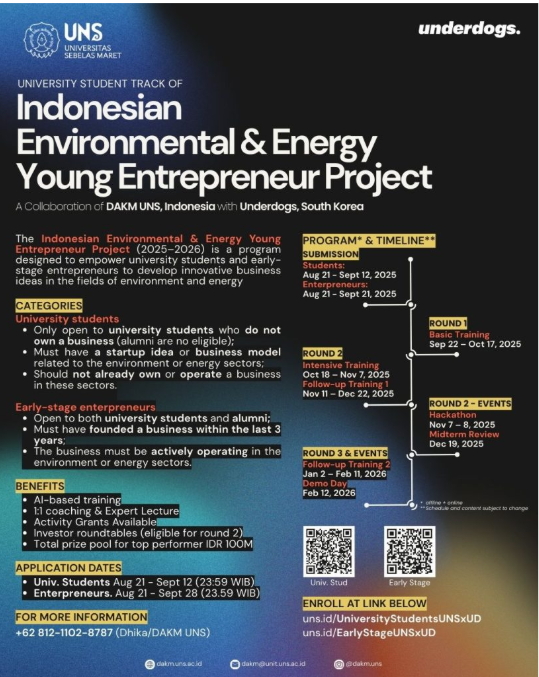
In September 2025, UNS, through its Directorate of Alumni and Student Entrepreneurship (DAKM), established an international partnership with Underdogs Startup from South Korea to implement the Indonesian Environmental & Energy Young Entrepreneur Project (IEEYEP). The program was designed to support university students and early-stage entrepreneurs developing innovative business ideas and start-ups in the environmental and energy sectors. It attracted 27 teams and 64 individual applicants, demonstrating interest in developing businesses that address environmental and energy challenges.
The program provides direct support through AI-based training, one-on-one coaching, expert lectures, activity grants, and investor networking opportunities. Selected participants can also join investor roundtables and compete for a total prize pool of IDR 100 million. Through this initiative, UNS helps early-stage start-ups strengthen their business capabilities, develop sustainable solutions, and improve their readiness for future commercialization. The program directly supports low-carbon innovation by encouraging entrepreneurship in environmental protection and clean energy, contributing to the advancement of SDG 7.
References:
2. SEMESTA Incubation Program – AInergy Smart Energy Technology
In 2025, UNS provided financial and incubation assistance to AInergy through the Sebelas Maret Startup Academy (SEMESTA), a university-supported start-up incubation program managed by UNS Innovation Hub under the Institute for Research and Community Service (LPPM). Developed by Dr. Ir. Warindi, S.T., M.Eng., from the Faculty of Engineering, AInergy focuses on an Artificial Intelligence and Internet of Things (AI and IoT)-based building energy meter designed to improve electricity management and energy efficiency.
UNS approved IDR 50 million in funding for this initiative under its 2025 non-state-budget innovation and start-up incubation program. Through this support, UNS facilitates the development of smart energy management technology to monitor electricity consumption, identify inefficient energy use, and improve building energy management.
By supporting an innovative business solution for energy efficiency, UNS helps translate technological innovation into practical applications that contribute to a low-carbon economy and SDG 7 objectives.
References:
LOW-CARBON TECHNOLOGY START-UPS
1. PT Polimikro Berdikari Nusantara – Lithium-Ion Battery Technology
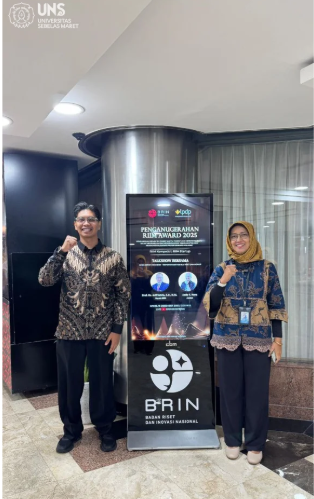
UNS supports the development and commercialization of research-based energy-sector start-ups through its Center of Excellence for Electrical Energy Storage Technology (PUI TPEL) and UNS Innovation Hub. One example is PT Polimikro Berdikari Nusantara (PBN), a research-based start-up that originated from lithium-ion battery cathode research at UNS. PBN previously participated in the Sebelas Maret Startup Academy (SEMESTA) incubation program in 2021, which provided an institutional pathway for transforming university research into a technology-based business.
PBN develops lithium-ion battery cathode materials, including Lithium Ferro Phosphate (LFP) and Lithium Nickel Manganese Cobalt Oxide (NMC), which are important components for energy storage systems and electric vehicle technologies. In December 2025, the start-up received the RIIM Startup Award 2025 from the National Research and Innovation Agency (BRIN). This achievement demonstrates the continued development and recognition of a start-up originating from UNS’s innovation and incubation ecosystem.
By supporting the development and commercialization of battery-related technologies, UNS contributes to innovations that can facilitate cleaner energy systems and the transition toward a low-carbon economy, in line with SDG 7.
References:
2. PT Ekolektrik Mandiri – Electric Vehicle Conversion Technology

In 2025, the Faculty of Engineering at UNS involved PT Ekolektrik Mandiri, a university-supported start-up specializing in electric vehicle conversion, in a capacity-building program for an electric vehicle conversion workshop at SMK Karya Nugraha in Boyolali. The initiative aimed to strengthen technical capabilities and support the development of electric vehicle conversion services through collaboration among the university, vocational education institutions, and local stakeholders.
The six-month program, which started in March 2025, included technical training, mentoring, the introduction of Internet of Things (IoT) technology, risk management, quality control, and productivity improvement. PT Ekolektrik Mandiri’s involvement shows how UNS connects a university-supported start-up with practical applications of low-carbon technology.
By facilitating collaboration and promoting electric vehicle conversion, UNS helps develop cleaner transportation solutions and supports the broader transition to sustainable energy use under SDG 7.
INSTITUTIONAL INCUBATION SUPPORT
1. UNS Innovation Hub – Institutional Support for Low-Carbon Start-Ups
UNS provides institutional assistance to technology-based start-ups through UNS Innovation Hub, managed by the Unit for Research Product Downstreaming and Commercialization (UHKPP) under LPPM. The incubator supports research-based business development by connecting academic research, entrepreneurship, and industry. Since its 2021 repositioning, UNS Innovation Hub has consistently incubated about 9–30 start-ups annually across sectors including agriculture, renewable energy, food, education, and health.
Its support mechanisms include research commercialization coaching clinics, pre-commercialization assistance, Matching Fund facilitation, intellectual property rights support, and technology licensing collaboration. In July 2025, UNS received the 5 Years of Impact Award at Pertamina Goes To Campus 2025 in recognition of its sustained contribution to developing innovative start-ups.
Through this institutional incubation ecosystem, UNS provides essential support that helps start-ups strengthen their business models, develop innovative products, and commercialize research-based technologies. Its support for renewable energy and other sustainable technology ventures reinforces the university’s contribution to low-carbon innovation and SDG 7.
References:
2. SMART-I – Smart Energy Monitoring System for Energy Conservation
In 2025, UNS provided innovation funding through its SMART INNOVATION (SMART-I) scheme to support the development of a Smart Energy Monitoring System proposed by Ir. Sutrisno, S.T., M.Sc., Ph.D., from the Faculty of Engineering. The project received approved funding of IDR 100 million under the university’s non-state-budget innovation program. It focuses on developing a technology-based solution to optimize energy conservation and support the implementation of the UNS Green Campus program.
The system is intended to improve energy monitoring and support more efficient electricity management. By facilitating the development of smart energy monitoring technology, UNS strengthens its institutional capacity to generate and apply innovations that reduce unnecessary energy consumption. Although this project is documented as an innovation initiative rather than a confirmed start-up, it demonstrates complementary institutional support for low-carbon technology development. Together with the university’s start-up incubation programs, this initiative contributes to energy efficiency and the broader objectives of SDG 7.
References:
CONCLUSION
Through its direct entrepreneurship assistance, research-based start-up incubation, and institutional innovation support, UNS demonstrates its commitment to helping start-ups that foster and support a low-carbon economy and low-carbon technology. The combination of financial assistance, training, mentoring, commercialization support, and access to innovation networks enables emerging businesses to develop practical solutions in energy efficiency, energy storage, renewable energy, and electric transportation.
These initiatives show that UNS not only generates sustainable research but also supports turning innovative ideas into business activities and technologies with practical applications. By strengthening the development and commercialization of low-carbon innovations, UNS helps accelerate the transition to affordable, reliable, and clean energy while advancing the objectives of Sustainable Development Goal 7.