

SDG 2 In Number
Total food waste (mt)
1,66
Campus population
31,279
Number of graduates
6,213
Number of graduates from agriculture and aquaculture courses including sustainability aspects
1,727
2.5.1 Access To Food Security Knowledge
Access to Food Security Knowledge, Skills, and Technology for Sustainable Agriculture and Aquaculture at Universitas Sebelas Maret
Universitas Sebelas Maret (UNS) is committed to expanding access to food security knowledge, skills, and technology in sustainable agriculture and aquaculture for local farmers and food producers. This commitment is demonstrated through community service programs, community empowerment grants, and student-led initiatives that connect academic knowledge with hands-on practices in local communities. Through these programs, UNS helps community members gain practical knowledge and skills to improve agricultural productivity, optimize local resources, adopt appropriate technologies, and develop more sustainable food production systems.
In 2025, UNS carried out various activities that provided access to knowledge and technology in environmentally friendly agriculture, crop cultivation, precision farming, organic waste utilization, and integrated food production systems. These activities involved farmer groups, women’s farmer groups, and rural communities as beneficiaries, helping strengthen local food producers’ capacity and support community-based food security.
1. Training on Trichoderma and Botanical Pesticide Production for Farmers in Karangbangun Village

On October 21, 2025, the Student Organization Capacity-Building Program (PPK Ormawa) team from the KSI Student Organization of the Faculty of Agriculture at UNS, in collaboration with the Karanganyar Regency Agriculture Office, held a training session on producing Trichoderma and botanical pesticides in Karangbangun Village, Karanganyar Regency. The activity involved 20 farmers from eight farmer groups and one Women’s Farmer Group (KWT). It provided farmers with direct access to practical knowledge and skills that could be applied to agricultural production. The training was provided free of charge, allowing participants to gain this knowledge and skills without paying any participation fees.
The training covered producing Trichoderma as a biological agent to support plant health and preparing botanical pesticides from natural ingredients to help control pests. Through this training, farmers gained practical knowledge of more environmentally friendly crop management alternatives and how to use local resources in farming activities.
This activity supports sustainable agriculture by introducing crop management practices that reduce dependence on synthetic chemicals. By providing farmers with free access to technical knowledge and skills, UNS helps strengthen the capacity of local food producers and promote more sustainable food production systems.
2. Knowledge and Technology Transfer on Aquaponics to the Tani Mulya Women’s Farmer Group in Sukoharjo

In 2025, the research group from the Plant Physiology and Biotechnology Laboratory, Faculty of Agriculture, UNS, introduced aquaponics technology to the Tani Mulya Women’s Farmer Group in Gentan Village, Sukoharjo Regency. As part of a program running from April to October 2025, the activity gave community members access to knowledge, skills, and technology for integrating fish farming with vegetable production. The activity was provided free of charge, allowing participants to gain knowledge, skills, and an introduction to aquaponics technology without paying any fees.
Through information sessions, training, and hands-on practice, participants were introduced to the principles of aquaponics and how the system can be applied to food production. This approach supports more integrated resource use by connecting aquaculture activities with crop cultivation, while also creating opportunities to diversify food production at the community level.
The program helps expand access to food security knowledge and sustainable aquaculture practices. By equipping women’s farmer groups with cultivation skills that they can apply independently, UNS supports the development of more diverse and efficient local food production systems through free access to knowledge and technology.
3. Empowering Women’s Farmer Groups through Internet of Things (IoT)-Based Precision Grape Cultivation
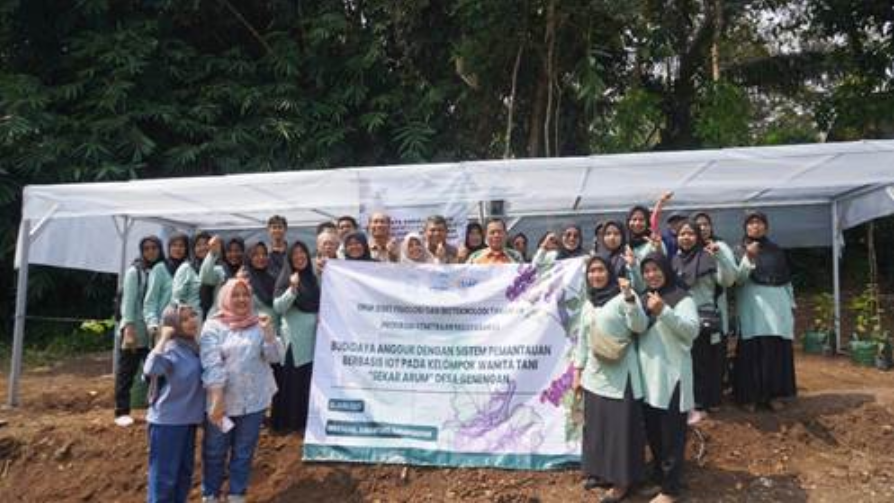
In 2025, the Faculty of Agriculture at UNS implemented a community partnership program to introduce Internet of Things (IoT)-based precision grape cultivation to the Sekar Arum Women’s Farmer Group in Genengan Village, Jumantono District, Karanganyar Regency. The program took place in July 2025 and gave community members involved in crop and horticultural production access to digital agricultural knowledge and technology. The activities were provided free of charge, allowing participants to join information sessions, receive guidance, and take part in practical training without paying any fees.
The activities included information sessions, guidance, practical grape cultivation, grafting techniques, and demonstrations of IoT sensors through a demonstration plot. This approach helped participants understand how technology can be applied to farming activities and introduced precision farming methods that support crop monitoring and more targeted production management.
Through this program, UNS expanded farmers’ and local food producers’ access to modern agricultural skills and technology. Precision cultivation also supports sustainable agriculture by using information to improve farming decisions, potentially increasing production efficiency and strengthening local food security. Free access to this knowledge and technology further supports these goals.
4. Strengthening the Capacity of the Dewi Sri Women’s Farmer Group through Organic Vegetable Cultivation in Sapen Village
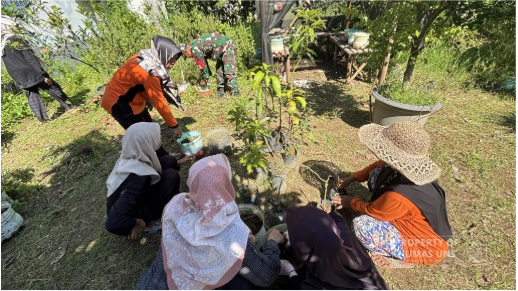
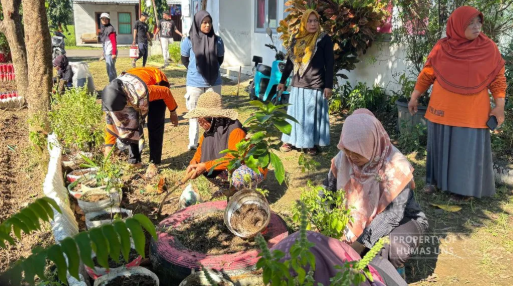
From February to May 2025, the UNS MBKM Grant Team carried out a community empowerment program for the Dewi Sri Women’s Farmer Group in Sapen Village, Sukoharjo Regency. The program focused on developing organic vegetable cultivation through guidance, training, and hands-on practice, providing the farmer group with access to knowledge and skills that support sustainable food production. The program was provided free of charge, allowing members of the Dewi Sri Women’s Farmer Group to gain knowledge and skills in organic vegetable cultivation without paying participation fees.
The activities included practical training in organic vegetable cultivation, organic fertilizer production, processing harvested crops into value-added products, and strengthening digital marketing skills. These activities not only improved agricultural production skills but also expanded the group’s ability to make better use of harvested crops and develop business opportunities based on local food products.
Through this program, UNS supports access to sustainable agriculture knowledge while strengthening local food producers’ capacity. Organic cultivation methods and organic fertilizers encourage more environmentally friendly production practices, while post-harvest processing increases the economic value of local products and supports the sustainability of community-based businesses. Free access to this training and knowledge also helps strengthen community capacity and local food security.
Source: UNS — MBKM Grant Team Develops Organic Vegetable Cultivation in Sapen Village, Sukoharjo
5. Developing Smart Farming and Strengthening Farmers’ Capacity in Matesih Village

In 2025, the PPK Ormawa GAMAGRITA team from the UNS Vocational School implemented a community empowerment program in Matesih Village, Karanganyar Regency, to introduce smart farming and strengthen local farmer groups’ capacity. The activities, reported between July and September 2025, provided access to sensor-based agricultural knowledge and technology, as well as supporting skills for agricultural business development. The activities were provided free of charge, allowing participants to gain the knowledge and skills offered without paying participation fees.
The program introduced sensors to monitor key aspects of cultivation, including water, fertilizer, pests, and plant diseases. In addition to the technology introduction, the activities included training in horticultural product packaging and digital marketing to support business development and improve the competitiveness of local agricultural products.
By combining technical knowledge with business skills, UNS helps farmers access technology that can improve agricultural management efficiency. The program supports sustainable agriculture by introducing information-based cultivation systems while strengthening local food producers’ ability to develop and market their products. Free access to knowledge, technology, and training also helps improve farmers’ capacity and strengthen local food security.
Sources:
6. Knowledge Transfer on Sustainable Agriculture through Intercropping and Biocompost Blocks

In 2025, the UNS Impactful Learning Grant Team, through the JARPAK program from the D3 Agribusiness Study Program at the Vocational School, carried out activities to develop a sustainable farming system in Matesih Village, Karanganyar Regency. The activities aimed to give farmers access to knowledge and sustainable agricultural practices by using local resources and applying more environmentally friendly cultivation techniques. The information sessions and training were provided free of charge, allowing farmers to gain knowledge and skills in sustainable agriculture without paying participation fees.
The program included information sessions and training on intercropping systems and using biocompost blocks made from agricultural waste. These activities introduced ways to optimize land use and turn agricultural residues into useful cultivation materials.
Through this knowledge and skills transfer, UNS supports farmers in adopting sustainable agricultural practices and managing resources more efficiently. The activity also expands local food producers’ free access to knowledge, skills, and simple technology alternatives that can be adapted to local agricultural needs and conditions, contributing to community-based food security.
Source: UNS — UNS Impactful Learning Grant Team Develops a Sustainable Farming System
7. Jamur Tani 5.0: Developing Ear Mushroom Cultivation Technology and Utilizing Agricultural Waste
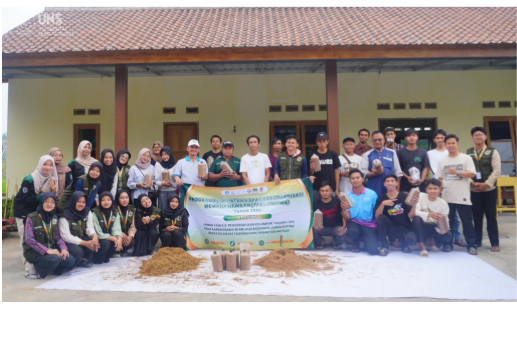
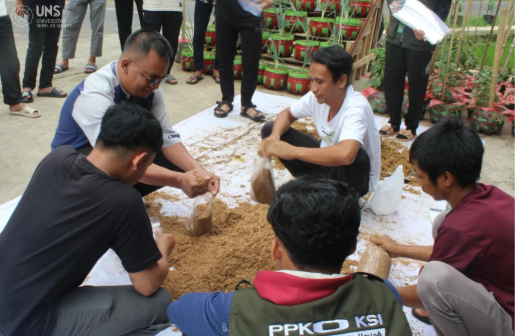
In 2025, the PPK Ormawa KSI team from the Faculty of Agriculture at UNS developed the Jamur Tani 5.0 program in Karangbangun Village, Karanganyar Regency. The program focused on developing ear mushroom cultivation using a smart farming approach and utilizing rice husks as a growing medium. It provided rural communities with access to knowledge and technology for alternative food production. The educational and mentoring activities were provided free of charge, allowing community members to gain knowledge and skills in mushroom cultivation without paying participation fees.
Through development activities and mentoring, the program introduced mushroom cultivation techniques and the use of agricultural waste as a productive resource. This approach connects cultivation knowledge with local resource management while creating opportunities for communities to diversify food production.
Jamur Tani 5.0 supports food security by introducing alternative food production and expanding community skills in mushroom cultivation. Using rice husks also aligns with sustainable agriculture principles by reducing waste and increasing the value of locally available materials. In this way, the program expands free access to knowledge and technology for local food producers and could strengthen cultivation businesses suited to local village conditions.
Sources:
Conclusion
Through these seven activities, Universitas Sebelas Maret expanded access to knowledge, skills, and technology for farmers, farmer groups, women’s farmer groups, and communities involved in local food production in 2025. The activities covered environmentally friendly farming training, organic vegetable cultivation, IoT-based precision agriculture, smart farming, agricultural waste utilization, and aquaponics systems that integrate agriculture and aquaculture.
These programs demonstrate UNS’s approach to connecting academic knowledge and technological innovation with the practical needs of local communities. Through information sessions, training, demonstrations, and mentoring, farmers and local food producers gained opportunities to improve their skills, adopt more sustainable production methods, and make better use of resources available in their local environments.
Overall, these activities strengthen food security, expand access to knowledge on sustainable agriculture and aquaculture, and improve the capacity of local food producers. By providing these activities free of charge, UNS helps ensure that local communities can access relevant knowledge, skills, and technology without financial barriers. These efforts support Sustainable Development Goal 2 (SDG 2): Zero Hunger, particularly its focus on improving food security and promoting sustainable food production systems.