

17.2.4 Collaboration For SDG Best Practice
International Collaboration and Research for SDG Best Practices
Universitas Sebelas Maret (UNS) engages in international collaboration and research to review comparative approaches and develop international best practices for tackling the Sustainable Development Goals (SDGs). Throughout 2025, UNS carried out various collaborative research activities with international universities and research institutions. These activities involved cross-country data collection and analysis, empirical studies, field observations, and the exchange of research findings to identify effective approaches to sustainable development challenges.
Through these collaborations, UNS goes beyond academic exchange and knowledge sharing by actively examining how different countries and institutions address sustainability issues. By comparing policies, practices, and research findings across contexts, UNS helps identify effective approaches and develop solutions that can be adapted and applied in other settings. These efforts address a wide range of SDG-related issues, including environmental protection, food systems, sanitation, biodiversity, social inclusion, and sustainable urban development. They also strengthen SDG 17 (Partnerships for the Goals) by building international research networks, sharing expertise, and promoting joint action toward common sustainable development objectives.
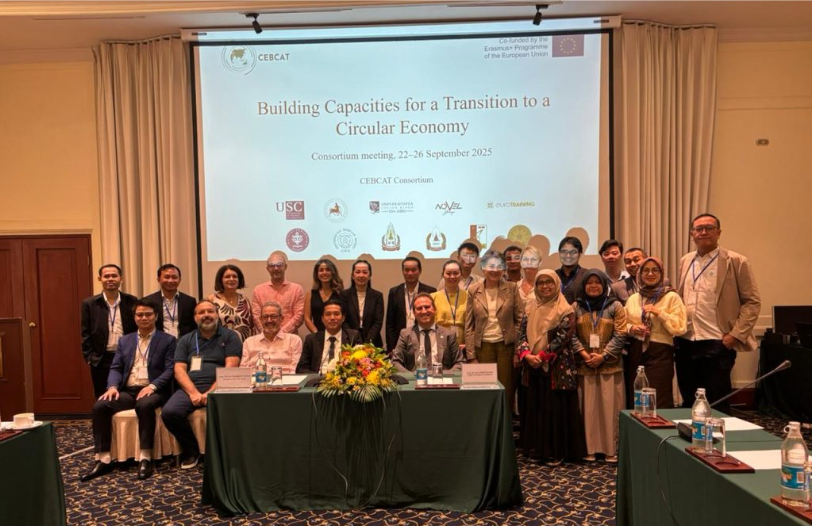
1. CEBCAT: Perbandingan Pendekatan Ekonomi Sirkular di Asia dan Pengembangan Praktik Pembelajaran Berkelanjutan
2. ASEAN-5 Research on Sustainability Committees and Corporate Carbon Performance
UNS participated in international collaborative research examining the role of sustainability committees in improving corporate carbon performance across the ASEAN-5 region. The study involved researchers from Indonesia and Malaysia and analyzed 1,033 firm-year observations from Indonesia, Malaysia, Singapore, Thailand, and the Philippines. The research provided empirical evidence on how sustainability governance mechanisms operate across different national contexts.
The study reflects a comparative approach by examining the effectiveness of sustainability committees across countries, while accounting for differences in national contexts, industry characteristics, and emission types. The findings showed that sustainability committees were more clearly associated with increased emissions disclosure than with actual emissions reductions. This suggests that the same governance mechanism may produce different outcomes depending on the context in which it is implemented.
These comparative findings provide useful lessons for developing international best practices in sustainability governance and carbon management. The study highlights the need to strengthen the capacity and authority of sustainability committees so their roles extend beyond improving transparency and emissions disclosure to driving measurable emissions reductions. Such evidence-based recommendations can help improve sustainability governance practices across different national and corporate settings.
Through international collaboration and research, UNS helps identify more effective approaches to sustainability governance that can inform companies and policymakers in other countries. The research directly supports SDG 13 (Climate Action) and SDG 12 (Responsible Consumption and Production), while strengthening SDG 17 (Partnerships for the Goals) through cross-country research collaboration and knowledge exchange.
3. International Research on Community-Based Adaptation for Marine Microplastic Management
UNS, through researchers from the Environmental Science Study Program at the Faculty of Mathematics and Natural Sciences, collaborated with Universitas Pertamina, Universiti Teknologi PETRONAS in Malaysia, and National Dong Hwa University in Taiwan on a study titled “Exploratory Factors in Community-Based Adaptation Strategies for Managing Marine Microplastics.” Conducted in 2025, the research combined expertise and perspectives from several countries to identify factors that influence community participation in marine microplastic management.
The study used exploratory factor analysis, cluster analysis, and logistic regression to examine different approaches to community-based environmental management. It identified five key factors: asset integration, responsive flexibility, coordinated systems, knowledge-based empowerment, and stakeholder activation. Through this approach, the research not only examined marine microplastic pollution but also analyzed mechanisms to improve community involvement in environmental management.
The findings were used to develop a framework that can be transferred to other contexts as a set of best practices for community-based adaptation. Factors such as coordinated systems and stakeholder activation highlight the importance of coordination and active stakeholder involvement in improving community participation. Other regions facing marine pollution challenges can adapt these lessons to strengthen community-based environmental management.
This collaboration demonstrates how UNS uses international collaboration and research to review comparative approaches and develop transferable lessons that can be applied in other contexts as international best practice. The research supports SDG 14 (Life Below Water) through improved marine microplastic management and contributes to SDG 11 (Sustainable Cities and Communities) by strengthening community resilience and participation.
4. Indonesia–Taiwan Collaboration on Digital Twins for Marine Debris Management
UNS collaborated with Universitas Tanjungpura, Universitas Negeri Medan, Universitas Pertamina, and National Dong Hwa University in Taiwan on research titled “Enhancing Community Engagement with Digital Twins: Technological Adoption in Marine Debris Management.” The study examined the application of digital twin technology in marine debris management and community engagement in Bali, particularly in Denpasar, Badung, Gianyar, and Tabanan.
The research reviewed different approaches to environmental management by connecting community participation mechanisms with digital technology. Using Structural Equation Modeling (SEM) and a community resilience framework, the study analyzed risk perception, planning capability, coping ability, and interest level. The findings identified several approaches to strengthening community preparedness, including campaigns and workshops to improve risk awareness, action plans and task forces to strengthen planning capacity, and real-time technology to improve responses to environmental challenges.
The research findings provide transferable approaches for integrating technology, community participation, and environmental decision-making. Digital twin technology can support monitoring, predictive analysis, and the simulation of different management strategies before they are implemented. These approaches can serve as useful references for governments, planners, and communities in other regions facing similar marine debris challenges.
Through Indonesia–Taiwan international collaboration and research, UNS contributes to developing international best practices in technology-based environmental management. The approaches developed support SDG 14 (Life Below Water), SDG 11 (Sustainable Cities and Communities), and SDG 13 (Climate Action). This research demonstrates how international research collaboration can turn knowledge exchange and comparative approaches into practical solutions for sustainability challenges.
5. International Research on Clean Energy Transition and Climate Change Mitigation
UNS, through the Faculty of Economics and Business, collaborated with researchers from Universiti Tenaga Nasional in Malaysia, DEPECOS Research Center, British Canadian University in Nigeria, and the University of Calabar on an international study titled “Economic Growth, Climate Change and Clean Energy in a Post-COVID Era.” Published in 2025, the research examined the relationships between clean technology, renewable energy, electric vehicles, clean fuels, renewable electricity generation, economic growth, and climate change.
The study used international data from the World Development Indicators (WDI) and the Generalized Method of Moments (GMM) method to analyze the relationships between clean energy technology adoption, economic development, and climate change. Using cross-country data enabled a comparative analysis of different development conditions and energy transition approaches. Collaboration among researchers from Indonesia, Malaysia, and Nigeria also brought together perspectives on the challenges of energy transition in developing countries.
The findings provide relevant lessons for developing international best practices in clean energy transition and climate change mitigation. The study highlights the importance of adopting electric vehicles, cleaner fuels, renewable energy, and energy-efficient technologies to reduce emissions and support sustainable development. These lessons can serve as references for countries and institutions facing similar challenges in balancing economic growth with climate mitigation goals.
This research demonstrates UNS’s contribution through international collaboration and research by reviewing cross-country evidence and identifying relevant approaches to clean energy transition. It primarily supports SDG 13 (Climate Action) and SDG 7 (Affordable and Clean Energy), while also contributing to related goals concerning health, sustainable cities, and environmental protection.
Conclusion
These five examples demonstrate a consistent approach: UNS uses international collaboration and research to review comparative approaches from different countries, identify successful practices and challenges, and translate research findings into frameworks, strategies, learning modules, recommendations, and solutions that can be adapted to other contexts.
The scope of these collaborations also reflects the diversity of best practices developed through UNS’s international research activities. These include circular economy education, sustainability governance and carbon management, community-based marine microplastic management, digital technology for marine debris management, and clean energy transition and climate change mitigation.
Through these efforts, UNS goes beyond participating in international academic networks. It actively contributes to developing international best practices for tackling the SDGs by conducting collaborative research, learning from different national experiences, and developing transferable solutions. These partnerships also strengthen SDG 17 (Partnerships for the Goals) by promoting international research networks, sharing knowledge and expertise, and encouraging collective action to address global sustainability challenges.