

17.2.3 International Collaboration Data Gathering for SDG
International Collaboration in Gathering and Measuring Data for the Sustainable Development Goals
Universitas Sebelas Maret (UNS) participates in international collaborations to gather and measure data for the Sustainable Development Goals (SDGs). Throughout 2025, UNS engaged in collaborative research with international universities and research institutions involving the collection of primary data, biological samples, surveys, field observations, spatial mapping, environmental measurements, interviews, and focus group discussions.
These collaborations show that UNS’s international partnerships extend beyond knowledge exchange and academic activities to include directly collecting and measuring data to generate empirical evidence on sustainable development challenges. The collected data support a better understanding of environmental conditions, food systems, sanitation, biodiversity, social inclusion, and urban development, addressing various SDG-related issues.
1. International Collaboration in Data and Sample Collection for Native Poultry Sustainability
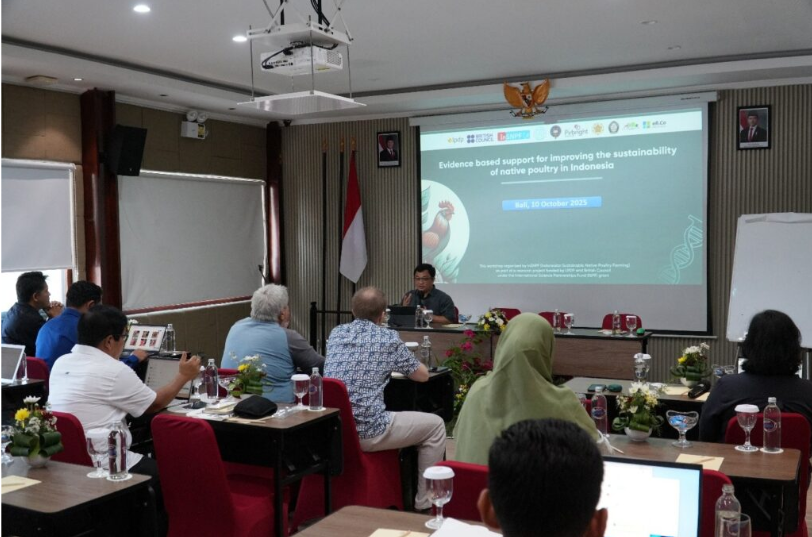
In 2025, a research team from the Center for Research and Development of Biotechnology and Biodiversity (P3BB), Institute for Research and Community Service (LPPM), and the Faculty of Animal Science at UNS, led by Prof. Adi Ratriyanto, conducted an international research collaboration with Prof. Adrian Smith from the Department of Biology, University of Oxford, and Dr. Steven Fiddaman from the Pirbright Institute, United Kingdom. The collaboration was carried out through a project titled “Evidence-Based Support for Improving the Sustainability of Native Poultry in Indonesia,” funded by the International Science Partnership Funds (ISPF) from the British Council and LPDP. The research maps the phenotypic and genetic diversity of native poultry in the Wallacea region based on geographical and cultural factors.
A key component of this research was the gathering of data and biological samples through field activities. Eleven recent graduates from partner universities were trained as professional enumerators to support data and sample collection. Within approximately three months, around 90% of the targeted data and samples had been collected. This demonstrates that UNS’s international collaboration involved systematic primary data and sample collection, rather than being limited to knowledge exchange or joint academic activities.
The data collection process was supported by a collaborative network involving UNS, the University of Oxford, the Pirbright Institute, partner universities in Indonesia, the National Research and Innovation Agency (BRIN), and local government stakeholders. A project workshop held in Bali on October 10, 2025, also provided a forum to gather additional information on the characteristics and conditions of native poultry farming in different regions involved in the research.
The collected phenotypic, genetic, geographical, and contextual data provide a basis for understanding the sustainability of local poultry genetic resources, food system resilience, and sustainable livelihoods. This activity therefore demonstrates UNS’s participation in international collaboration on gathering data for the SDGs, particularly those related to SDG 2 (Zero Hunger), SDG 8 (Decent Work and Economic Growth), and SDG 15 (Life on Land). Through this partnership, UNS and its international research partners contribute complementary expertise and jointly generate evidence to support sustainable food systems and biodiversity conservation. This also reflects the importance of global partnerships in addressing shared development challenges.
Beyond its contribution to food security and biodiversity conservation, this research also supports SDG 17 (Partnerships for the Goals) by strengthening international research cooperation between UNS, the University of Oxford, and the Pirbright Institute. Through this partnership, the institutions combine their scientific expertise, research resources, and fieldwork capacity to gather and analyze data on native poultry diversity. The involvement of Indonesian universities, research institutions, and local government stakeholders further demonstrates how international and domestic partnerships can work together to generate evidence for sustainable development.
Source:
2. International Collaboration in Gathering and Measuring Community Sanitation Data
UNS participated in an international research collaboration with National Dong Hwa University (NDHU), Taiwan, through a study titled “Adaptive Governance in the Water-Energy-Food-Ecosystem Nexus for Sustainable Community Sanitation.” The research examines adaptive governance within the water, energy, food, and ecosystem nexus to support sustainable community sanitation. Published in 2025, the study provides empirical evidence on sanitation practices and community engagement in environmental sustainability.
The research explicitly involved gathering primary data through structured questionnaires. The collected data were processed and analyzed using quantitative methods, including binary probit and binary logit models, to identify factors influencing adaptive capacity and community participation in sanitation practices. Therefore, this collaboration did not merely discuss SDG-related issues at a conceptual level; it also involved data collection and measurement through systematic research instruments.
The data collection and measurement generated empirical evidence on community conditions and the factors influencing public participation in sanitation management. The involvement of an international partner from Taiwan strengthened the international collaboration. At the same time, the use of primary data and quantitative analysis demonstrated a clear process of measuring data better to understand sustainable development challenges at the community level.
The research directly supports SDG 6 (Clean Water and Sanitation) and contributes to broader sustainability issues related to SDG 11 (Sustainable Cities and Communities) and SDG 13 (Climate Action). The UNS–NDHU collaboration demonstrates how international research partnerships can support the gathering, measurement, and analysis of primary data for the SDGs. By combining research expertise across institutions, the partners contribute to evidence-based approaches to improving community sanitation and environmental governance.
The collaboration also contributes to SDG 17 (Partnerships for the Goals) by promoting international cooperation in research and knowledge sharing between UNS and National Dong Hwa University. By combining institutional expertise and research approaches, the partnership strengthens the capacity to gather, measure, and analyze community-level data. This cooperation shows how international academic partnerships generate reliable evidence to address shared challenges in water management and sustainable sanitation.
3. International Collaboration in Gathering Data on Water Quality, Plastic Pollution, and Public Spaces
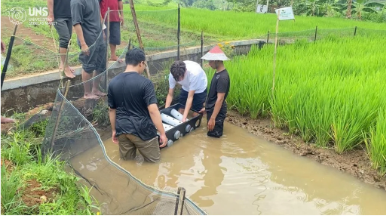
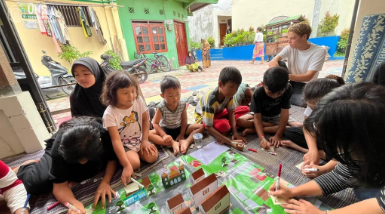
From August to December 2025, the Urban-Rural Design and Conservation (URDC) Laboratory, Architecture Study Program, Faculty of Engineering, UNS, collaborated with three students from Rotterdam University of Applied Sciences, the Netherlands, on research addressing environmental quality, water systems, plastic pollution, and public spaces in Surakarta. This international collaboration involved students and UNS academics in field-based research that generated various types of environmental and social data.
The activities used several data-gathering and measurement methods. Research on plastic pollution in the Sumber River and Bengawan Solo River used high-resolution drone technology and thousands of aerial photographs to map waste accumulation points. Another study on canal water quality in Gentungan Village used QGIS mapping, social surveys, and chemical water quality testing at four locations. These methods generated data to identify pollution sources and provide an empirical understanding of local water quality conditions.
The collaboration also involved social data collection through field observations and three focus group discussions (FGDs) involving children, parents, community members, and UNS Architecture students. These activities were conducted as part of research on improving child-friendly public spaces in Kampung Blangkon. Through these methods, the international collaboration generated various types of data, including environmental measurements, spatial data, survey results, observational data, and community-based qualitative information.
The collected and measured data support a better understanding of water quality, plastic pollution, environmental management, urban resilience, and public space quality. This activity demonstrates UNS’s participation in international collaboration to gather and measure data on SDG-related challenges, particularly those associated with SDG 6 (Clean Water and Sanitation), SDG 11 (Sustainable Cities and Communities), and SDG 13 (Climate Action). By combining international academic expertise with local knowledge and field-based research, the partnership strengthens collaborative efforts to address environmental and urban sustainability challenges.
This collaboration also supports SDG 17 (Partnerships for the Goals) by connecting international academic expertise with local research activities and community participation. Through cooperation between Rotterdam University of Applied Sciences and UNS’s URDC Laboratory, the research combines international perspectives, technical methods, and local knowledge to gather environmental and social data. The involvement of residents and community members further strengthens multi-stakeholder cooperation in generating evidence for sustainable water management, pollution control, and inclusive urban development.
4. International Collaboration in Gathering Data on Disability Inclusion
UNS also conducted an international research collaboration with Universiti Malaya, Malaysia, through a study on disability inclusion through social and digital entrepreneurship in ASEAN. The 2025 research used a comparative case study approach in Indonesia and Malaysia, including Rumah Harapan Mulya in Indonesia and GOLD (Generating Opportunities for Learning Disabled) in Malaysia. The collaboration was supported through the UNS International Collaboration Research Scheme.
The research involved gathering primary data through in-depth semi-structured interviews and field observations. The team collected data in both national contexts and analyzed them thematically to identify patterns related to disability inclusion, social and digital entrepreneurship, and economic participation. This cross-country comparative approach enabled UNS and its international partner to generate empirical evidence from different social and institutional contexts.
Through this primary data collection, the international collaboration generated information on the barriers and opportunities people with disabilities face in participating in social and economic activities. This shows that UNS’s international collaboration went beyond academic exchange and included gathering and analyzing data to address development challenges related to equality and social inclusion.
The research primarily supports SDG 10 (Reduced Inequalities) through its focus on disability inclusion and equal participation, as well as SDG 8 (Decent Work and Economic Growth) through its examination of entrepreneurship and economic participation. This activity demonstrates UNS’s participation in international collaboration to gather SDG data through comparative research and field-based data collection with an international academic partner. The partnership also shows how institutions from different countries can combine their expertise and research perspectives to address shared social development challenges.
This research also contributes to SDG 17 (Partnerships for the Goals) by strengthening cross-border academic cooperation between UNS and Universiti Malaya. Through a comparative study across Indonesia and Malaysia, both institutions contribute their research expertise and perspectives to gather and analyze data on disability inclusion. This partnership demonstrates how international research cooperation can generate comparative evidence and shared knowledge to address inequalities and support inclusive economic participation across different national contexts.
Conclusion
These international research collaborations also demonstrate UNS’s contribution to SDG 17 (Partnerships for the Goals) through strengthened international partnerships, research cooperation, knowledge sharing, and joint evidence generation. By working with universities and research institutions across different countries, UNS combines institutional expertise, research capabilities, and local knowledge to gather and measure data addressing shared sustainable development challenges. The involvement of domestic institutions, government stakeholders, and local communities further reflects the importance of multi-stakeholder partnerships in supporting sustainable development.
Through these collaborative efforts, UNS contributes to the global development agenda by strengthening international research networks and generating empirical evidence to support progress toward SDG 2, SDG 6, SDG 8, SDG 10, SDG 11, SDG 13, and SDG 15, while reinforcing the role of SDG 17 as an enabling framework for international cooperation and evidence-based sustainable development.