
SDG 6 In Number
Volume of water used in the university: Inbound (treated/extracted water) (m³)
60,056
Campus population
31,279
6.5.3 Off-Campus Water Conservation Support
UNS Community-Based Initiatives for Sustainable Water Conservation Beyond the Campus
Universitas Sebelas Maret (UNS) actively supports practical off-campus water conservation through community service programs, student engagement, and institutional collaboration with local communities. Throughout 2025, UNS implemented several initiatives to promote sustainable water resource management beyond the university campus. These initiatives focused on improving rainwater infiltration, reducing surface runoff, promoting rainwater harvesting, and strengthening community awareness and participation in water conservation practices.
Through these programs, UNS provides practical support by introducing appropriate technologies, delivering environmental education, and encouraging local residents to help implement and maintain water conservation facilities. These efforts contribute directly to SDG 6 by promoting sustainable water management, improving rainwater utilization, supporting groundwater recharge, and strengthening community capacity to conserve local water resources.
Community-Based Water Conservation Initiatives in 2025
UNS implemented the following initiatives to support practical water conservation beyond its campus boundaries:
1. Application of Biopore Infiltration Technology in Bumi Graha Indah Residential Area, Karanganyar
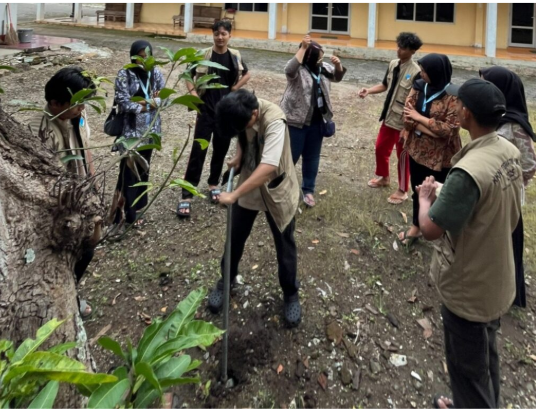
In September 2025, a community service team from the Faculty of Mathematics and Natural Sciences (FMIPA) UNS implemented biopore infiltration technology in the Bumi Graha Indah (BGI) Residential Area, Jaten, Karanganyar. The initiative aimed to improve rainwater infiltration, reduce surface runoff, and address waterlogging in the residential area. The team installed 20 biopore infiltration holes at strategic locations, including gardens, residential yards, and small drainage channels. The program also included site surveys, community awareness sessions, practical training, and field evaluations.
Monitoring results showed that average waterlogging depth decreased from 8.05 cm to 2.98 cm, a reduction of about 63%. The duration of waterlogging also decreased from more than two hours to less than one hour. Through practical training and community involvement, UNS encouraged residents to independently maintain and expand the biopore facilities. This initiative demonstrates direct institutional support for practical, off-campus water conservation through improved rainwater infiltration, reduced surface runoff, and enhanced groundwater recharge, contributing to sustainable water resource management under SDG 6.
References:
2. Community Empowerment through Mosque-Based Rainwater Harvesting in Sukoharjo
In 2025, UNS, through a community service team from the Faculty of Engineering, conducted a community empowerment program on sustainable clean water supply through mosque-based rainwater harvesting at the Mitra Shobirin Foundation in Palur Village, Mojolaban, Sukoharjo. The initiative introduced rainwater harvesting (RWH) as an alternative water source and promoted practical water conservation within the local community. Activities included educational sessions, discussions, and information on collecting rainwater from mosque rooftops, filtering it, and storing it for non-drinking uses.
The program increased the community’s understanding of water conservation and the potential of rainwater as an alternative water source. It also encouraged local residents and mosque administrators to develop similar systems independently and promote more efficient water use within their community. By supporting rainwater-harvesting education and community participation in sustainable water resource management, UNS demonstrated its commitment to practical off-campus water conservation. This initiative contributes to SDG 6 by promoting alternative water resources, responsible water use, and community-based approaches to sustainable water management.
3. Rainwater Infiltration Improvement through Biopore Installation by KKN 37 UNS in Bulurejo
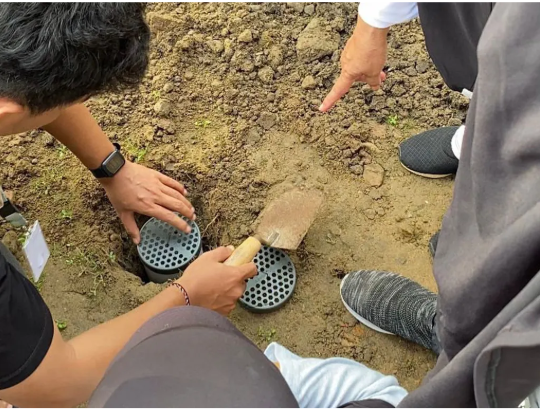
In February 2025, students from UNS Community Service Program (KKN) Group 37 carried out a program titled “Socialization and Installation of Biopore Holes to Improve Rainwater Infiltration” in three hamlets in Bulurejo Village: Gunungduk, Mendungsari, and Cinet. The initiative aimed to improve rainwater absorption into the soil, reduce surface water accumulation, and promote the use of organic waste through biopore technology. The team installed 58 biopore holes across the three hamlets, providing practical water conservation facilities directly within the community.
The program combined technical implementation with environmental education and active community participation. Through this initiative, UNS supported practical off-campus water conservation by promoting rainwater infiltration, reducing surface runoff, and encouraging sustainable management of local water resources. These efforts contribute to SDG 6 by strengthening community awareness and participation in protecting water resources and improving local rainwater management.
4. Tree Planting and Biopore Installation to Reduce Flooding in Sukoharjo
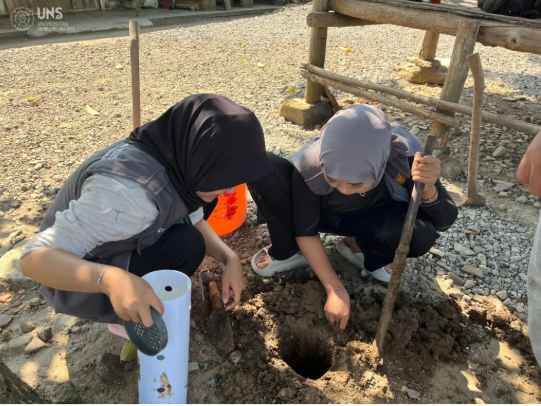
In July–August 2025, students from UNS Community Service Program (KKN) Group 203 initiated a community-based environmental conservation program in Brenggalan Hamlet, Sukoharjo. The activities included planting sengon trees and installing biopore infiltration holes to improve rainwater absorption, reduce surface runoff, and help prevent local flooding. By combining vegetation-based conservation with practical rainwater infiltration facilities, the initiative encouraged sustainable water management at the neighborhood level.
The program demonstrated UNS’s off-campus support for practical water conservation through direct environmental interventions and student-community engagement. These activities support SDG 6 by promoting rainwater infiltration, protecting local water resources, and encouraging sustainable water management practices within the community.
Conclusion
Through these four initiatives, Universitas Sebelas Maret demonstrates its institutional commitment to supporting practical water conservation off campus. By implementing biopore infiltration technology, promoting rainwater harvesting, planting vegetation, and engaging local communities, UNS improves rainwater management, reduces surface runoff, and strengthens community awareness of sustainable water resource management.
These initiatives demonstrate UNS’s contribution to SDG 6 through practical interventions, community empowerment, and the promotion of sustainable water conservation practices beyond the university campus. By working directly with local communities, UNS helps strengthen local capacity to protect water resources, improve rainwater utilization, and support the long-term availability and sustainable management of water.