
SDG 11 In Number
University expenditure (IDR)
1.550.122.866.706
University expenditure on arts and heritage (IDR)
20.280.022.432
11.2.2 Public Access to UNS Library
Providing Public Access to Knowledge, Books, and Publications

The Universitas Sebelas Maret (UNS) Library, located in Surakarta, Indonesia, serves as an academic and public learning facility that supports education, research, and literacy. As part of its commitment to expanding access to knowledge, UNS provides public access to library facilities, books, publications, and selected digital resources. These services help students, lecturers, researchers, alumni, and the general public access information and build their knowledge.
1. Library Collections and Information Resources
The UNS Library provides a wide range of printed and digital information resources to support learning and research. Users can explore more than 209,000 print titles through the UNS Library Online Catalog (UNSLA): https://unsla.uns.ac.id/.
The library also provides access to e-books, e-journals, and international academic databases, including Scopus, ScienceDirect, Emerald, and Springer, through UNS EZproxy (https://ezproxy.uns.ac.id/), subject to applicable access permissions.
To support open access to academic knowledge, the library maintains an institutional repository containing scholarly works, including theses, dissertations, and research publications, available through https://digilib.uns.ac.id. Its Subject Guide (https://library.uns.ac.id/subject-guide/) helps users identify relevant academic publications and research resources. The library also publishes Jurnal Pustaka Ilmiah, which facilitates scholarly discussions on library science, information management, and digital technology.
In addition, the library provides specialized facilities through its Disability Corner, including Braille materials, audio-support software, and wheelchairs to promote accessible, inclusive learning.
2. Membership and Public Access
The UNS Library provides public access to its books, publications, electronic collections, and learning facilities through several access arrangements. In addition to serving university staff and students, the library extends its services to alumni, students from partner universities, and members of the general public. The library provides public access through free online resources, external membership registration, and limited on-site access to printed and electronic collections.
- Automatic Free Access
The UNS Library provides free public access to selected electronic collections and educational resources without requiring registration. These resources include:
- UNS Library Subject Guide: Provides guidance for identifying and accessing relevant academic resources (https://library.uns.ac.id/subject-guide/).
- E-learning: Offers online learning resources without registration.
- Open Access Collections: Provides selected academic and informational publications curated by UNS Library staff (https://library.uns.ac.id/open-access/).
- Literacy Center: Provides access to literacy-related information and learning resources without registration (https://library.uns.ac.id/literacy-center/).
These resources allow the public to access selected knowledge resources independently and free of charge.
- Access Upon Registration
The UNS Library also provides free access to its institutional repository through online registration. The repository contains electronic theses and dissertations, research outputs, and local content, allowing registered users to explore academic publications and research produced at UNS.
External membership is also available to alumni and students from universities participating in the Forum Kerja Sama Perpustakaan Perguruan Tinggi Negeri (FKP2TN). UNS alumni can register free of charge by presenting their UNS alumni identification card, while students from FKP2TN member universities can obtain a Kartu Sakti for IDR 15,000, valid for three months (90 days), by presenting a student ID card from their home university. These membership arrangements provide eligible external users with access to the library’s printed collections and study spaces.
- Access in Some Circumstances
Members of the general public can access the UNS Library through two visitor membership options:
- Kartu Kunjung (Visitor Card): A one-day visitor pass with a registration fee of IDR 5,000.
- Kartu Baca (Reading Card): A one-month (30-day) reading pass with a registration fee of IDR 25,000.
Applicants must present a valid identification document, such as a national identity card (KTP), driver’s license (SIM), or passport.
External members holding a Kartu Sakti, Kartu Kunjung, or Kartu Baca can access all printed library collections for on-site reading. However, they may not borrow printed materials. They can also use designated study spaces within the library.
In addition, external members may obtain limited access to electronic resources for up to seven days through an additional registration process. To activate this access, users must visit the Self-Access Terminals (SAT) room and present their valid membership card to library staff.
This arrangement allows members of the public to access printed books and publications directly while providing limited opportunities to explore the library’s electronic resources.
3. Community Engagement and Literacy Programs
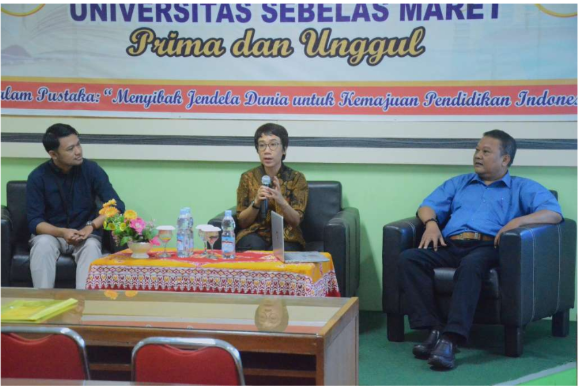
The UNS Library actively engages the wider community through educational workshops and literacy programs that promote knowledge sharing and preserve cultural heritage. On June 25, 2025, the library organized a workshop entitled “Dari Tulis ke Digital: Menggali Nilai-nilai Budaya melalui Warisan Tulis” (From Writing to Digital: Exploring Cultural Values through Written Heritage). The event brought together 50 participants from various universities, government institutions, and cultural communities across Central Java and the Special Region of Yogyakarta.
The workshop featured cultural preservation experts who discussed the role of digital technology in documenting, studying, and preserving written cultural heritage. Topics included using artificial intelligence (AI) and Natural Language Processing (NLP) to explore cultural texts, preserving historical printed collections and manuscripts, and digitizing cultural materials to support wider access to knowledge. The interactive discussion also gave participants opportunities to exchange experiences and explore potential collaborations in cultural preservation.
Through this initiative, the UNS Library extends its role beyond providing books and publications by facilitating public learning, strengthening literacy, and encouraging collaboration among educational institutions and cultural organizations. These efforts support Sustainable Development Goal (SDG) 11: Sustainable Cities and Communities by preserving cultural heritage, promoting inclusive access to knowledge, and strengthening community engagement in safeguarding cultural resources for future generations.
Conclusion
Overall, through its public library services, accessible information resources, and community-based literacy initiatives, the UNS Library demonstrates its commitment to making knowledge more accessible beyond the university community. By combining access to books and publications with opportunities for public learning, cultural exchange, and collaboration, the library serves as an inclusive learning hub that supports lifelong learning and cultural heritage preservation. These contributions reinforce UNS’s commitment to SDG 11 by fostering informed, inclusive, and culturally sustainable communities.
References: