17.2.4 Collaboration For SDG Best Practice
UNS Collaboration for SDG Best Practice
As part of its contribution to the global sustainable development agenda, Universitas Sebelas Maret (UNS) is strongly committed to actively building international research collaborations that review comparative approaches and develop best practices to support the achievement of the Sustainable Development Goals (SDGs).
- International Conference on “The Role of Soil in Overcoming the Global Environmental Crisis and Realizing Sustainable Agriculture”
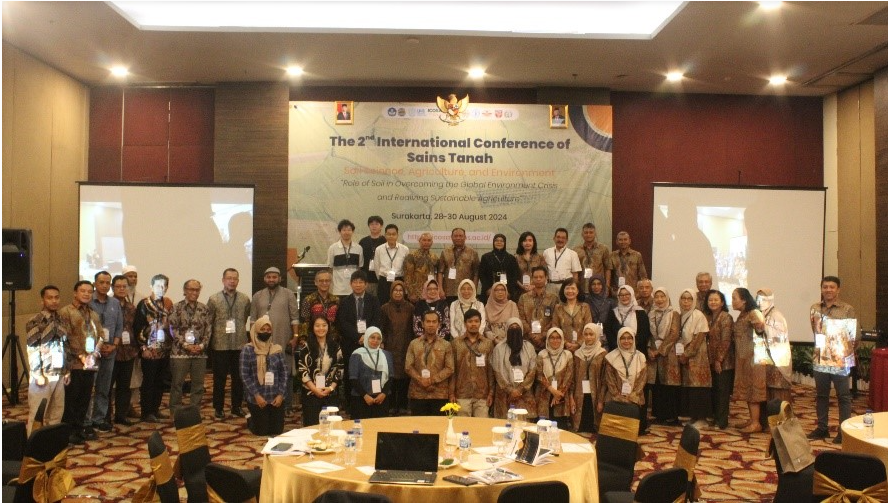
Demonstrating its commitment to advancing Sustainable Development Goal (SDG) 2 to end hunger, achieve food security and improved nutrition, and promote sustainable agriculture, UNS organized an International Conference on August 28, 2024, themed “The Role of Soil in Overcoming the Global Environmental Crisis and Realizing Sustainable Agriculture.”
The conference exemplified international collaboration for SDG best practice, bringing together global experts and institutions such as the FAO, Wageningen University & Research (The Netherlands), The University of Sydney (Australia), Universiti Putra Malaysia, Tohoku University (Japan), Hungarian University of Agriculture and Life Sciences, and The University of the South Pacific.
This event provided a comparative platform for researchers and practitioners to exchange knowledge, review approaches, and develop international best practices in tackling sustainability challenges related to agriculture and the environment. Discussions focused on four key areas:
-
- Strategies to reduce greenhouse gas emissions;
- Best practices in soil and water conservation;
- Identification and remediation of soil contamination; and
- Inspirational initiatives from organizations such as Tunas Hijau Foundation, Sekolah Alam Lembah Harau, and Tropenbos Indonesia, which have consistently championed environmental sustainability.
Source: https://www.hiti.or.id/the-2nd-international-conference-of-sains-tanah-icosata-2024/
- “Exploring the Role of Sustainability Committees in Carbon Performance: Evidence From ASEAN-5 for Good or for Worse?”
UNS, through its lecturer from the Faculty of Economics and Business, took part in an international research collaboration with Universitas Airlangga (Indonesia) and Universiti Teknologi Malaysia. This collaboration resulted in a publication titled “Exploring the Role of Sustainability Committees in Carbon Performance: Evidence From ASEAN-5 for Good or for Worse?” (John Wiley & Sons, 2025).
The study analyzed 1,033 company observations from five ASEAN countries (Indonesia, Malaysia, Singapore, Thailand, and the Philippines) to compare the roles of sustainability committees in improving corporate carbon performance. The findings indicate that these committees are more effective in promoting transparency in emission disclosure than in achieving actual emission reduction, particularly in environmentally sensitive industries.
This research contributes to international best practices by highlighting the need to strengthen the capacity and authority of sustainability committees to ensure real progress in emission reduction. Through this collaborative study, UNS supports SDG 12 (Responsible Consumption and Production) and SDG 13 (Climate Action).
Source : https://onlinelibrary.wiley.com/doi/abs/10.1002/csr.70079
- “Economic Growth, Climate Change and Clean Energy in a Post-COVID Era”
Researchers from UNS’s Faculty of Economics and Business collaborated with Universiti Tenaga Nasional (Malaysia), DEPECOS Research Centre (Nigeria), British Canadian University (Nigeria), and University of Calabar (Nigeria) in the international publication “Economic Growth, Climate Change and Clean Energy in a Post-COVID Era” (EconJournals, 2025).
Using global data from the World Development Indicators (WDI) and applying the Generalized Method of Moments (GMM), the study examined how clean energy technologies can reduce the impacts of climate change and promote sustainable development. The results show that adopting renewable-based electric vehicles, eco-friendly fuels, and energy-efficient equipment can significantly reduce carbon emissions and household energy consumption.
The findings contribute to global best practices in clean energy transition and climate change mitigation, supporting SDG 3 (Good Health and Well-being), SDG 6 (Clean Water and Sanitation), SDG 9 (Industry, Innovation, and Infrastructure), SDG 11 (Sustainable Cities and Communities), SDG 13 (Climate Action), SDG 14 (Life Below Water), and SDG 15 (Life on Land).
Read the full article (PDF)
https://www.econjournals.com/index.php/ijeep/article/view/17169/8712
- “Evaluating factors influencing community readiness for post-mining environmental development strategies”
UNS collaborated with National Dong Hwa University (Taiwan) and Universitas Pertamina (Indonesia) in an international research project titled “Evaluating Factors Influencing Community Readiness for Post-Mining Environmental Development Strategies.”
The study employed a mixed-methods approach, combining structured questionnaires, exploratory factor analysis, and logistic regression, to evaluate the influence of company resource management, environmental governance, community capacity building, and demographic factors on community readiness for environmental development following mining activities.
Results show that while corporate resource management aims to provide benefits, it can also create economic dependency that lowers communities’ readiness to support new development strategies. The research provides valuable insights into international best practices, highlighting how companies and stakeholders can design interventions that enhance readiness, reduce dependency, and promote active community participation in sustainable environmental development. The study supports the achievement of SDG 11 (Sustainable Cities and Communities), SDG 12 (Responsible Consumption and Production), and SDG 13 (Climate Action).
Read the full article (PDF)
https://www.sciencedirect.com/science/article/pii/S0301479724018097
- “Advancing the 2030 Agenda with Community Importance-Performance Perspective and Public Relations Strategies for Community-Based Sanitation”
In 2024, UNS researchers from the Environmental Science Program collaborated with Universitas Pertamina, Universitas Kristen Indonesia, and National Dong Hwa University (Taiwan) to publish “Advancing the 2030 Agenda with Community Importance-Performance Perspective and Public Relations Strategies for Community-Based Sanitation.”
The study examined how community engagement and public relations strategies can enhance the effectiveness of sanitation programs in the Komodo District. Using Importance-Performance Analysis (IPA), the research identified sanitation priorities and proposed a practical framework that combines community input with effective communication strategies.
Findings underscore the importance of fostering trust and collaboration with local communities to enhance participation and acceptance of sanitation programs. The resulting framework can be adapted across regions and countries, directly contributing to international best practices that support SDG 6 (Clean Water and Sanitation).
Read the full article (PDF)
https://www.sciencedirect.com/science/article/pii/S2666188825002011
- “Exploratory factors in community-based adaptation strategies for managing marine microplastics”
Researchers from the Environmental Science Program, Faculty of Mathematics and Natural Sciences (FMIPA) UNS, collaborated with Universitas Pertamina (Indonesia), Universiti Teknologi PETRONAS (Malaysia), and National Dong Hwa University (Taiwan) in a study titled “Exploratory Factors in Community-Based Adaptation Strategies for Managing Marine Microplastics” (Elsevier, 2025).
Using exploratory factor analysis, cluster analysis, and logistic regression, the research identified key factors influencing community participation in marine microplastic management in Jakarta. Five main determinants emerged: asset integration, responsive flexibility, coordinated systems, empowerment through knowledge, and stakeholder activation.
Among them, coordinated systems and stakeholder activation were found to be the most significant in improving community participation. These findings underscore the significance of community-based adaptation strategies and provide a transferable framework for best practices to support SDG 14 (Life Below Water) and SDG 11 (Sustainable Cities and Communities).
Read the full article (PDF)
https://www.sciencedirect.com/science/article/pii/S2352485525000064
- “Enhancing community engagement with digital twins: Technological adoption in marine debris management”
UNS also collaborated with Universitas Tanjungpura, Universitas Negeri Medan, Universitas Pertamina, and National Dong Hwa University (Taiwan) in the international publication “Enhancing Community Engagement with Digital Twins: Technological Adoption in Marine Debris Management” (2025).
The research examined how digital twin technology can support marine debris management in Bali (Denpasar, Badung, Gianyar, Tabanan) using Structural Equation Modeling (SEM). The study analyzed four factors within a community resilience framework: risk perception, planning capability, coping ability, and interest level.
Results show that improving risk perception through campaigns and workshops, strengthening planning capability via action plans and task forces, and applying real-time technology-based coping mechanisms significantly increase community readiness to adopt digital twins. Active community participation also plays a vital role in supporting this innovation.
This research contributes to international best practices in integrating advanced technology into community-based environmental management. Through this Indonesia–Taiwan collaboration, the study provides transferable comparative approaches and policy implications that support SDG 14 (Life Below Water), SDG 11 (Sustainable Cities and Communities), and SDG 13 (Climate Action).
Read the full article (PDF)
https://www.sciencedirect.com/science/article/pii/S2226585625000536
Conclusion
Through these six international collaborative studies, UNS demonstrates its strong commitment and consistent contribution to producing high-quality international publications. More importantly, UNS plays a strategic role in developing and sharing best practices for achieving the Sustainable Development Goals (SDGs) through evidence-based international collaboration and research.