
SDG 5 In Number
Number of women starting a degree
6.489
Number of first-generation women starting a degree
4.113
Number of students starting a degree
9.032
Number of first-generation students starting a degree
6.205
Number of students
27.604
Number of employees
3.760
Number of academic staff
1.950
Number of senior academic staff
685
Number of female senior academic staff
303
Number of graduates by subject area (STEM, Medicine, Arts & Humanities / Social Sciences): Total
6.192
Number of graduates: STEM
1.905
Number of graduates: Medicine
627
Number of graduates: Arts & Humanities / Social Sciences
3.660
Number of female graduates by subject area (STEM, Medicine, Arts & Humanities / Social Sciences): Total
4.353
Number of female graduates: STEM
1.244
Number of female graduates: Medicine
301
Number of female graduates: Arts & Humanities / Social Sciences
2.808
Number of graduates: Total
6.192
5.3.1 Tracking Access Measures
Systematic Monitoring of Women’s Access to Higher Education through Gender-Disaggregated Student Data
Universitas Sebelas Maret (UNS) systematically measures and tracks women’s enrollment, acceptance, and registration rates through its digital Student Analytics Dashboard, which provides gender-disaggregated student data to support institutional monitoring, evaluation, and evidence-based decision-making. This system helps the university monitor gender representation in its student population and assess whether access to higher education is equitable for women and men.
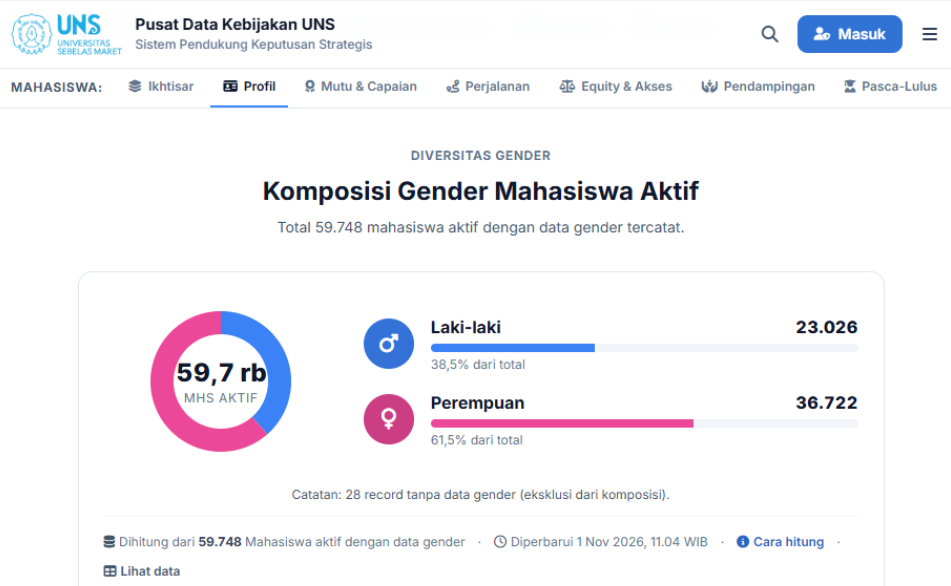
Through the Student Profile page (https://analitik.uns.ac.id/mahasiswa/profil), UNS systematically monitors the gender composition of its active student population. The dashboard shows that female students represent 61.5% of the total active student population, compared to 38.5% male students, providing an overview of women’s participation and representation in higher education at UNS.
These figures provide measurable evidence of women’s participation and representation in higher education at UNS. Regularly updated data enables the university to track changes in gender representation and evaluate access patterns over time.
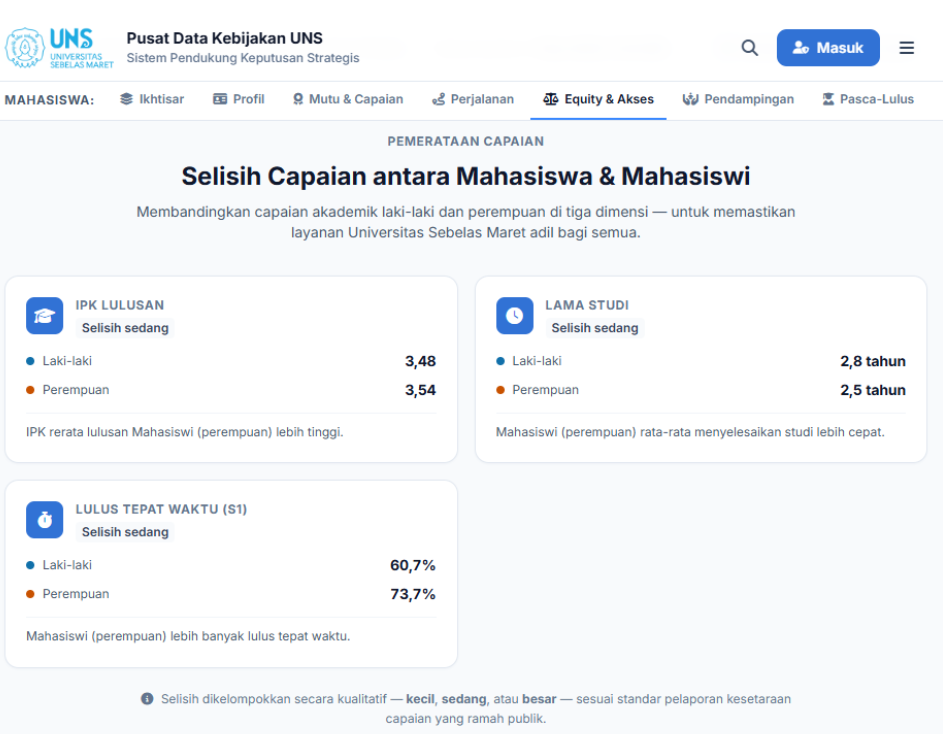
Furthermore, the Equity & Student Access page (https://analitik.uns.ac.id/mahasiswa/equity) provides additional information to assess gender equity in students’ academic experiences and educational outcomes. The dashboard compares male and female students across several dimensions, including graduates’ average GPA, study duration, and on-time graduation rates. The latest data show that female graduates have a higher average GPA (3.54 compared to 3.48 for males), a shorter average study duration (2.5 years compared to 2.8 years), and a higher on-time graduation rate (73.7% compared to 60.7%). These comparisons allow UNS to identify gender-related differences and monitor whether educational opportunities and academic outcomes are equitable.
By maintaining an integrated, regularly updated system of gender-disaggregated data, UNS strengthens its capacity to measure and track women’s participation in higher education, evaluate gender equity in student access, and support data-informed institutional policies. These efforts contribute to Sustainable Development Goal 4 (Quality Education) by promoting inclusive and equitable access to higher education, ensuring equal educational opportunities for women and men, and supporting successful learning outcomes for all students.
Sources: