
SDG 5 In Number
Number of women starting a degree
6.489
Number of first-generation women starting a degree
4.113
Number of students starting a degree
9.032
Number of first-generation students starting a degree
6.205
Number of students
27.604
Number of employees
3.760
Number of academic staff
1.950
Number of senior academic staff
685
Number of female senior academic staff
303
Number of graduates by subject area (STEM, Medicine, Arts & Humanities / Social Sciences): Total
6.192
Number of graduates: STEM
1.905
Number of graduates: Medicine
627
Number of graduates: Arts & Humanities / Social Sciences
3.660
Number of female graduates by subject area (STEM, Medicine, Arts & Humanities / Social Sciences): Total
4.353
Number of female graduates: STEM
1.244
Number of female graduates: Medicine
301
Number of female graduates: Arts & Humanities / Social Sciences
2.808
Number of graduates: Total
6.192
5.6.7 Track Women’s Graduation Rate
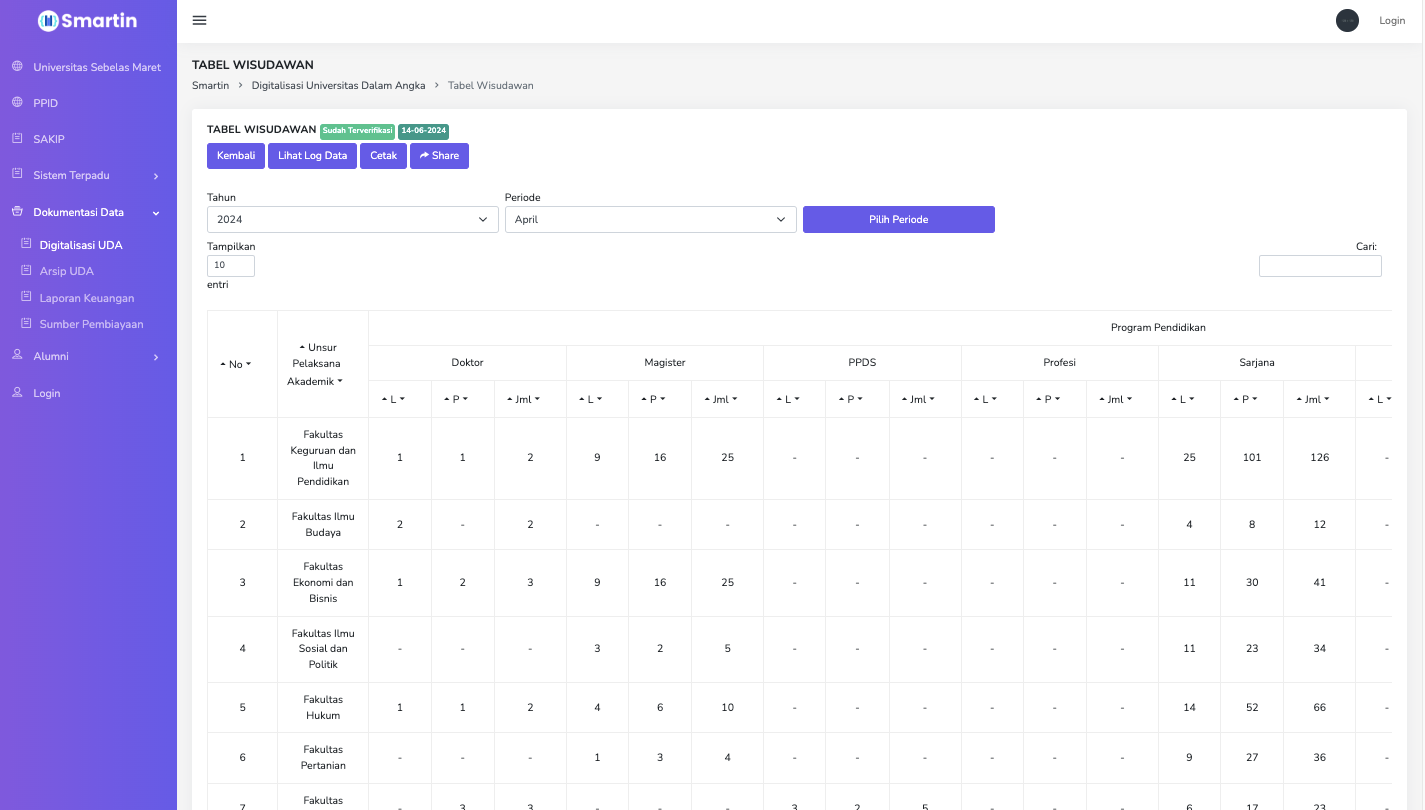
Gender-Based Graduation Monitoring through SMART-IN at UNS
Universitas Sebelas Maret (UNS) demonstrates a strong commitment to gender equality by systematically monitoring student graduation data based on gender through the platform. SMART-IN (Smart Integrated System UNS) This system contains digitalized data on graduates from all faculties, from diploma to doctoral levels, which is officially verified by the UNS Academic and Student Affairs Bureau every month.
This system allows universities to monitor graduation trends between female and male students systematically and transparently. This serves as a basis for evaluating equal access and academic success in the academic environment. By monitoring this data, UNS can identify any gender disparities in graduation rates and design policy strategies to improve academic success for disadvantaged groups.
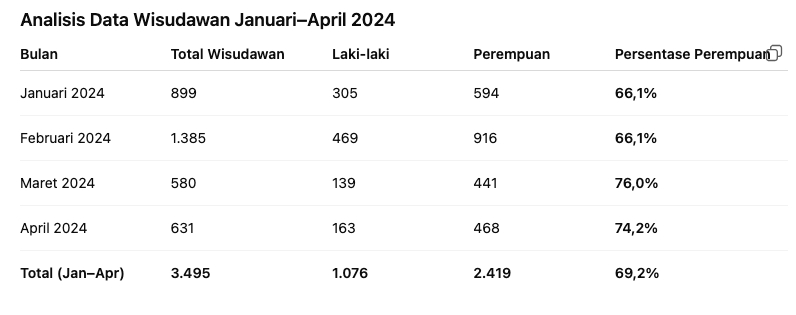
From the data above, it can be seen that during the period from January to April 2024, the number of female graduates consistently exceeds that of male graduates across all faculties and levels of education. The percentage of female graduates reached 69.2%, showing that female students not only have high participation rates but also significant study completion rates.
This trend also indicates that there is no significant gap in graduation chances between male and female students. Even in several faculties, such as Teaching and Education, Cultural Sciences, and Medicine, the number of female graduates far exceeds that of male graduates.
Systematic monitoring through SMART-IN is a real step by UNS in realizing the indicators.SDG 5 (Gender Equality), especially the measurement or tracking of women’s likelihood of graduating compared to men’s. With this data-driven tracking system, universities can identify the ratio of male to female graduates at each graduation period, develop data-driven policies to maintain equal academic participation, and provide public transparency regarding their achievements in promoting gender equality in higher education.
Source : https://smartin.uns.ac.id/digitalisasi-uda/wisudawan?tahun=2024