
SDG 5 In Number
Number of women starting a degree
6.489
Number of first-generation women starting a degree
4.113
Number of students starting a degree
9.032
Number of first-generation students starting a degree
6.205
Number of students
27.604
Number of employees
3.760
Number of academic staff
1.950
Number of senior academic staff
685
Number of female senior academic staff
303
Number of graduates by subject area (STEM, Medicine, Arts & Humanities / Social Sciences): Total
6.192
Number of graduates: STEM
1.905
Number of graduates: Medicine
627
Number of graduates: Arts & Humanities / Social Sciences
3.660
Number of female graduates by subject area (STEM, Medicine, Arts & Humanities / Social Sciences): Total
4.353
Number of female graduates: STEM
1.244
Number of female graduates: Medicine
301
Number of female graduates: Arts & Humanities / Social Sciences
2.808
Number of graduates: Total
6.192
5.3.2 Policy for women applications and entry
The issue of gender equality in higher education remains a challenge, particularly during the application and admission stages. To address this, Sebelas Maret University (UNS) has taken concrete steps through Rector’s Regulation No. 18 of 2024 concerning Independent Selection for New Student Admissions for Diploma and Undergraduate Programs. This regulation aims to regulate new student admissions based on the principles of transparency, fairness, and equal access. UNS has also a Circular Letter Number: 81.4/UN27/HK.06/2024 concerning Anti Discrimination. This letter containing measures for the prevention and handling of all forms of discrimination within the university environment, while promoting equality in all campus activities for the entire academic community, regardless of gender, economic background, disability status, region of origin, country of origin (including developing nations), or minority identity based on ethnicity, religion, race, culture, or other groups.
The output of this policy is clear student admissions procedures and fair selection standards, with admission requirements free from gender discrimination. The expected outcomes are an increase in the number of female applicants and students in various study programs, a more balanced gender distribution, and the elimination of the perception that gender is a barrier to access to higher education.
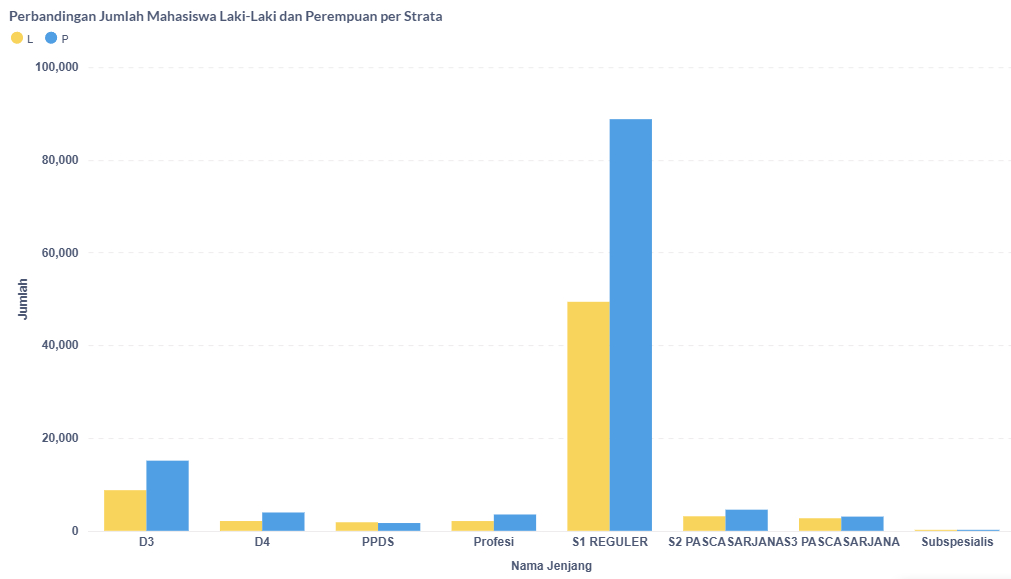
Based on comparative data on the number of male and female students at various educational levels, it is clear that female students constitute a significant proportion at all levels. This demonstrates that the application, admission, and participation processes at UNS are gender-neutral and provide equal opportunities for women to access higher education.
Moving forward, UNS plans to monitor application data by gender each academic year, evaluate any imbalances, and adjust quotas or support programs for prospective female students as needed. If faculties or study programs are identified with significant gender disparities, interventions will be implemented through special outreach, affirmative action policies, or revised admission criteria to be more inclusive. Furthermore, information campaigns and outreach to schools, especially in remote areas, will be strengthened to inform women from diverse backgrounds about opportunities to access UNS.
The following are UNS’s formal policies that ensure equal opportunities for women in the application, admission, and participation process at the university:
SDG 5 Indicator
Women's Progress Measures
|
Title of Regulation |
Link |
Summary of Regulation |
Relevant Articles |
|
Law Number 20 of 2003 on the National Education System (Sisdiknas Law) |
https://peraturan.bpk.go.id/details/43920/uu-no-20-tahun-2003 |
This law affirms that every citizen has the right to receive quality education without discrimination. It regulates the educational pathway from primary to higher education, establishes the state’s obligation to guarantee equal access, and mandates a minimum allocation of 20% of the national and regional budgets (APBN/APBD) for education. Therefore, the Sisdiknas Law serves as a national legal foundation to ensure equal access to education, including for women, in entering and participating in higher education. |
Article 4 paragraph (1) states that education shall be conducted democratically, fairly, and without discrimination, while upholding human rights, religious values, cultural diversity, and national pluralism. |
|
Law Number 12 of 2012 on Higher Education |
https://peraturan.bpk.go.id/Details/39063/uu-no-12-tahun-2012 |
This law emphasizes that higher education institutions must provide education that is democratic, equitable, and free from discrimination. It regulates various aspects, including the structure and function of higher education institutions, academic freedom, the three pillars of higher education (education, research, and community service), student admission systems, curriculum, lecturers and educational staff, funding, and quality assurance. |
Article 6 letter (b) emphasizes the principles of justice, democracy, and non-discrimination in the implementation of higher education. |
|
Rector’s Regulation of Universitas Sebelas Maret Number 18 of 2024 |
This regulation governs the mechanism for the Independent Selection of New Students for Admission to Diploma and Undergraduate Programs. |
|
|
|
Circular Letter Number: 81.4/UN27/HK.06/2024 concerning Anti Discrimination |
A circular letter containing measures for the prevention and handling of all forms of discrimination within the university environment, while promoting equality in all campus activities for the entire academic community, regardless of gender, economic background, disability status, region of origin, country of origin (including developing nations), or minority identity based on ethnicity, religion, race, culture, or other groups |