

SDG 1 In Number
Number of student 2024
27.604
Number of low income students receiving financial aid
20.353
1.4.4 Policy Addressing Poverty
UNS’ Active Role in Policy-Making for Poverty Eradication
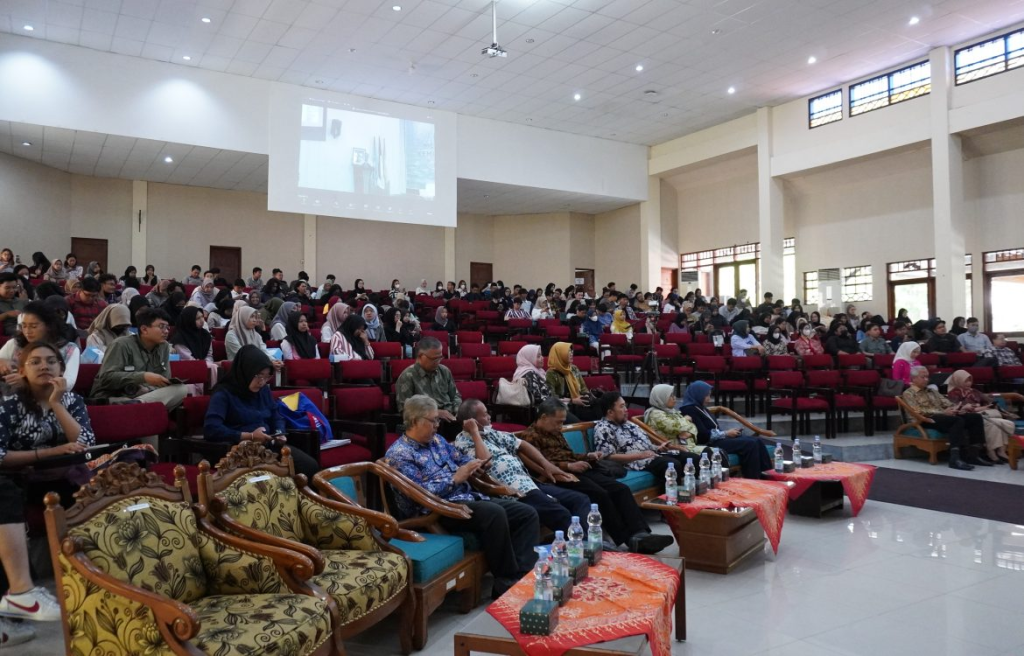
Universitas Sebelas Maret (UNS) actively contributes to the policy-making process on poverty eradication at both the national and local levels. This commitment was demonstrated through the Academic Forum “Towards the Elimination of Extreme Poverty by 2024”, held on 27 September 2023 at the Faculty of Economics and Business, UNS.
The event brought together the Ministry of Human Development and Cultural Affairs (Kemenko PMK) and the National Team for the Acceleration of Poverty Reduction (TNP2K) as representatives of the national government, as well as the Regional Development Planning Agency (Bappeda) of Surakarta City representing the local government. The forum served as a strategic platform for UNS to deliver research-based policy recommendations for the formulation of effective poverty alleviation policies at both national and local levels.
As a follow-up, a Memorandum of Understanding (MoU) was signed between Kemenko PMK and UNS, covering cooperation in education, research, and community service related to poverty reduction. Through this partnership, UNS is officially recognized as a government partner in implementing national programs for the elimination of extreme poverty while simultaneously strengthening local poverty reduction policies through collaboration with regional authorities
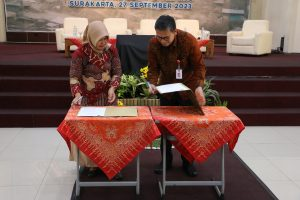
Through academic forums, public lectures, and collaborative workshops, UNS plays an active role not only as an academic institution but also as an active actor in policy-making at the local, regional, and national levels. These efforts support the achievement of SDG 1: No Poverty, which aims to end poverty in all its dimensions.
Level of Policy Involvement: Local / Regional / National
UNS’s policy engagement is backed by a strong body of research. Prof. Suwarto’s study on poverty dynamics among fishing communities provides an empirical foundation for regional poverty policies. Dr. Dwi Prasetyani and Dr. Lukman Hakim highlight the importance of social capital and institutional-geographical approaches in shaping inclusive strategies for Central Java. Dr. Luthfiyah Trini Hastuti offers policy insights on Islamic microfinance for primary needs financing, while Aris Arif Mundayat’s mapping of socio-economic problems in East Nusa Tenggara supports local government planning for poverty alleviation. Collectively, these studies demonstrate how UNS translates academic research into actionable public policy.