SDG 1 In Number
Number of student 2024
27.604
Number of low income students receiving financial aid
20.353
1.4.1 Local Start-Up Assistance
Local Start-Up Assistance
Universitas Sebelas Maret (UNS) consistently implements various initiatives to support the development of financially and socially sustainable local entrepreneurship. Through incubation programs, training, and mentoring, UNS plays an active role in facilitating the growth of start-ups that not only have strong business potential but also deliver positive social impacts on the community. These efforts are carried out in collaboration with the government, industry players, and other strategic partners to create an inclusive and sustainable entrepreneurship ecosystem.
At the center of these initiatives stands the UNS Innovation Hub, an officially registered business incubator recognized on the national incubation portal. This incubator functions as a development platform for entrepreneurs and the commercialization of research products into competitive start-ups and tenants. Through mentoring facilities, training workshops, access to industry networks, and intensive business assistance, the Innovation Hub acts as a key driver in creating sustainable and socially oriented new businesses.
All incubation services—such as mentoring, training, and access to facilities—are provided free of charge for start-ups selected through the incubation program, especially those led by students, researchers, and local entrepreneurs with social innovation ideas. However, for advanced start-ups seeking extended mentoring, co-working spaces, or customized business consultancy beyond the standard incubation package, paid service options are also available to ensure long-term financial sustainability of the program.
In 2024, several activities under the UNS Innovation Hub demonstrated UNS’s strong commitment to supporting new entrepreneurs, strengthening the capacity of local businesses, and promoting inclusive economic growth and job creation.
Demo Day: UNS Startup Academy X Ministry of Cooperatives and SMEs
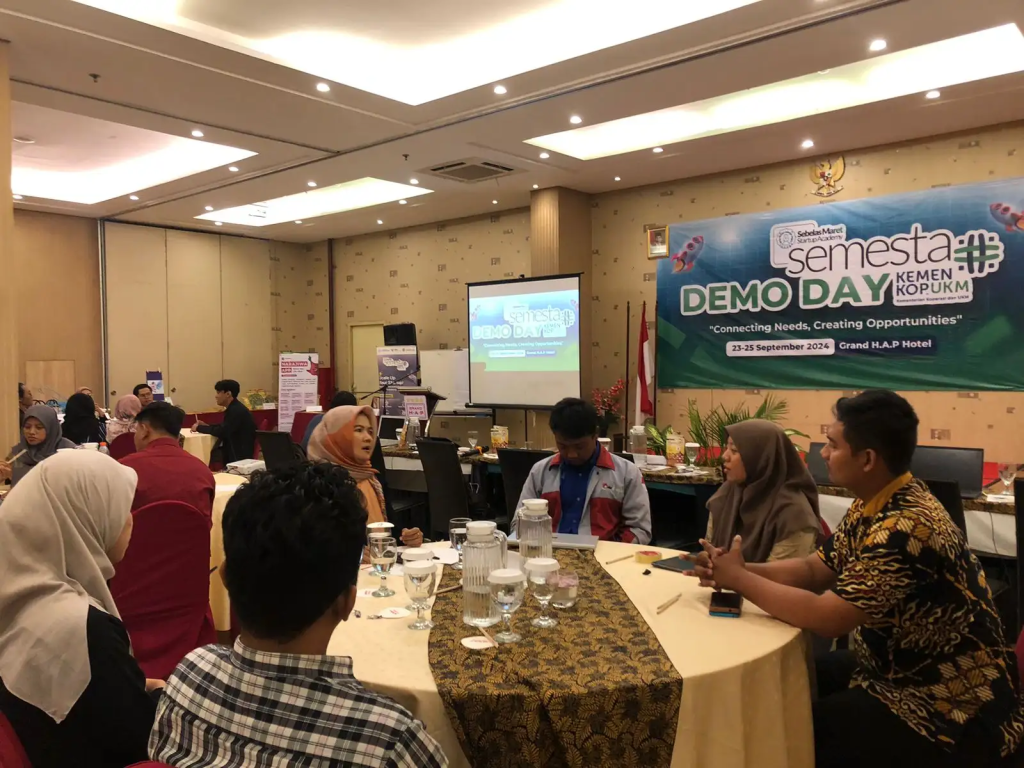
In response to the increasing economic inequality in Indonesia, where the Gini Index rose from 0.379 in March to 0.381 in September 2024, UNS continues to take concrete actions to help reduce disparities through local start-up empowerment. By strengthening the start-up ecosystem and connecting young entrepreneurs with investors, UNS contributes directly to SDG 1 (No Poverty) through job creation, MSME empowerment, and increased community income.
Through the Sebelas Maret Startup Academy, UNS collaborated with the Ministry of Cooperatives and SMEs of the Republic of Indonesia (Kemenkop UKM) to organize the Demo Day Startup Semesta at Grand HAP Hotel Solo on September 24, 2024. This event successfully connected 20 selected start-ups with several investors. As a result, nine start-ups officially received Letters of Intent (LoI) as a commitment to further cooperation.
This collaboration not only supports SDG 1 but also aligns with SDG 17 (Partnerships for the Goals) by promoting multi-sector synergy for community economic empowerment.
The Assistant Deputy of Kemenkop UKM, Christina Agustin A.Pi., M.M., opened the event and stated, “This Demo Day is the culmination of a series of incubation activities that began with open call selection, bootcamps, coaching clinics, and pitching sessions before the jury, reviewers, potential investors, and ministry representatives. Out of 100 start-ups that joined the selection, 20 were selected to present today.”
She also noted that Indonesia currently ranks sixth globally and first in Southeast Asia in the number of active start-ups, with 2,617 start-ups nationwide. Among them, 555 have been supported by Kemenkop UKM between 2021 and 2024, exceeding the government’s annual target of 500.
UNS Commitment to Local Entrepreneurship
Separately, UNS Rector, Prof. Dr. Jamal Wiwoho, S.H., M.Hum., emphasized the university’s commitment to nurturing start-ups. “UNS is committed to being a leading facilitator for both student and community start-ups. Through business incubation, access to research facilities, and industry networks, UNS ensures that innovations born within the university bring both economic and social benefits to society,” he said.
Meanwhile, the Coordinator of UNS Innovation and Startup Incubation, Khresna Bayu Sangka, added, “Our role is like stitching connections—we bring start-ups together with investors. We hope these collaborations will have a long-term impact on Indonesia’s start-up ecosystem.”
Investors attending the event included Pertamina, BNI Venture, HIPMI, KNPI, and representatives from the Surakarta City Office of Kemenkop.
Nine start-ups operating across various sectors—technology, modern agriculture, green business, and renewable energy—received Letters of Intent from investors. In the coming years, these start-ups are expected to create hundreds of direct and indirect job opportunities, strengthen local MSME supply chains, increase community income, and contribute to reducing poverty and income inequality.
Examples of Successful UNS-Supported Start-Ups
UNS has produced several successful incubated start-ups, including:
- Polimikro – renewable energy innovation using lithium batteries,
- Enerma – supplier of liquefied natural gas (LNG) for small industries,
- Lingkup – digital marketing consultancy,
- Garasi Juang – a cart rental platform for street vendors,
- SIAB (Siaga Air Bersih) – clean water management technology,
- Provita – water purification technology, and many others.
These start-ups have created numerous job opportunities while addressing local social and environmental challenges, aligning with UNS’s mission to promote socially responsible entrepreneurship.
Research and Knowledge Sharing
UNS’s academic contribution to this area is also reflected in research, such as the study titled “Do the Characteristics of Startup Founders Matter for Funding Performance?” published in the Journal of Indonesian Economy and Business (2024). The research highlights that founder characteristics significantly influence the success of start-ups in obtaining investor funding.
Additionally, through the UNS SDG Series 2024, the university disseminates research findings related to poverty reduction and inclusive economic growth, reinforcing its role in supporting evidence-based policymaking for sustainable development.
Looking ahead, UNS, through the Innovation Hub, plans to:
- Expand its incubation coverage and increase the number of supported start-ups each year,
- Strengthen collaboration with ministries, investors, and international partners, and
- Build a more research-driven and socially innovative start-up ecosystem.
These efforts reflect UNS’s continuous dedication to empowering the local community and contributing to the achievement of SDG 1 (No Poverty) and SDG 17 (Partnerships for the Goals) through sustainable entrepreneurship and inclusive economic development.
Sources:
https://mettanews.id/demo-day-sebelas-maret-startup-academy-x-kemenkop-9-bisnis-rintisan-jalin-kerjasama-dengan-investor/
https://bisnis.espos.id/semesta-kemenkop-ukm-fasilitasi-20-startup-soloraya-bertemu-investor-2005879
Training on Developing Digital Marketing through the Shopee Marketplace
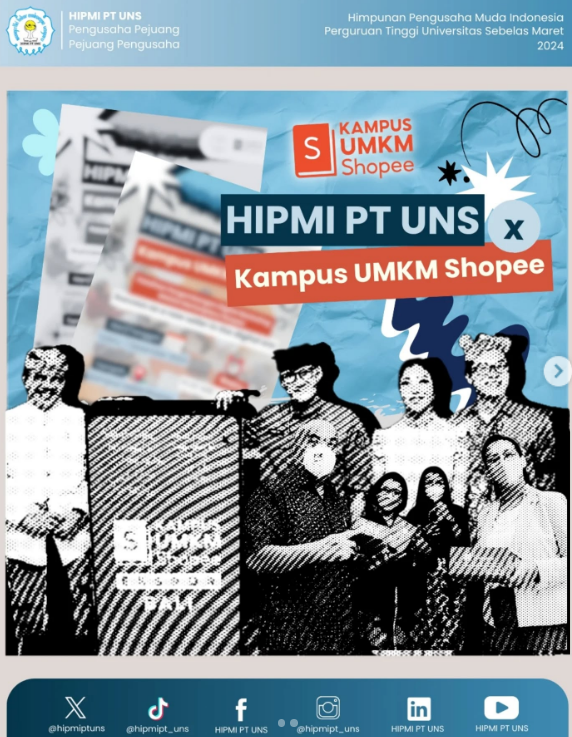
Students of Sebelas Maret University (UNS) who are members of the Himpunan Pengusaha Muda – Young Entrepreneurs Association (HIPMI) UNS, in collaboration with Shopee’s MSME Campus (Kampus UMKM Shopee), organized a training program for local start-ups across the Greater Solo region. The workshop focused on Developing Digital Marketing Strategies through the Shopee Marketplace and was held on December 7, 2024.
Source : https://www.instagram.com/p/DDEJuGtTZv-/
Integrating Entrepreneurship into the Curriculum
In addition to incubation programs, all undergraduate and vocational students at UNS are required to take a compulsory course titled Entrepreneurship (Kewirausahaan) with a credit load of 2 SKS. This course includes key materials such as business management, preparation of business proposals supporting the Student Creativity Program (Program Kreativitas Mahasiswa – PKM) and the Semesta program, as well as presentations on business ideas. It also introduces students to the process of developing and nurturing entrepreneurial ideas. The primary objective of this course is to equip students with entrepreneurial skills, encourage community participation in economic development, and contribute to addressing the issue of educated unemployment.
Beyond institutional incubation activities, research conducted by UNS academics also contributes to local entrepreneurship development. For instance, Prof. Dr. Ir. Suwarto, M.Si.’s study ‘“Intervensi dalam Pengembangan UMKM dan Implementasi Model Penciptaan Wirausaha Baru pada Masyarakat Miskin di Kabupaten Wonosobo,” demonstrates UNS’s commitment to empowering low-income communities through entrepreneurship training and mentoring. This community-based research complements UNS’s incubation programs by extending entrepreneurial impact to marginalized groups outside the university ecosystem.
Source : Mata Kuliah – Kewirausahaan