SDG 6 In Number
Volume of water used in the university: Inbound (treated/extracted water) (m³)
94.092
Campus population
31.364
6.5.4 Cooperation on Water Security
Cooperation with Local Government
- Embung Djowo Management by KKN UNS 230 Students in Ponowaren Village, Sukoharjo
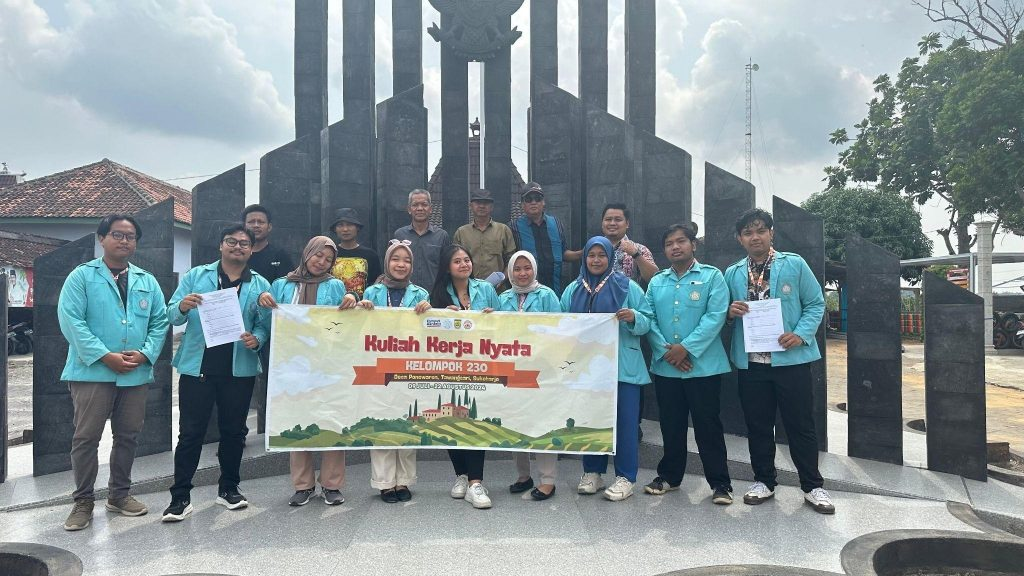
Sukoharjo, 1 August 2024 – Students from Universitas Sebelas Maret (UNS) participating in the KKN UNS 230 group actively took part in a village meeting in Ponowaren Village, Tawangsari, Sukoharjo. The activity focused on preparing a draft cooperation agreement for the management of Embung Djowo, a local water reservoir and an important source of water for the community. The presence of village officials, BUMDES, community leaders, and villagers highlights the importance of cooperation between UNS students and the local government in managing water resources.
The draft agreement was designed to provide a clear and fair legal basis for all parties involved in managing the reservoir. This activity ensures that the rights and responsibilities of each party are fulfilled properly, allowing for sustainable and equitable water management at Embung Djowo. In addition to governance, the meeting also served as a forum to discuss strategies for developing Embung Djowo as a tourist destination to enhance community welfare.
Through the village meeting and the preparation of the cooperation agreement, the KKN UNS 230 group demonstrates the university’s role in supporting local water security. The students contribute not only to water resource management but also help the village government and community to develop the reservoir sustainably.
- Clean Water Storage Tank Development by KKN UNS 203 in Sunggingan Village, Sragen
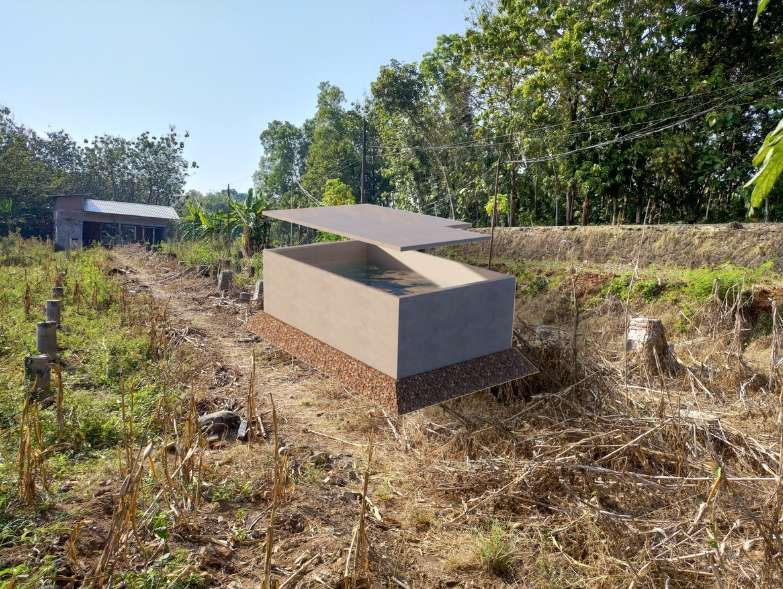
In August 2024, KKN UNS 203 students launched an important initiative by building a clean water storage tank in Sunggingan Village, Miri Subdistrict, Sragen Regency. This project, part of the “UNS Membangun Desa” program, aimed to improve rural living conditions by providing better access to clean water, especially during the dry season when the village faced serious water shortages.
The project involved close cooperation with the village government and active participation from local residents throughout the construction process. By engaging the community and coordinating with village authorities, the students ensured that the project addressed the village’s urgent water needs while promoting sustainable water management practices.
Through this initiative, KKN UNS 203 demonstrates the university’s commitment to supporting local water security. The clean water storage tank is expected to provide long-term benefits for the community, improving both health and overall well-being while strengthening local capacity to manage water resources effectively.
Source:
https://rri.co.id/daerah/934169/kkn-uns-bangun-tandon-air-bersih-di-desa-sunggingan
- Development and Management of Embung Songgo Langit by KKN UNS 158 in Poncol Village, Magetan
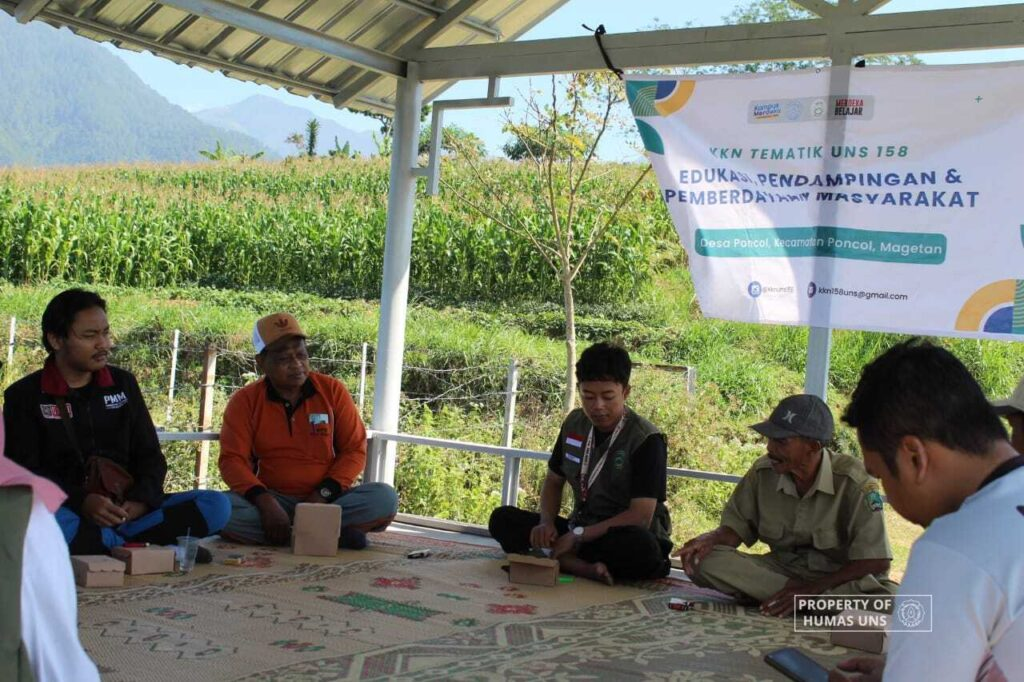
From July to August 2024, KKN UNS 158 students carried out a program to develop the potential of Embung Songgo Langit in Poncol Village, Magetan. The project, conducted under the guidance of Dr. Siti Khoiriyah, involved both physical improvements—such as access enhancements, signage, and area revitalization—and non-physical activities, including community awareness and training on the management of the embung. These efforts aimed to improve the sustainability of the embung as a water source for irrigation and groundwater recharge, while also enhancing its potential as a tourist destination.
The program was implemented in close cooperation with the village government, BPD, Karang Taruna, and local community groups. Students facilitated discussions, coordinated development plans, and ensured that all stakeholders were involved in the decision-making process, demonstrating effective collaboration between the university and local authorities.
Through this initiative, KKN UNS 158 highlights the role of higher education in supporting local water security. By improving the management and functionality of Embung Songgo Langit, the project contributes to sustainable water use, community engagement, and long-term benefits for the residents of Poncol Village.
Cooperation with Regional Government
- Empowering Communities for Water Ecosystem Management at Rawa Pening, Central Java
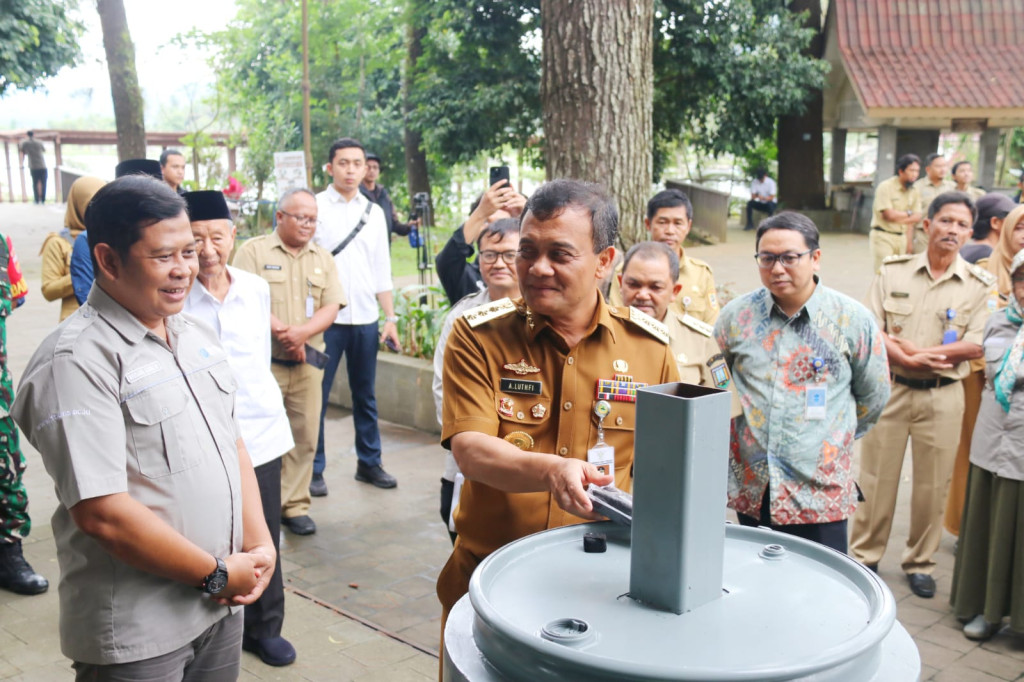
The Central Java Provincial Government, in collaboration with the Faculty of Engineering at Universitas Sebelas Maret (UNS) and Bank Jateng, has implemented a program to empower local communities in the Rawa Pening area, Semarang Regency. The initiative focused on transforming water hyacinth (Eichhornia crassipes), an invasive aquatic plant, into bio-briquettes and paving blocks. By providing training and processing equipment, the program aimed to reduce the overgrowth of water hyacinth while promoting sustainable use of local water resources.
This project involved close cooperation with the provincial government and local residents, enabling effective management of the regional water ecosystem. The Faculty of Engineering at UNS provided technical guidance, while the community received hands-on training to utilize water hyacinth as a valuable economic resource. The initiative demonstrates a practical approach to maintaining water quality and ecosystem stability in Rawa Pening.
Through this program, the collaboration highlights the university’s commitment to promoting regional water security. By combining environmental management with community empowerment, the project not only mitigates ecological risks but also provides long-term socio-economic benefits for the residents surrounding Rawa Pening.
Cooperation with National Government
- Partnership with the Ministry of Public Works and Housing (Kemen PUPR)
Universitas Sebelas Maret (UNS) has partnered with the Ministry of Public Works and Housing (Kemen PUPR) to construct a wastewater treatment plant (IPAL) on campus. The purpose of this collaboration is to manage domestic wastewater efficiently and sustainably. With this initiative, UNS has become the first university in Indonesia capable of independently managing its campus wastewater, setting a benchmark for higher education institutions nationwide.
Source:
https://uns.ac.id/id/uns-update/uns-berpotensi-jadi-kampus-percontohan-pengelolaan-limbah.html
- Collaboration with the Environmental Agency of Madiun Regency
In 2024, Universitas Sebelas Maret (UNS) collaborated with the Environmental Agency of Madiun Regency on the preparation of the Regional Environmental Management Performance Information Document (IKPLHD). This project involved comprehensive data collection, analysis, and reporting to improve governance and monitoring of environmental and water-related resources at the regional level, reflecting UNS’s commitment to supporting sustainable water management in line with national regulations.
Source:
https://b2b.integrasi.uns.ac.id/tampil-kerjasama/show/7845
- Maintenance of Wastewater Treatment Plant (IPAL) at UNS Hospital
UNS also collaborated with PT Kimia Jaya Utama to maintain the Wastewater Treatment Plant (IPAL) at UNS Hospital. This national-level partnership involves the private sector and ensures proper operation and management of hospital wastewater. The project not only meets environmental standards but also serves as a model for sustainable water and wastewater management practices within institutional settings.
Source:
https://b2b.integrasi.uns.ac.id/tampil-kerjasama/show/7507
Cooperation at Global Level
- UNS Participation in Wetskills Indonesia 2024
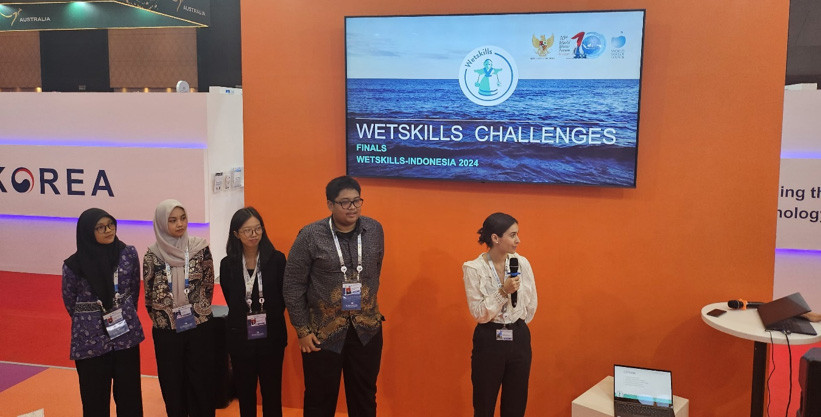
The Urban Rural Design and Conservation (URDC) Research Group and the Architecture Program at Universitas Sebelas Maret (UNS) participated in Wetskills Indonesia during the World Water Forum 2024, from May 11 to 23, 2024. This international program, coordinated by Wetskills Foundation based in The Hague, Netherlands, brought together students and young professionals from multiple countries and disciplines to address interdisciplinary water challenges. UNS collaborated with Universitas Islam Sultan Agung (UNISSULA), PDAM Tirta Moedal Semarang, BBWS, and international interns, including Carole Le du from Pantheon-Sorbonne University, France, demonstrating global-level cooperation in water security.
During the program, participants worked in three teams addressing distinct cases, including reusing wastewater from ablution (wudhu), compensation of water footprints, and environmental management in pesantren. Team 3 from UNS, led by Anindya Koeswanto, won the competition with a filtration system that recycles wudhu water for repeated ablution, irrigation, and fish ponds. This innovative solution highlights UNS’s commitment to sustainable water use and global knowledge exchange, while addressing the anticipated impacts of climate change on water scarcity.
Through this engagement, UNS demonstrates active participation in global networks for water security, combining research, practical solutions, and international collaboration to tackle water management challenges.
Sources:
https://ft.uns.ac.id/berita-pengumuman/rg-urdc-labo-arsitektur-ft-uns-ikuti-wetskills-indonesia-world-water-forum-2024-di-bali
https://wetskills.com/event/wetskills-indonesia-2024/
- UNS and Tzu Chi Sinarmas Initiative
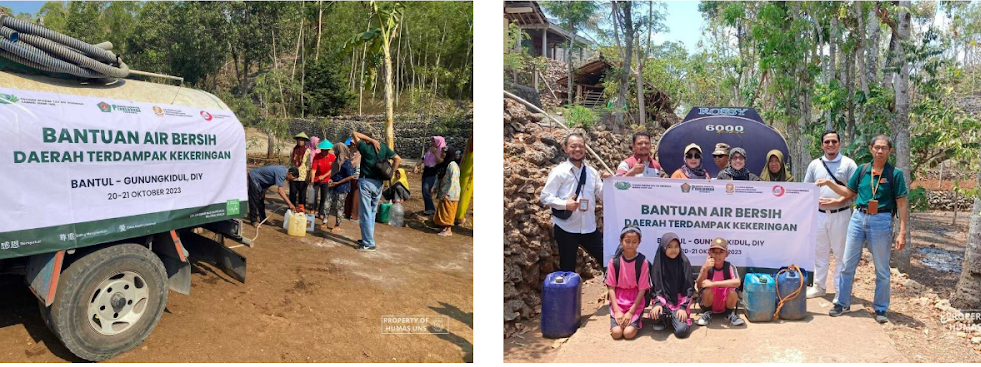
Tzu Chi Sinarmas Organization collaborated with the Alumni Family of the Faculty of Agriculture (KAFP) UNS to provide approximately 330,000 liters of clean water to several villages in Gunungkidul and Bantul, which were severely affected by drought. In Gunungkidul, water was distributed to two hamlets in Kenteng Village, Pojong District, and three hamlets in Keteng Village, Saptosari District, benefiting more than 1,000 households. In Bantul, clean water was provided to the Dusun Semuter community (Jatimulyo Village) and the Dusun Tangkit community (Muntul Village).
This initiative reflects UNS’s active role in global and humanitarian water security efforts, addressing urgent needs in communities facing water scarcity. By partnering with an international organization like Tzu Chi Sinarmas, UNS not only provides practical assistance but also demonstrates its commitment to social responsibility and the sustainable management of water resources.
RELEVANT RESEARCH
In 2024, UNS provided research and community service funding, focusing on SDG 6 topics, to achieve SDG 6: Ensure availability and sustainable management of water and sanitation for all. For example, the research “Allocation and Distribution of Water in the Colo Irrigation Area, Bengawan Solo” by RR. Ratri Werdiningtyas and “Vulnerability Reduction Planning Framework in Watershed: Responding to Climate Change and Rapid Urbanization in Urban Regions of Bengawan Solo River Basin” by Dr. Paramita Rahayu demonstrate collaboration with local and regional governments and stakeholders to enhance water security.