SDG 8 In Number
Number of employees
3.760
Number of academic staff
1.950
University expenditure (IDR)
1.850.122.866.706
Number of students
27.604
Number of students with work placements for more than a month
12.832
Number of employees on contracts of over 24 months
3.760
8.2.1 Employment practice living wage
Implementation of Decent Employment Practices and Living Wage at Universitas Sebelas Maret
Universitas Sebelas Maret (UNS) is committed to ensuring that all staff and faculty receive salaries that meet or exceed the local living wage, in accordance with government standards and the university’s internal regulations.
Policies and Official Regulations
UNS has several official regulations governing the payment of salaries and allowances for all staff and faculty
- Rector Regulation No. 52 of 2020 concerning the Main Provisions for Adjusting the Basic Salary of Permanent Non-Civil Servant Employees according to Rector Regulation No. 11 of 2017, into the Basic Salary of Permanent Non-Civil Servant Employees according to Rector Regulation No. 50 of 2020.
- Rector Regulation No. 2 of 2021 concerning Meal Allowances for UNS Non-Civil Servant Employees.
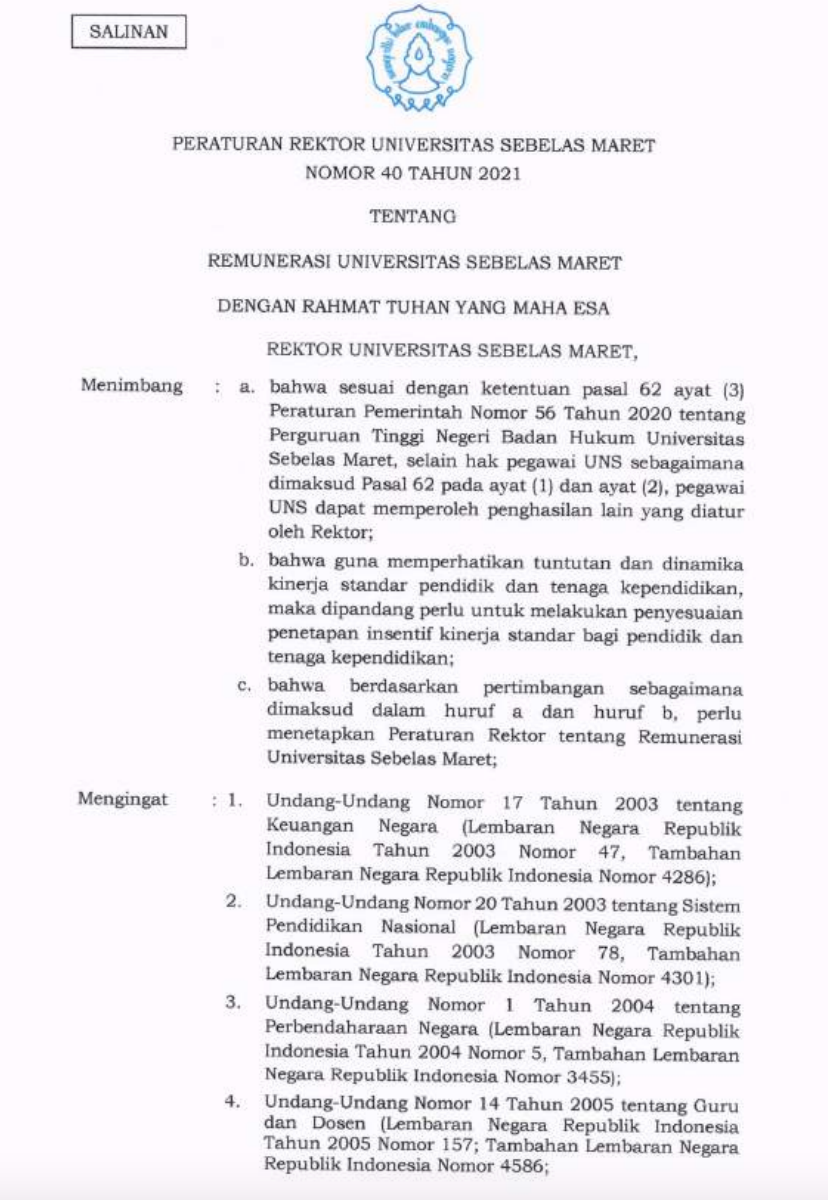
- Rector Regulation No. 40 of 2021 concerning Remuneration at Universitas Sebelas Maret.
Source : https://kantorhukum.uns.ac.id/detailDokumen/438
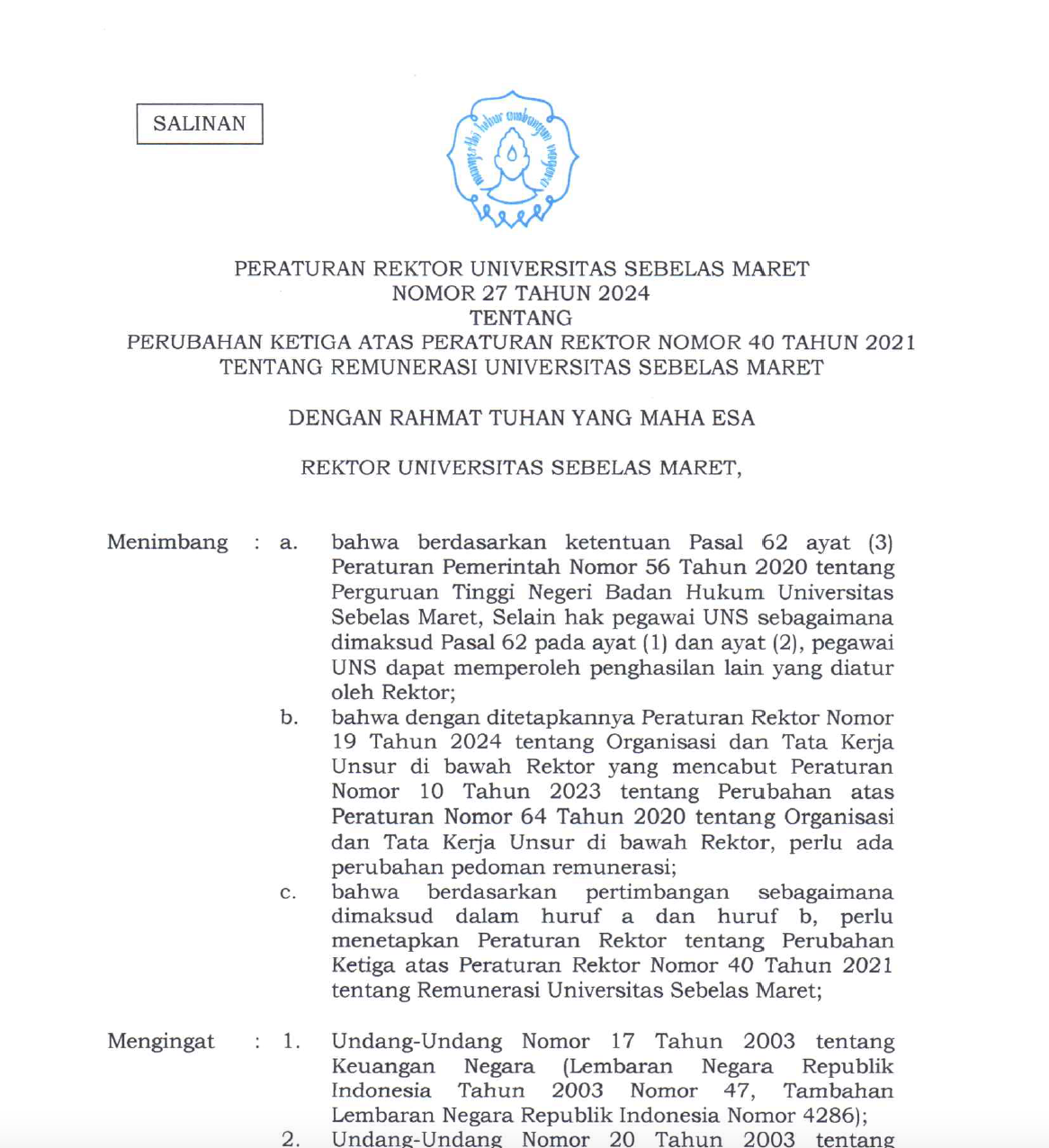
- Rector Regulation No 27 of 2024 concerning Remuneration
- Government Regulation of the Republic of Indonesia No. 51 of 2023 regulates wages, including the formula for calculating the minimum wage and its implementation in regions. The minimum wage in Surakarta City for 2024 is IDR 2,269,070
- Government Regulation of the Republic of Indonesia No. 5 of 2024, concerning the Nineteenth Amendment to Government Regulation No. 7 of 1977 on Civil Servants’ Salaries (PNS)
Definition and Standard of Living Wage
At UNS, the living wage is determined based on:
- The local minimum wage (Surakarta City: IDR 2,269,070 per month) according to Government Regulation No. 51 of 2023.
- The university’s internal regulations regarding basic salaries and remuneration applied to all employees, both civil servants (PNS) and non-civil servants.
Salary Structure and Additional Income
In addition to basic salaries, all UNS staff and faculty receive additional income as follows:
Family Allowances: Spouse/Partner Allowance, Child Allowance, Rice Allowance Daily Meal Allowance:
- Grade IV: IDR 41,000 per working day
- Grade III: IDR 37,000 per working day
- Grades II and I: IDR 35,000 per working day
Performance-Based Remuneration: Each staff member and faculty member receives additional remuneration calculated based on individual and unit performance achievement.
All employees, staff, and faculty are covered under this system. Salary and remuneration reviews are conducted annually to adjust for inflation and ensure compliance with the latest living wage requirements.
With the combination of basic salary, allowances, meal allowance, and performance-based remuneration, all UNS employees receive compensation that exceeds the local living wage. This aligns with fair employment practices, where all staff and faculty are paid at least the local living wage. Such practice supports the achievement of SDG 8 by ensuring decent work and economic well-being for all employees, while also promoting inclusive and productive economic growth within the university environment.
In support of achieving SDG 8, which aims to promote sustained, inclusive, and sustainable economic growth, full and productive employment, and decent work for all, UNS also conducts research that directly contributes to improving labor welfare and fair employment practices. One such study was conducted by Rino Ardhian Nugroho, Ph.D., titled “Strengthening Literacy for the Welfare of Indonesian Workers in Taiwan through Collaboration with PKBM PPI Taiwan.” This research focuses on improving the well-being of Indonesian migrant workers by enhancing financial and labor literacy, empowering them to understand their rights, manage income effectively, and access fair working conditions. Through collaboration between UNS and the Indonesian Migrant Learning Center (PKBM PPI Taiwan), the study directly contributes to promoting decent work and living wages for overseas workers. This initiative reflects UNS’s evidence-based approach to advancing SDG 8 by ensuring fair, inclusive, and sustainable employment practices both within and beyond the university, including:
- Rino Ardhian Nugroho, S.Sos., M.T.I., Ph.D. – “Strengthening Literacy for the Welfare of Indonesian Workers in Taiwan through Collaboration with PKBM PPI Taiwan”
This research focuses on enhancing literacy and improving the welfare of Indonesian workers abroad, with the goal of supporting the achievement of fair wages and decent working conditions. - Dr. Nurul Istiqomah, S.E., M.Si – “Economic Growth and Sustainable Development through the Application of Circular Economy”
This study emphasizes the significance of sustainable economic growth, which can indirectly enhance opportunities for decent employment and provide a sufficient income for society. - Dr. Muhammad Sabandi, S.E., M.Si – “The Role of Higher Education and Schools in Economic Learning Supporting Sustainable Economy”
This research underscores the significance of economic education in cultivating competent and productive workers, thereby enhancing their earning potential and overall productivity. - Dr. Suryanto, S.E., M.Si – “The Impact of Climate Change on Food Security and Economic Growth: Panel Error Correction Model and ARIMA”
The analysis of the relationship between climate change, food security, and economic growth reveals how economic and environmental factors can impact job creation and income adequacy.
Putra Pamungkas, S.E., M.Rech., Ph.D – “Disentangling the Connection between Financing and Economic Growth”
This study examines the relationship between financing and economic growth, which, in turn, supports employment opportunities and decent incomes through overall economic improvement. - Sarwoto, S.E., M.Sc., Ph.D., LSS.Cp – “Multidimensional Study of Local Wisdom in Business Management and Economic Development towards Sustainability in Indonesia”
This research demonstrates how business management practices grounded in local wisdom can foster sustainable economic growth and promote equitable employment opportunities.