17.2.3 International Collaboration Data Gathering for SDG
Universitas Sebelas Maret’s International Collaboration in SDG-Related Data Gathering
Universitas Sebelas Maret (UNS) consistently takes an active role in various international collaborative research projects and conferences that focus on gathering and measuring data related to achieving the Sustainable Development Goals (SDGs).
- The 5th International Conference on Environmental and Sustainable Development (5th ICESD) 2024
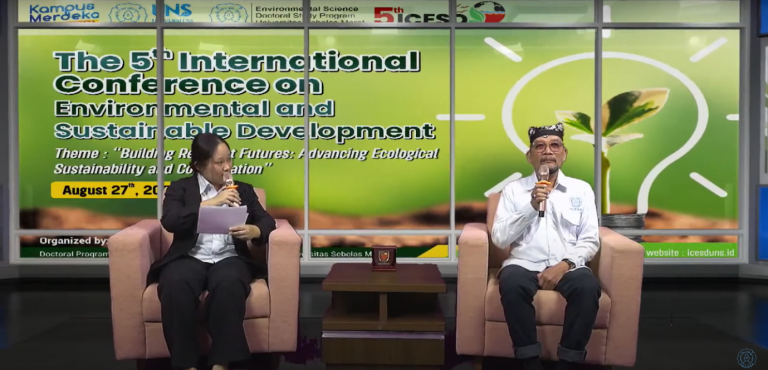
The Graduate School of UNS organized the 5th International Conference on Environmental and Sustainable Development (5th ICESD) on August 27, 2024, which was held online via Zoom. With the theme “Building Resilient Futures – Advancing Ecological Sustainability and Conservation,” the conference served as a strategic forum to discuss global issues, including climate change, biodiversity loss, and the depletion of natural resources. The conference featured speakers from Australia, Malaysia, Taiwan, and Indonesia, such as:
-
- Parulian Silaen, Ph.D. dari University of Wollongong, Australia;
- dr. Ari Natalia Probandari dari Universitas Sebelas Maret, Indonesia;
- Prof. Dr. Mohammad Hairy Ibrahim dari Universiti Pendidikan Sultan Idris, Malaysia;
- Dr. Ir. Yohanes Purwanto, DEA dari Pusat Riset Ekologi dan Etnobiologi Badan Riset dan Inovasi Nasional, Indonesia;
- Chung-Hung Lee dari National Dong Hwa University, Taiwan.
The event was attended by 190 participants and 176 presenters from various countries, showing UNS’s strong role in expanding its international collaboration network in the field of sustainability. The presence of academics, researchers, and government institutions reflected cross-sector cooperation in developing and sharing data to support evidence-based decision-making for global environmental challenges.
All presented papers were directed toward publication in reputable international journals, thereby contributing to the global data pool for monitoring SDG indicators and strengthening UNS’s participation in international collaboration on gathering and measuring data for the SDGs.
By involving academics, government institutions, practitioners, and international stakeholders, the 5th ICESD became a clear example of cross-sectoral dialogue and collaborative data generation related to the SDGs. The conference brought together different sectors to strengthen global collaboration in achieving SDG 13 (Climate Action), SDG 14 (Life Below Water), SDG 15 (Life on Land), and SDG 17 (Partnerships for the Goals). It also reaffirmed UNS’s role as a catalyst for international dialogue and data-driven sustainability initiatives.
Sources:
https://www.youtube.com/live/UiR7GzacE5A?si=Lh7f3nv1MpHwWXiy
https://pasca.uns.ac.id/blog/2024/09/17/5th-international-conference-on-environmental-and-sustainable-development-icesd-2024-building-resilient-futures-advancing-ecological-sustainability-and-conservation/
- International Conference on Multidisciplinary Studies (ICoMSI) 2024
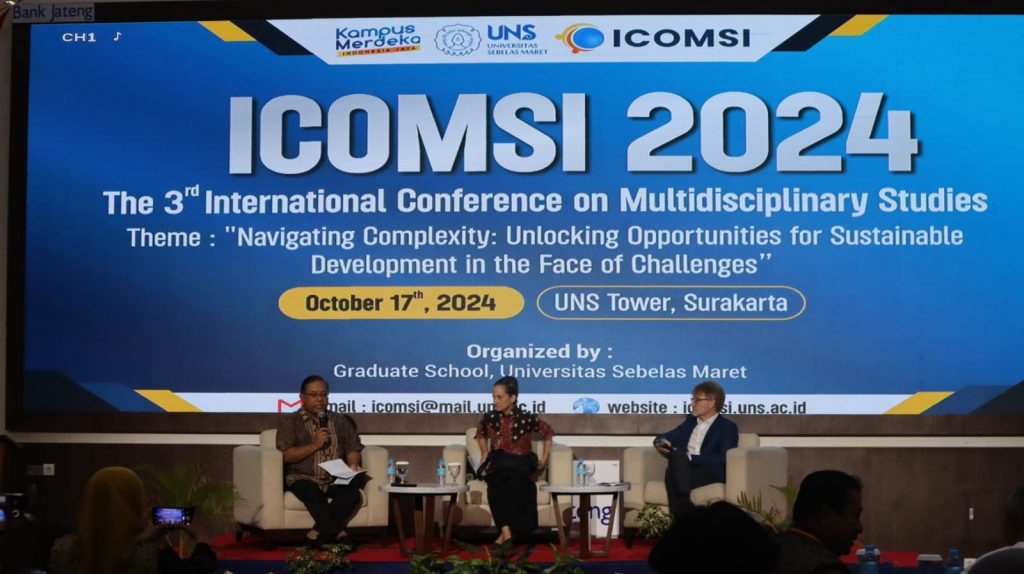
The Graduate School of Universitas Sebelas Maret (UNS) organized the International Conference on Multidisciplinary Studies (ICoMSI) 2024 on 17 October 2024 at the UNS Tower Hotel and online. Carrying the theme “Navigating Complexity: Unlocking Opportunities for Sustainable Development in the Face of Challenges,” the conference gathered 100 participants from various national and international universities. It served as a forum to promote multidisciplinary dialogue and collaboration on issues related to sustainable development, cultural preservation, social justice, and ecological balance.
Cross-sector involvement was reflected through the participation of government representatives, including Diane Butler, Ph.D., a researcher from the National Research and Innovation Agency (BRIN), who delivered a keynote speech emphasizing the link between academia and public policy in supporting sustainable development. The conference also involved both domestic and international academics, strengthening the global perspective and collaborative efforts in discussions related to the SDGs.
Through the organization of ICoMSI 2024, UNS played a crucial role in initiating and facilitating dialogue between the academic, governmental, and international research sectors, discussing innovative and data-driven approaches to achieving the Sustainable Development Goals. The exchange of research findings and policy insights during the conference contributed to international collaboration on gathering and measuring SDG-related data, particularly in areas of social inclusion, environmental sustainability, and policy integration.
Source:
https://pasca.uns.ac.id/blog/2024/10/17/gelar-tahun-ketiga-konferensi-internasional-icomsi-2024/
- The 19th Joint Conference on Chemistry 2024

UNS organized the 19th Joint Conference on Chemistry 2024, held on September 12, 2024, at the UNS Tower, “Ki Hadjar Dewantara.” The conference was a collaboration among seven universities in Central Java, gathering participants and speakers from various countries, including Italy, Japan, Spain, and Malaysia. The main theme focused on material science for the future, with applications in polymers, nanomaterials, catalysis, pharmaceuticals, green chemistry, and environmentally friendly technologies, all of which are closely aligned with the Sustainable Development Goals (SDGs).
The event featured cross-sectoral dialogue through the participation of academics, the industrial sector, and NGOs. Keynote speakers included Oki Muraza, Deputy President Director of Pertamina, a state-owned enterprise (SOE) in the energy and oil and gas sector, who plays a key role in advancing sustainable energy and technology development in Indonesia. In addition, Prof. Claudio Tiribelli, representing the Italian Liver Foundation, an international NGO in the field of health research, contributed to strengthening international and cross-sector collaboration during the conference.
Through discussions and the presentation of scientific findings, the conference facilitated the exchange of research data and methodologies relevant to sustainability and environmental chemistry. These interactions contributed to international collaboration on gathering and measuring SDG-related data, particularly in areas such as sustainable energy, green chemistry, and environmental protection.
With its strong cross-sectoral participation and focus on sustainability issues, the 19th Joint Conference on Chemistry 2024 stands as a clear example of cross-sectoral and international dialogue on the SDGs. UNS played a crucial role in initiating and facilitating knowledge exchange and collaborative research among academia, government, industry, and NGOs to support the achievement and monitoring of the Sustainable Development Goals.
Source: https://jcc.uns.ac.id/
- The 2nd International Conference on Environmental Management (ICEM) 2024
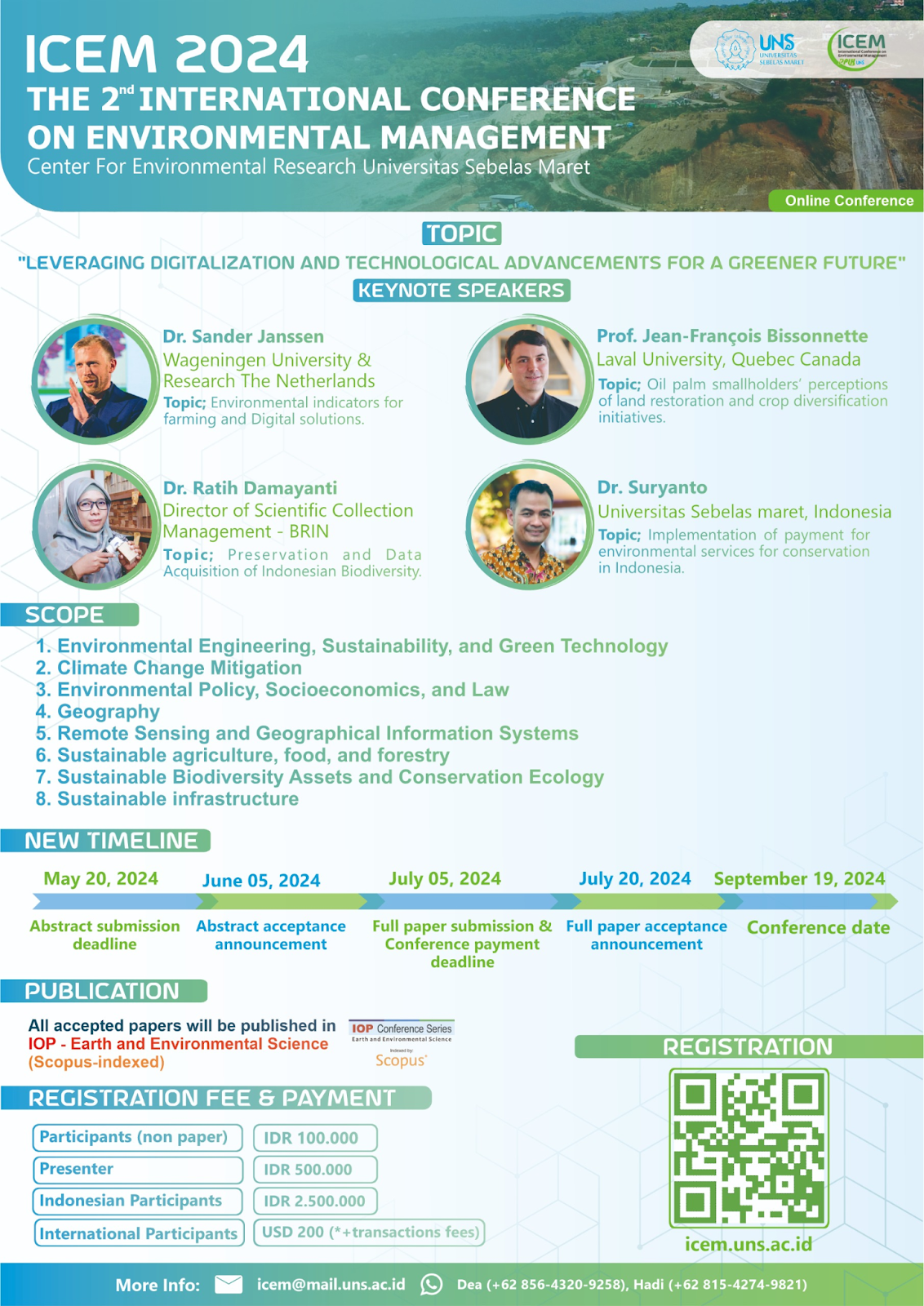
UNS, through its Center for Environmental Research, organized the 2nd International Conference on Environmental Management (ICEM) 2024 on 19 September 2024 under the theme “Leveraging Digitalization and Technological Advancements for a Greener Future.” The conference featured speakers from various countries, including Dr. Sander Janssen from Wageningen University & Research (The Netherlands), Prof. Jean-Francois Bissonnette from Laval University (Canada), as well as academics and researchers from UNS and the National Research and Innovation Agency (BRIN), Indonesia.
The theme emphasized the importance of collaboration among academia, government institutions, and environmental practitioners to promote sustainability and conservation.
ICEM 2024 served as a cross-sectoral dialogue forum, discussing topics such as sustainability, climate change mitigation, biodiversity conservation, green technology, sustainable agriculture and forestry, and sustainable land and infrastructure management. The involvement of BRIN demonstrated strong collaboration between academia and government in addressing natural resource management and conservation, highlighting interaction among research institutions, universities, and government agencies to develop science-based and data-driven solutions for environmental challenges.
Through these discussions and research exchanges, ICEM 2024 also contributed to international collaboration on gathering and sharing environmental data relevant to the SDGs, particularly those related to SDG 13 (Climate Action), SDG 14 (Life Below Water), SDG 15 (Life on Land), and SDG 17 (Partnerships for the Goals).
Source: https://icem.uns.ac.id/
- Advancing Disability Inclusion through Social and Digital Entrepreneurship in ASEAN
The research project titled “Advancing Disability Inclusion through Social and Digital Entrepreneurship in ASEAN” focuses on empowering persons with disabilities through social and digital entrepreneurship. It highlights the importance of creating inclusive economic opportunities across Southeast Asia.
This study is a cross-country collaboration between the Faculty of Economics and Business at Universitas Sebelas Maret (Indonesia) and the Faculty of Business and Economics at Universiti Malaya (Malaysia). The partnership enriches the research perspective by combining the Indonesian and Malaysian contexts, providing broader insights into best practices for integrating persons with disabilities into productive economic activities.
The study applies a qualitative case study approach involving two organizations: Rumah Harapan Mulya (RHM) in Karangpatihan, Indonesia, and Generating Opportunities for Learning Disabled (GOLD) in Malaysia. Primary data were collected through:
-
- In-depth, semi-structured interviews with individuals and stakeholders;
- Field observations of social entrepreneurship activities; and
- Thematic analysis to identify patterns, challenges, and opportunities.
Through this approach, the research not only develops conceptual understanding but also provides empirical evidence based on field data, which can support policy formulation and inclusive development practices.
This study contributes to several Sustainable Development Goals:
-
- SDG 8 (Decent Work and Economic Growth): promoting the participation of persons with disabilities in economic activities through social and digital entrepreneurship.
- SDG 10 (Reduced Inequalities): reducing social and economic disparities by providing equal access for vulnerable groups.
- SDG 4 (Quality Education): offering adaptive vocational training and entrepreneurial skills development for persons with disabilities.
The findings indicate that social entrepreneurship models in Indonesia and Malaysia can facilitate the transformation of social identity among people with disabilities, thereby enhancing their inclusion in society. However, the study also identifies several challenges, including low digital literacy, dependence on volunteers, and limited infrastructure. These results underscore the importance of systemic support, inclusive policy frameworks, and digital innovation in expanding the impact of similar programs across ASEAN.
- Adaptive Governance in the Water-Energy-Food-Ecosystem Nexus for Sustainable Community Sanitation
The study “Adaptive Governance in the Water-Energy-Food-Ecosystem Nexus for Sustainable Community Sanitation” addresses environmental and sustainability issues, including community sanitation as a key aspect of sustainable development. This research involves collaboration among scholars from Universitas Pertamina, Universitas Kristen Indonesia, Universitas Sebelas Maret (Indonesia), and National Dong Hwa University (Taiwan).
The research highlights the significance of adaptive governance in managing the intricate interconnections within the Water–Energy–Food–Ecosystem (WEFE) nexus, particularly in the context of community-based sanitation under climate change pressures. The international collaboration strengthens both local and global perspectives on sustainable community sanitation management.
Primary data were collected through structured surveys distributed among local communities to measure adaptive governance attributes, including assets, flexibility, organization, learning, and agency capacity. The data were analyzed using binary probit and binary logit models to identify factors influencing community participation in sanitation initiatives. Descriptive analysis was also conducted to describe respondent characteristics and attribute distributions.
This study directly contributes to several SDGs:
-
- SDG 6 (Clean Water and Sanitation): strengthening community engagement in sustainable sanitation practices.
- SDG 11 (Sustainable Cities and Communities): improving community resilience in managing sanitation amid climate change.
- SDG 13 (Climate Action): supporting climate change mitigation through adaptive governance that enhances community resilience.
The findings confirm that adaptive capacities such as flexibility, organization, and learning significantly influence community participation in sanitation programs. This shows that the success of sanitation initiatives depends not only on infrastructure but also on adaptive governance that responds to environmental dynamics and local needs.
The study recommends integrating adaptive governance principles into national and regional sanitation development policies. This integration will strengthen community resilience to climate challenges and improve environmental health quality.
- The Disruptive Potential of Importance-Performance Eduruption and Transforming Consumerism in Single-Use Plastic Reduction Initiatives
The collaborative study “The Disruptive Potential of Importance-Performance Eduruption and Transforming Consumerism in Single-Use Plastic Reduction Initiatives” involves researchers from Universitas Pertamina, Universitas Tanjungpura, Universitas Negeri Medan, Universitas Brawijaya, Universitas Sebelas Maret (Indonesia), and National Dong Hwa University (Taiwan).
This research explores the potential of the Importance-Performance Eduruption method in encouraging behavioral change among consumers—especially university students—to reduce the use of single-use plastics (SUPs).
Through this cross-country collaboration, the study integrates both local and global perspectives on the challenges of plastic consumption, producing findings that are relevant to regional and international contexts.
The research applies a quantitative method, using:
-
- Binary choice models to analyze factors influencing students’ willingness to participate in SUP reduction; and
- Importance-Performance Analysis (IPA) to identify the most effective educational strategies and areas that need improvement.
- Primary data were collected directly from student respondents, who were evaluated based on learning strategies such as Problem-Based Learning and Project-Based Learning. This ensures that the study is based on measurable field data.
The study contributes to several SDGs:
-
- SDG 12 (Responsible Consumption and Production): promoting sustainable consumption behavior by reducing single-use plastic usage.
- SDG 4 (Quality Education): integrating innovative learning strategies to enhance sustainability awareness and practice among students.
- SDG 13 (Climate Action): indirectly contributing to climate change mitigation by reducing plastic waste and associated carbon emissions.
The findings reveal that project- and problem-based learning approaches are highly effective in shaping sustainable consumption behaviors among students. However, the study also highlights the need to strengthen research-based approaches for greater impact. The results suggest that curriculum planning and education policies should be better aligned with the goal of reducing single-use plastics, reinforcing the role of educational institutions in global sustainability efforts.
Conclusion
Through international research collaboration and cross-country data collection, UNS has made a tangible contribution to achieving the Sustainable Development Goals. These studies demonstrate how regional academic cooperation can yield reliable empirical data, enhance policy recommendations, and bolster global efforts toward inclusive and sustainable development.