
SDG 2 In Number
Total food waste (mt)
1.75
Campus population
31.364
Number of graduates
6.192
Number of graduates from agriculture and aquaculture courses including sustainability aspects
1.705
2.5.1 Access To Food Security Knowledge
In response to national food security challenges such as declining land quality, farmers’ high dependence on chemical fertilizers, and the threat of climate change, Sebelas Maret University (UNS) has taken concrete action through a sustainable agriculture program in various villages in Central Java. This program arose as a form of concern for the food crisis and environmental degradation, as well as a manifestation of UNS’s commitment to Sustainable Development Goal (SDG) 2: Zero Hunger. Through this activity, UNS strives to strengthen local food security, increase farmer capacity, and encourage the implementation of environmentally friendly, productive, and sustainable agricultural practices.
All knowledge and capacity-building programs under this initiative are provided free of charge to the local community, ensuring open and equitable access to food security knowledge.
- Community-Based Programs (KKN and Sustainable Agriculture in Rural Areas)
- UNS KKN 56.2 Supports the Improvement of Organic Farming-Based Educational Tourism in Mundu Village, Klaten
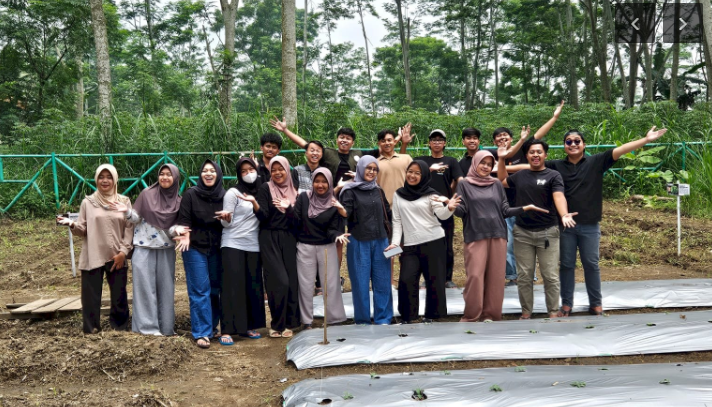
Students from Sebelas Maret University (UNS), through their Community Service Program (KKN) group 56.2, contributed to supporting the development of organic farming-based educational tourism in Mundu Village, Tulung District, Klaten Regency. This program aims to optimize the village’s rich agricultural resources through an environmentally friendly approach, involving the community in cultivating vegetables and fruits such as chilies, tomatoes, watermelons, and melons, and using liquid organic fertilizer from household waste. This initiative aligns with UNS’s commitment to Sustainable Development Goal (SDG) 2: Zero Hunger, particularly indicator 2.4.1 “Access to food security knowledge,” which aims to provide local communities with access to knowledge, skills, and technology related to food security and sustainable agriculture.
The training and knowledge-sharing sessions were conducted freely for all villagers, ensuring that everyone could participate without any financial burden.
Through this program, UNS not only plays a role in increasing the capacity of village communities in sustainable agricultural practices but also supports the development of agricultural educational tourism that strengthens the local economy while preserving soil and food ecosystems. The collaboration between students, the village government, and tourism awareness groups (Pokdarwis) reflects the concrete application of the principles of “teaching, research, and community engagement” in building village food security. Thus, this KKN activity is a concrete manifestation of UNS’s contribution to realizing a food system that is empowered, sustainable, and inclusive, in line with the direction of achieving SDG 2 at the local level.
- Hydroponic Farming Outreach by UNS Community Service Program (KKN UNS) in Dukuh Village: Advancing Sustainable Agriculture through Modern Technology
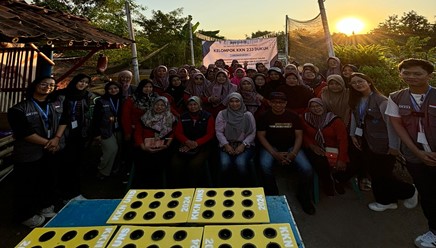
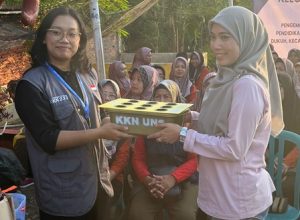
On July 20, 2024, UNS students conducted a community service activity in Dukuh Village, Sukoharjo Regency, introducing hydroponic farming systems to members of the local women’s farming group (Kelompok Wanita Tani or KWT Ceria). The activity focused on teaching modern cultivation using hydroponic technology through hands-on practice with pakcoy vegetables, including preparing the growing medium, nutrient mixing (Abemix), and harvesting stages.
All hydroponic training sessions were offered free of charge, allowing local women farmers to access modern agricultural knowledge without cost barriers.
This initiative demonstrates UNS’s real contribution to promoting sustainable agriculture through technology innovation that improves land efficiency, food productivity, and community welfare. The activity is in line with UNS’s commitment to SDG 2: Zero Hunger, which emphasizes providing access to food security and sustainable agriculture knowledge, skills, and technology for local farmers and food producers. Through this program, UNS actively transfers modern agricultural innovations to rural communities, supporting the development of environmentally friendly and competitive local food systems.
- Academic Activities and Knowledge Dissemination
- National Seminar on “Building a National Food Sovereignty Ecosystem: Synergy between Agriculture, Technology, and Food Industry”
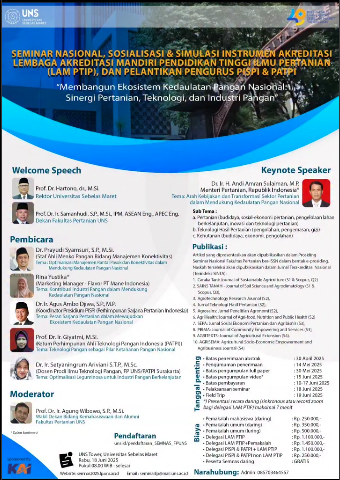
In addition to community service programs, UNS also actively organizes webinars, seminars, and guest lectures on food security and sustainable agriculture involving national experts, research institutions, agricultural practitioners, and local food entrepreneurs. One of these events was the national seminar titled “Building a National Food Sovereignty Ecosystem: Synergy between Agriculture, Technology, and Food Industry.”
All seminars and webinars were freely accessible to participants from both academic and non-academic backgrounds, ensuring open access to food security knowledge for all.
Through these academic activities, UNS provides broad access to knowledge on food security and sustainable agriculture skills for both the academic community and society. These initiatives reinforce UNS’s commitment to developing a resilient food system through the synergy of education, research, and public knowledge dissemination.
Source : https://www.instagram.com/reel/DIke4hqBycB/?utm_source=chatgpt.com
- Technology and Food Industry Empowerment for MSMEs and Local Producers
- Mentorship Program for Food SMEs: Expanding Market Access and Product Quality at Hokky Meatball SME, Sukoharjo
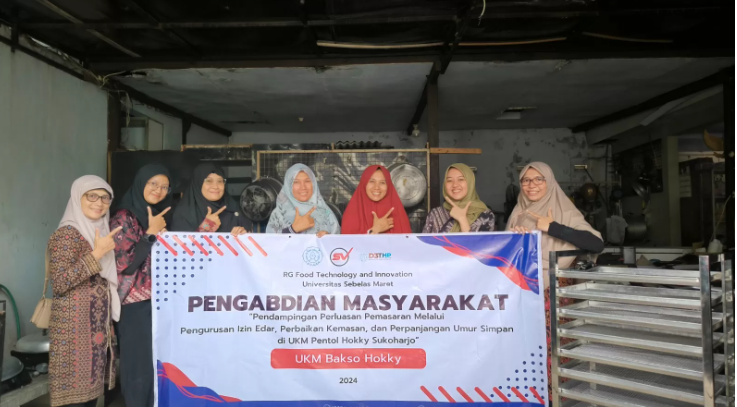
As part of its community engagement mission within the Tri Dharma Perguruan Tinggi framework, the Research Group of Food Technology and Innovation from the D3 Food Technology Study Program conducted a mentoring program for the Hokky Meatball SME in Sukoharjo. The program included technical marketing training, an assessment of equipment needs, and assistance in obtaining BPOM (National Agency for Drug and Food Control) permits, as well as guidance on managing frozen food production to enhance product shelf life.
All mentoring and assistance services were provided free of charge, reflecting UNS’s inclusive approach to capacity building for local food producers.
The UNS team also provided support in the form of a vacuum sealer, cooling racks, and other essential equipment to help the SME meet food safety standards and expand its market reach. The program also served as a research opportunity for studying local food supply chains and efficient food processing practices based on safe food principles.
This initiative reflects UNS’s strong belief that community service is not merely symbolic but a bridge between academic knowledge and local empowerment. In the future, UNS plans to replicate this mentoring model for other food MSMEs, integrate food safety modules into academic curricula, and strengthen collaboration with BPOM and relevant agencies to develop a resilient and sustainable local food ecosystem.
- Introduction of Appropriate Technology to the Rambak Eco Surakarta Home Industry
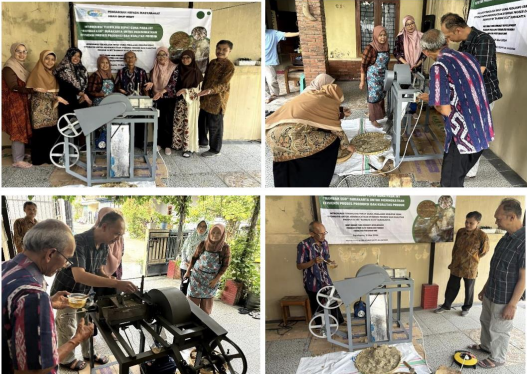
As part of its commitment to SDG 2: Zero Hunger, UNS continues to provide access to knowledge, skills, and technology for food security to local food producers. One example is a community service project conducted by lecturers and students from the Food Technology Study Program, which introduced appropriate technology to the Rambak Eco Home Industry in Surakarta.
All training and technical assistance in this project were provided for free to the home industry participants.
This activity aimed to improve production efficiency and product quality by applying semi-automatic machines for cutting and drying rambak products. The innovation reduced production time by up to 60% and ensured more consistent product quality. The program also included training on Good Manufacturing Practices (GMP), eco-friendly packaging, and food safety compliance in accordance with BPOM standards.
Through this program, UNS not only provided technical solutions but also ensured the transfer of knowledge and technology to strengthen the economic independence of small-scale food producers. This initiative directly supports UNS’s mission to provide access to knowledge, skills, and technology for sustainable agriculture to local farmers and food producers, while embodying the real implementation of community engagement within the Tri Dharma Perguruan Tinggi.
Moving forward, UNS plans to expand similar initiatives to other regions, focusing on food processing technologies, product diversification, and sustainable practices in home-scale industries, thereby contributing to the creation of a strong, safe, and sustainable local food ecosystem in Indonesia.
- Joint Business Development: Technology Innovation and Frozen Cassava Marketing in Beruk Village, Jatiyoso District, Karanganyar Regency
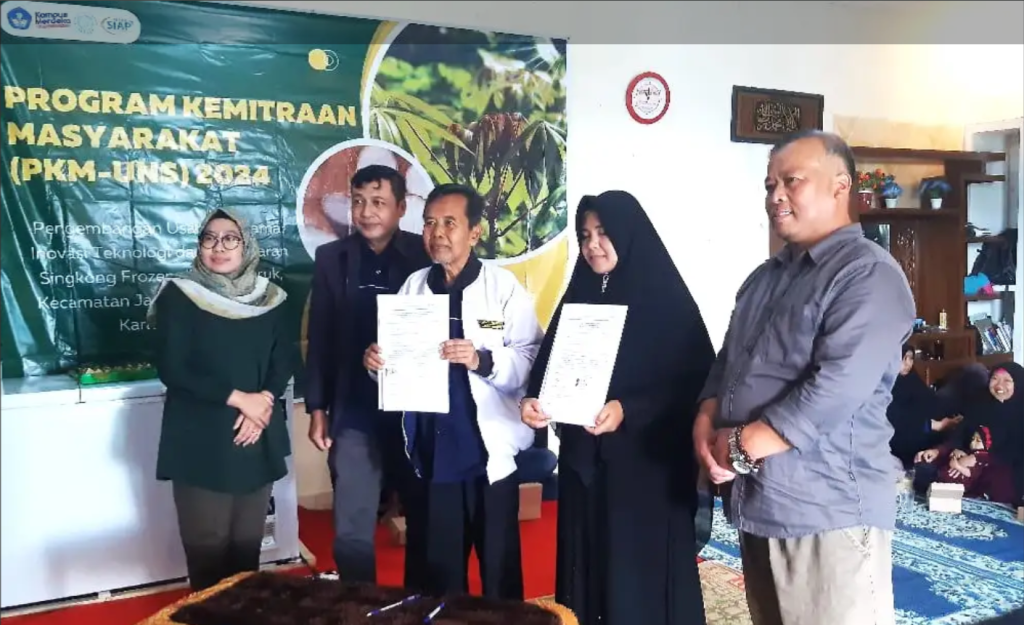
The Faculty of Agriculture at UNS demonstrated its strong commitment to empowering local food MSMEs in Beruk Village through the provision of freezer boxes for local food entrepreneurs. This initiative was not only about equipment support but also part of a broader community service program aimed at improving production capacity, ensuring food quality, and supporting hygienic and sustainable storage practices.
All training, mentoring, and technology transfer activities under this program were freely provided to the community to ensure equal access to food security knowledge.
By utilizing the freezer boxes, MSMEs can extend product shelf life, minimize food loss and waste, and maintain food safety and quality. This initiative also represents a form of technology and knowledge transfer to local food producers, consistent with the principle of SDG 2: Zero Hunger – providing access on food security and sustainable agriculture knowledge, skills, or technology to local farmers and food producers.
The program reflects the implementation of the Tridarma Perguruan Tinggi, particularly in community engagement that brings tangible social and economic impact. Going forward, UNS plans to continue this initiative through cold chain management training, product quality research, and collaboration with agricultural offices to help local MSMEs grow stronger, become more competitive, and contribute to sustainable regional food systems.
Source : https://news.espos.id/fp-uns-hibahkan-freezer-box-untuk-umkm-desa-beruk-1933672
To support efforts to end hunger, achieve food security and improved nutrition, and promote sustainable agriculture, in 2024, UNS provided research and community service funding on topics related to SDG 2. Several UNS researchers conducted studies aimed at addressing challenges related to food security and sustainable farming.
For example, UNS provides local farmers and food producers with access to knowledge, skills, and technology to promote sustainable agriculture. Dr. Ir. Dwiningtyas Padmaningrum’s research, “Information and Knowledge Sharing Petani Berbasis Teknologi Digital Menuju Pertanian Berkelanjutan,” enables farmers to use digital information to improve sustainable farming practices. Dr. Komariah’s study, “Estimasi Produksi dan Kualitas Kentang di Jawa Tengah berdasarkan karakteristik lahan dengan pendekatan machine learning,” offers insights into yield prediction and land management. Another example is Dr. Ir. Joko Sutrisno’s work, “Model Simulasi Sistem Dinamik Swasembada Kedelai,” which provides strategies for soybean production planning and contributes to sustainable food security.