SDG 1 In Number
Number of student 2024
27.604
Number of low income students receiving financial aid
20.353
1.3.4 Bottom Financial Quintile Student Support
Programmes and Initiatives to Assist Low-Income Students
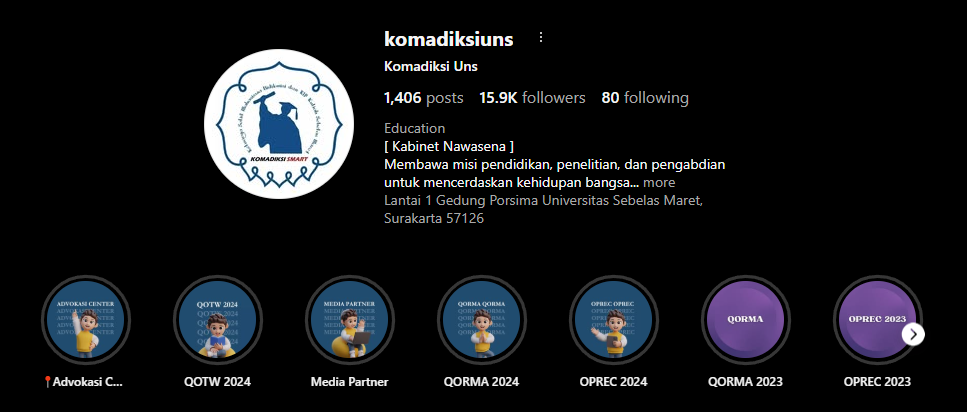
Universitas Sebelas Maret (UNS) is strongly committed not only to providing access to higher education for students from low-income families but also to ensuring that they can successfully complete their studies. One of the main initiatives that demonstrates this commitment is Komadiksi SMART UNS (https://www.instagram.com/komadiksiuns), a student community for KIP-Kuliah scholarship recipients. This community serves as a mentoring, social support, and motivation forum, where students share experiences, receive free academic assistance, and gain additional opportunities through internal programs, such as the Be Smart Scholarship, which provides financial support to members facing economic hardship.
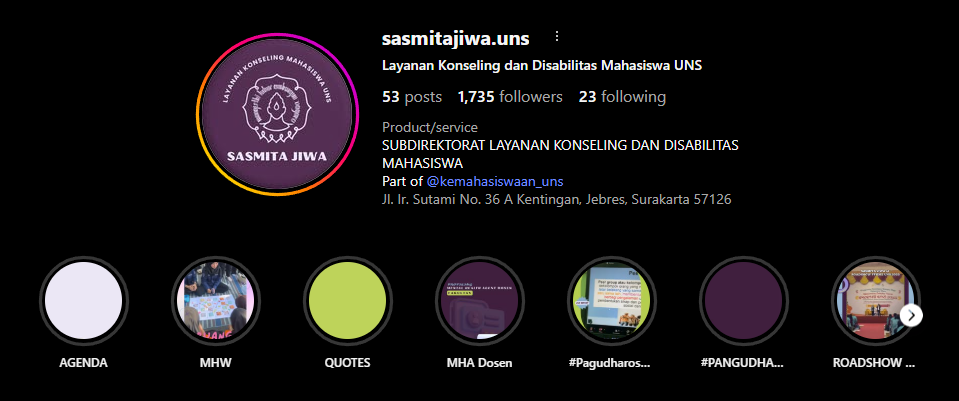
In addition to community-based support, UNS also offers a range of free services specifically designed for students from economically disadvantaged backgrounds. These include the free counseling service “Sasmita Jiwa” (https://www.instagram.com/sasmitajiwa.uns), managed by the Subdirectorate of Student Counseling Services. The service is available both offline (at UNS Medical Center) and online via Zoom, and it can be accessed free of charge by all students, including KIP-Kuliah recipients. Through this service, students are supported in overcoming personal and academic challenges, maintaining mental well-being, and finding solutions to problems that may affect their study completion. This approach highlights UNS’s holistic concern not only for the financial aspect but also for the mental and emotional welfare of its students.
UNS also provides free academic mentoring programmes to assist students from economically disadvantaged backgrounds in writing their theses or final assignments. This mentoring aims to ensure that students can graduate on time by developing their academic writing, research, and time management skills. Additionally, Unit Pelaksana Teknis Pelayanan dan Pengembangan Bahasa (UPT2B) offers a free English for Academic Purposes programme for students from economically disadvantaged backgrounds to improve their English language proficiency and support their participation in academic and international activities.
Furthermore, UNS encourages students from economically disadvantaged backgrounds to participate in lecturers’ research projects, community service programmes, and internships within various university units. These opportunities not only enrich their academic and professional experiences but also provide financial support through assistantships, stipends, or project-based payments, helping them sustain their studies until graduation.
UNS’s commitment is further reflected in its 2024 student admission data, where around 25–26% of new students were KIP-Kuliah scholarship holders. In the SNBT admission track, for example, 1,116 out of 3,607 students (30.94%) were recipients of the KIP-Kuliah scholarship, which is specifically targeted for students in the bottom 20% income group. These figures show that UNS not only provides admission opportunities but also ensures continued academic, social, psychological, and financial support for these students until graduation.
Through these comprehensive and free support programmes, UNS reaffirms its contribution to SDG 1: No Poverty, particularly in promoting inclusive and equitable access to higher education for students from low-income families, enabling them to achieve academic success and improve their social mobility.
UNS’s commitment to the Anti-Poverty Program (SDG 1), particularly through comprehensive support for students from low-income families, is reinforced by empirical research conducted by UNS scholars. Two key studies underpin this approach:
1. “Why are low-income eligible students reluctant to apply for financial aid? An empirical study from Central Java, Indonesia” (Springer, 2024), which highlights that financial barriers are compounded by psychological and informational constraints that prevent poor students from accessing scholarships
2. “Targeted scholarship for higher education and academic performance: Evidence from Indonesia” (Elsevier, 2021), which finds that targeted financial aid significantly improves the academic performance and graduation outcomes of students from the lowest income quintile.
Together, these studies provide a strong empirical foundation for UNS’s continuous support model—starting from improving scholarship awareness and motivation before admission, to maintaining academic, social, and psychological assistance throughout the study period. This research-backed approach ensures that UNS’s initiatives effectively promote access, persistence, and success among students from the bottom 20% income group.