SDG 8 In Number
Number of employees
3.760
Number of academic staff
1.950
University expenditure (IDR)
1.850.122.866.706
Number of students
27.604
Number of students with work placements for more than a month
12.832
Number of employees on contracts of over 24 months
3.760
8.2.7 Tracking Pay Scale For Gender Equity
Tracking Pay Scale for Gender Equity at Universitas Sebelas Maret
Gender-based wage gaps remain a significant employment issue across various sectors, including higher education. Differences in income that are not based on qualifications or work responsibilities, but rather on gender, can hinder the creation of a fair and inclusive work environment. Universitas Sebelas Maret (UNS) recognizes this challenge and emphasizes its commitment to preventing wage discrimination by implementing a transparent and measurable pay scale system.
Through Rector Regulation No. 12 of 2024, UNS establishes a salary scheme based on position, qualifications, and responsibilities. Additionally, UNS has issued Rector Regulation Number 40 of 2024 regarding employee remuneration, which includes academic staff. The University explicitly implements a non-discriminatory remuneration policy, ensuring that payments are based on employee performance. Both policies ensure that gender does not influence salary levels, so every staff member is fairly rewarded according to their capacity and contribution. In this way, the system inherently supports the principle of equality, ensuring that men and women in the same position receive equivalent pay.
The output of this policy is a fair and consistent salary structure, which serves as the standard for all UNS employees. As a result, it fosters a sense of fairness, increases work motivation, and nurtures an inclusive and professional work culture.
To maintain sustainability, UNS’s Human Resources Department routinely monitors and evaluates payroll data, including regular salary analysis, to prevent gender-based discrimination. This monitoring process reflects UNS’s commitment to tracking, safeguarding, and continuously strengthening gender equity in pay scales across both academic and administrative staff.
The results of this monitoring and evaluation are used as a basis to ensure, on an ongoing basis, that no discriminatory practices exist within the staff compensation system. Through this approach, UNS affirms itself as a campus that upholds gender equality while supporting the achievement of Sustainable Development Goal (SDG) 8: Decent Work and Economic Growth.
Framework of Employment and Human Rights Policies Supporting Fair and Equitable Work Practices at Universitas Sebelas Maret
SDG 8 Indicator
Employment Practice
|
Policy |
Link |
Summary |
Relevant Article |
|
Law No. 13 of 2003 on Manpower |
https://peraturan.bpk.go.id/Details/43013 |
Governs the rights, obligations, and protections of workers and employers in Indonesia. They cover equal employment opportunities, including the absence of discrimination, employment relationships, wages, working hours, occupational health and safety, welfare guarantees, and protection for vulnerable groups such as women, children, and persons with disabilities. |
|
|
Law No. 39 of 1999 on Human Rights |
https://peraturan.bpk.go.id/Details/45361/uu-no-39-tahun-1999 |
Regulates the principles, guarantees, and protection of human rights in Indonesia in accordance with Pancasila, the 1945 Constitution, and international standards. The laws affirm basic citizen rights, including the right to life, freedom of religion, freedom of opinion, freedom of association, access to justice, and the right to decent work without discrimination. Special protection is also provided for women, children, and vulnerable groups, with the National Human Rights Commission (Komnas HAM) established as an independent body to promote, enforce, and protect human rights. |
Article 38, Paragraph (3): Every female worker has the right to receive the same wage as male workers for work of equal value. |
|
Rector Regulation No. 12 of 2024 |
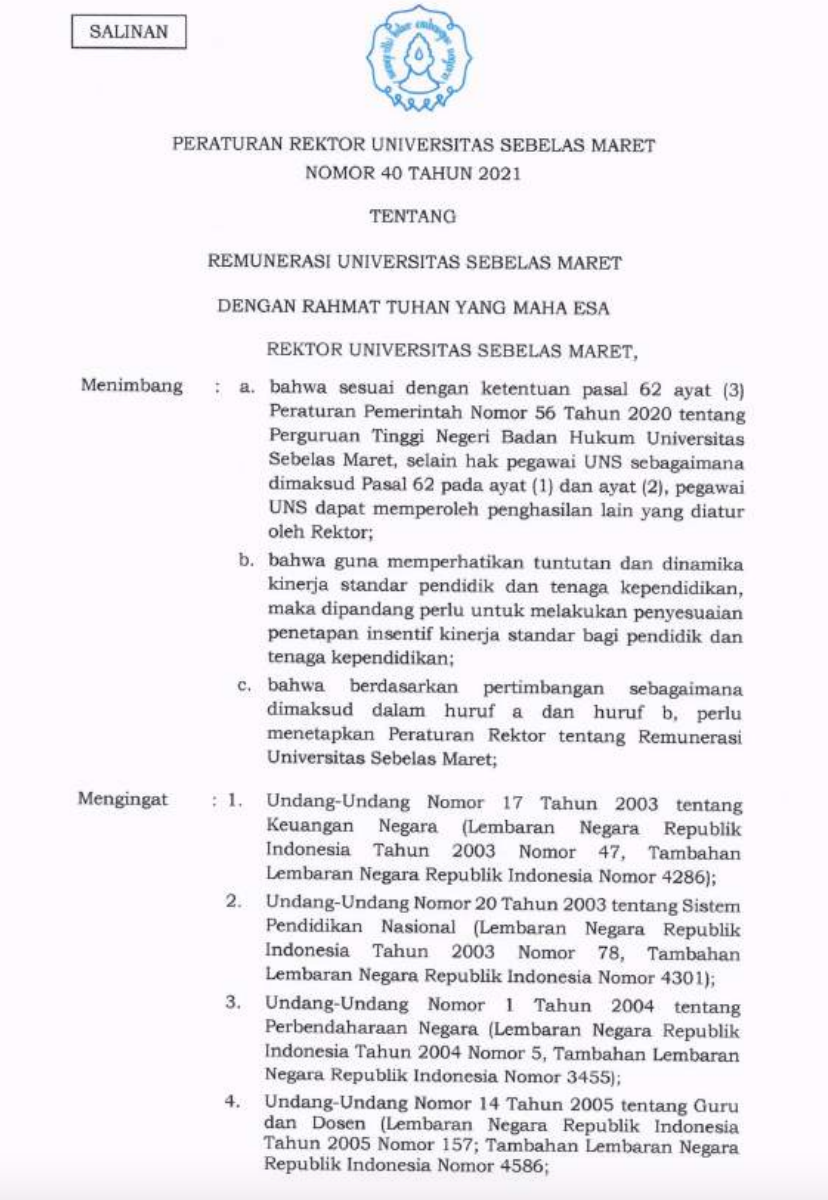
Stipulates salary adjustments for permanent non-civil servant staff with an 8% increase effective from January 1, 2024. This regulation emphasizes that salary levels are determined based on rank and length of service, as listed in the official salary schedule attachment. |
Article 1: Salaries of UNS Non-Civil Servant employees are determined based on rank and length of service. |
|
|
Rector Regulation No. 40 of 2024 |
Employees, including academic staff, receive remuneration based on their performance, without any gender-based discrimination. |
Article 3: The remuneration of employees is provided based on their performance in the preceding period |