

SDG 11 In Number
University expenditure (IDR)
1,561,027,263,159
University expenditure on arts and heritage (IDR)
220,320,172,206
11.4.1. Sustainable Practice Targets
Implementation, Measurement, and Target Setting for Sustainable Transportation Practices
Universitas Sebelas Maret (UNS) is committed to promoting sustainable commuting through institutional policies, transportation management, environmental monitoring, and the development of alternative transportation facilities. These efforts are designed to reduce dependence on private motorized vehicles, encourage low-emission mobility, and support more sustainable transportation practices across the university.
UNS integrates sustainable commuting into its broader Green Campus initiatives by promoting walking, cycling, public transportation, campus shuttle services, and electric vehicles. These initiatives are supported by transportation infrastructure, vehicle management policies, and environmental monitoring activities that contribute to the university’s sustainability objectives, particularly Sustainable Development Goal (SDG) 11: Sustainable Cities and Communities.
1. Emission-Free Mobility and Sustainable Commuting Initiatives

UNS promotes emission-free mobility through initiatives that encourage students, lecturers, and employees to reduce their reliance on private motorized vehicles. These initiatives include providing walking and cycling facilities, promoting public transportation, and implementing emission-free mobility practices on campus.
The university also provides alternative transportation options to support daily mobility. These include free campus shuttle buses, bicycles, and electric transportation facilities. These alternatives support a gradual transition to more sustainable commuting practices while helping reduce vehicle emissions and traffic congestion on campus.
Transportation Baseline and Facilities
The university’s transportation inventory documents several alternative transportation facilities, including three campus buses, approximately 20 bicycles available for students and employees, and six golf carts operating on designated schedules. Bicycle parking and cycling facilities also support non-motorized transportation.
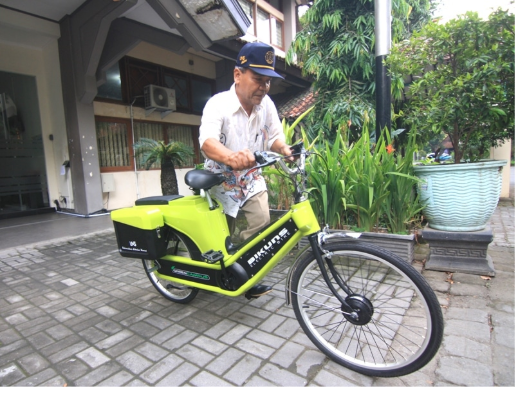
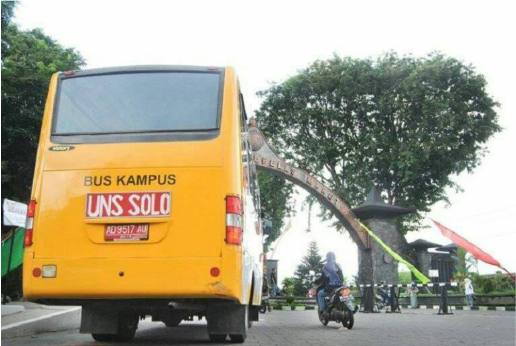
In addition, UNS provides scheduled shuttle services connecting campus buildings and facilities. The university’s shuttle service operates from designated departure points, while its transportation network is supported by bus stops and connections to public transportation services in Surakarta. These facilities provide a basis for planning and expanding sustainable commuting options for the university community.
References:
2. Electric Vehicles and Low-Emission Transportation Infrastructure

UNS supports the transition to low-emission transportation by providing electric vehicles and supporting infrastructure. These facilities support the university’s efforts to reduce conventional fuel consumption and encourage cleaner transportation alternatives on campus.
The university provides electric bicycles and electric motorcycles for operational mobility, as well as electric golf carts that serve campus transportation needs. These vehicles offer alternatives to conventional motorized transportation and support the gradual adoption of cleaner mobility options.
UNS has also developed electric vehicle charging infrastructure at several campus locations. The availability of charging stations, including facilities integrated with solar photovoltaic systems, supports an enabling environment for electric transportation.
These initiatives support sustainable commuting planning by providing infrastructure and transportation alternatives that can help gradually reduce conventional vehicle use.
References:
3. Carbon Emissions Inventory and Transportation Area Monitoring
UNS incorporates environmental monitoring into its sustainability initiatives to assess the environmental impact of campus activities, including transportation-related emissions. The university’s carbon emissions inventory records 588.13 tCO₂e, providing quantitative information to support evaluations of environmental performance and the development of emission-reduction strategies.
In addition to emissions monitoring, UNS documents and monitors land allocation for parking facilities across its campuses. The parking area mapping provides quantitative information on the extent of land used for vehicle parking and supports the university’s efforts
Parking Area Monitoring
Based on the parking area mapping documentation, the total parking area across UNS campuses was recorded as follows:
Year | Total parking area |
2023 | 49,300 m² |
2024 | 47,344 m² |
2025 | 43,012 m² |
2026 | 43,012 m² |
The data show a reduction of 4,332 m² between 2024 and 2025, equivalent to approximately 9.15%. In 2026, the parking area remained unchanged at 43,012 m², indicating that the previous year’s reduction was maintained.
This monitoring provides a quantitative basis for evaluating campus parking management and land-use efficiency. Combined with transportation emission data, it can support the university’s planning and assessment of sustainable commuting initiatives.
References:
4. Student Education and Awareness of Sustainable Commuting
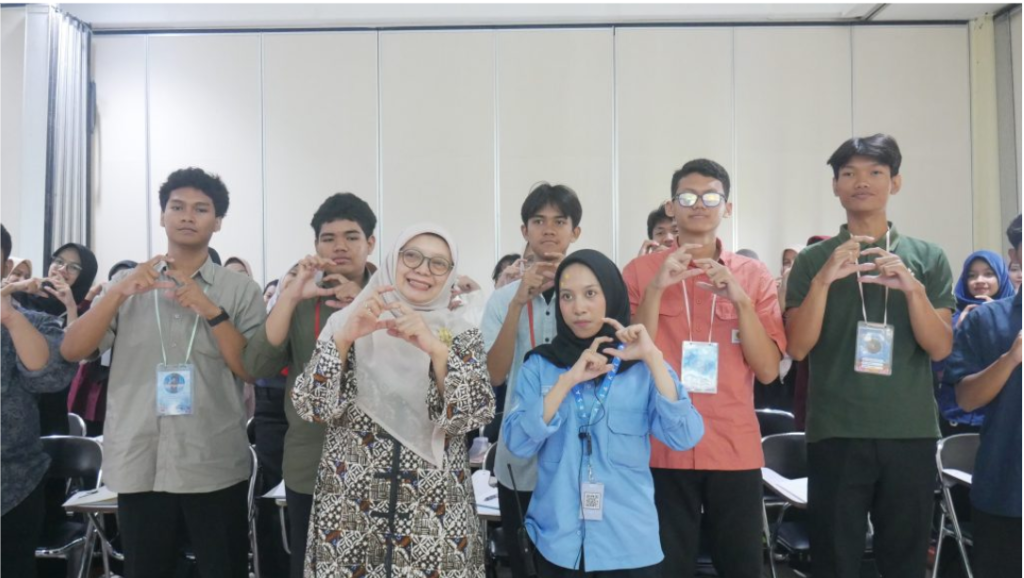
UNS promotes environmental awareness among students through educational initiatives that encourage responsible and sustainable behavior in daily campus activities. These efforts include highlighting the importance of environmental protection, reducing pollution, and adopting environmentally friendly practices, such as sustainable transportation.
In October 2025, UNS introduced sustainability principles to new students in the Environmental Science Study Program during campus orientation. The transportation component encouraged students to walk, cycle, use public transportation, and reduce their reliance on private motor vehicles. This initiative helped introduce sustainable mobility into students’ everyday campus habits and promoted awareness of environmentally responsible commuting choices.
By incorporating sustainable transportation into student orientation and broader environmental education initiatives, UNS seeks to encourage long-term behavioral changes among its academic community. These efforts help build a campus culture that recognizes the importance of reducing dependence on private motorized vehicles and adopting more sustainable mobility practices, supporting SDG 11 (Sustainable Cities and Communities) through greater awareness and participation in environmentally responsible transportation.
Reference: New Student Orientation: Environmental Science Program Introduces Sustainable Campus Values
5. Faculty-Level Sustainability Monitoring and Transportation Management
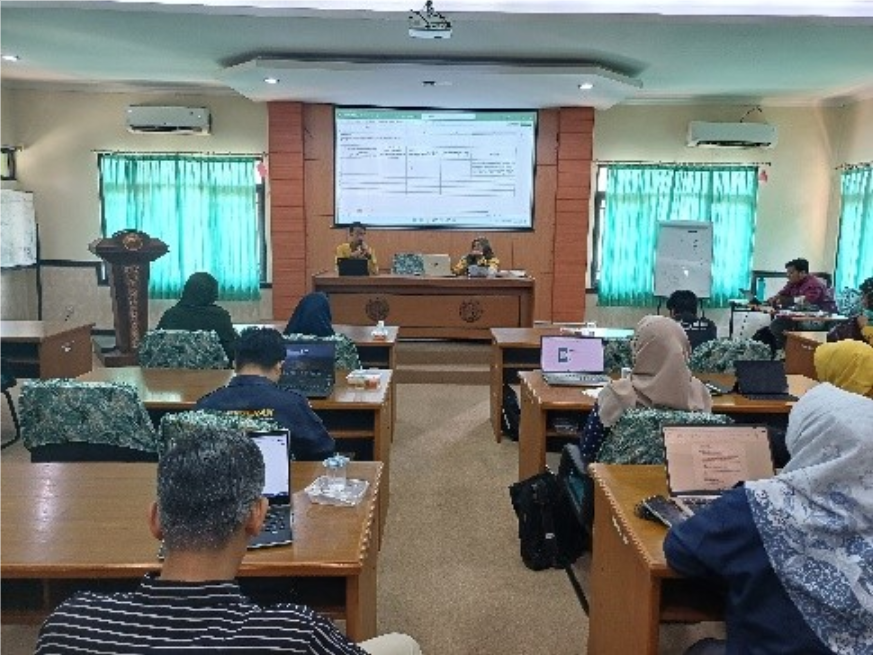
In July 2025, Universitas Sebelas Maret (UNS) strengthened its sustainability monitoring and reporting system by holding a socialization session for faculty-level Green Campus teams. The event included representatives from 11 faculties and 2 schools, responsible for reporting and verifying sustainable campus practices within their units.
Participants received reporting templates, sample forms, and indicator tables aligned with the UI GreenMetric World University Rankings. The reporting framework covered six key areas, including transportation, energy and climate change, waste, water, infrastructure, and education and research. This initiative aimed to improve the accuracy, consistency, and standardization of sustainability data while strengthening coordination across faculties.
As part of this framework, UNS supports implementing and monitoring sustainable transportation management at the faculty and unit levels. These efforts include regulating vehicle access, managing parking facilities, and implementing measures to encourage more organized campus mobility. For example, the Faculty of Engineering has implemented RFID-based vehicle access and parking management systems. Other initiatives include designated parking facilities, parking access controls, and vehicle restrictions to manage private vehicle use on campus.
Integrating faculty-level reporting and transportation management provides an institutional basis for monitoring sustainable campus practices, identifying areas for improvement, and evaluating progress toward sustainability objectives. These efforts strengthen UNS’s capacity to monitor transportation-related environmental performance and support its commitment to SDG 11.
References:
6. Development of the Green Campus Strategic Plan 2025–2029
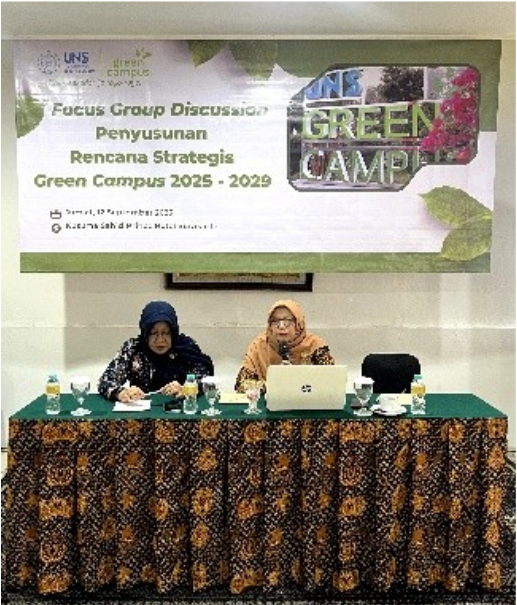
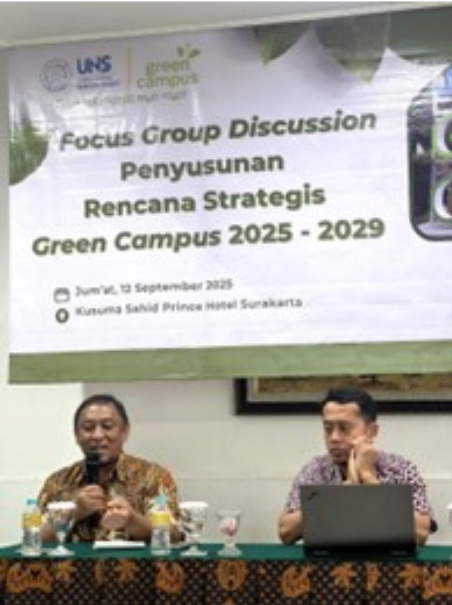
On September 12, 2025, Universitas Sebelas Maret (UNS) held a Focus Group Discussion (FGD) to develop its Green Campus Strategic Plan for 2025–2029. The discussion involved the UNS Green Campus core team and representatives from faculties and schools to formulate sustainability priorities, targets, performance indicators, and programs for the next five years.
This initiative demonstrates UNS’s commitment to strengthening long-term sustainability planning, monitoring progress, and integrating environmental responsibility into university operations. The institutional targets and performance indicators provide a strategic framework for measuring sustainability achievements and guiding future improvement initiatives.
The university’s sustainability priorities include:
- Energy Efficiency: Improving energy efficiency across campus operations.
- Climate Change Mitigation: Supporting emission reduction and climate change mitigation efforts.
- Waste Management: Strengthening campus waste management practices.
- Sustainable Transportation Development: Promoting environmentally friendly, sustainable transportation systems and developing more sustainable campus mobility practices.
Through this strategic planning process, UNS establishes a framework to set sustainability priorities and monitor institutional progress, including efforts to improve sustainable transportation and commuting. This long-term approach supports SDG 11 by integrating environmentally responsible mobility into the university’s institutional development strategy.
Reference: UNS Holds FGD to Develop the Green Campus Strategic Plan 2025–2029
Conclusion
UNS demonstrates its commitment to sustainable commuting through an integrated approach that combines transportation initiatives, environmental monitoring, institutional policies, and strategic campus planning. Campus shuttle buses, bicycles, electric vehicles, and supporting infrastructure provide alternative mobility options for the university community, while transportation management and parking area monitoring support more efficient campus land use.
The university’s transportation monitoring records, including its carbon emissions inventory and parking area measurements, provide quantitative information to support the evaluation of environmental performance and the development of future transportation strategies. Student awareness initiatives, faculty-level implementation, and the Green Campus Strategic Plan 2025–2029 complement these efforts.
Together, these initiatives build an institutional foundation to promote sustainable commuting and reduce dependence on private motorized vehicles. They also support UNS’s contribution to SDG 11: Sustainable Cities and Communities, particularly by promoting more sustainable, accessible, and environmentally responsible transportation practices.